Wednesday, June 30, 2021

issue 54

THE BRETON/GEROL NEWSLETTER

BIDEN-PUTIN SUMMIT. THE WORKING RELATIONSHIP

Most assessments of the Biden-Trump June 16th Geneva meeting tend to cast it as having been generally positive, but having produced only minor results. The fact that there had not been such a summit for a relatively long while, especially taking into account that Trump-Putin meetings were heavily discounted, somehow inflated expectations. Apart from Trump, Biden is not so different from most of his predecessors, but Vladimir Putin is neither Gorbachev nor Yeltsin. Putin came to this meeting not to achieve a compromise but to advance Russia’s interests in roughly the same manner as US Presidents have traditionally tried to advance US interests. This was not a negotiation to improve the relationship, as may have been the case at the end of the Soviet Union and in the following years.


©President of Russia Website


The point that Biden made during one of the presidential campaign debates about foreign affairs being all about relationships re-surfaced in his comments after the meeting and was also picked up in some way by Putin. In simple terms the leaders established a working relationship that can serve to prevent further conflicts down the road.. There was agreement for ambassadors to return to their respective embassies. There was also agreement to initiate consultations about the status of diplomatic and consular representations

It was also agreed to resume strategic stability consultations. That specific outcome does not get the media coverage that it deserves or is reduced to the dimension of consultations over nuclear weapons. In the professional diplomatic language, these consultations have a rather broad meaning and may be meant to cover virtually every arms control issue and most regional issues. The Biden-Putin conversation was in itself already very broad covering many regional issues, trade relations and even the Arctic.  

To avoid a repetition of the Trump-Putin fiasco in Helsinki in 2018, Biden and Putin held separate press conferences. Since Biden had suggested he would be sending strong messages to Putin about human rights especially the Navalny case and about cybersecurity he needed to stand alone and state how forceful he had been in his conversation with his Russian counterpart.

Nowhere is this more evident than on the issue of cybersecurity. The parties have essentially agreed to work together in addressing the new challenges in this area, very much in the same way as during the last days of the Obama administration. Yet, ever since 2016 when Donald Trump invited Russia to offer whatever dirt it had on Hillary Clinton and the Democrats, the matter of Russian interference in US elections has become politically hyper-sensitive. Donald Trump’s attempt to create a joint commission to look into cybersecurity was swiftly taken down by Congress and the foreign policy establishment. The prevailing view is that Russia must be punished and that its offers of cooperation are at best a smoke screen. In order to sweeten the bitter pill of cooperation with Russia Biden presented it as part of an injunction to Russia to stay away from 16 specific crucial areas of US infrastructure, thus making the US look like it is controlling Russian behaviour. This did not prevent Putin from singling out the agreement to cooperate in this area as extremely important. In due course, it could indeed have a major impact on the overall tone of the US-Russia relationship.

Ultimately, strategic stability consultations and cyber-security expert meetings are in the interest of both countries. They would however tend to reflect the Russian agenda and do not coincide with the prevailing US view that the US should be tough and give nothing to Russia. This put Biden on the defensive with his own media. This is why Biden kept insisting that personal dialogue and a working relationship were crucial and that the results of the June 16h decisions would become visible in some months. More symptomatic in the current world situation were the new American sanctions imposed on Russia soon after the summit was over. The sanctions are attached to the Navalny case and even to the companies at Nord Stream 2 despite the previous announcement that those sanctions were cancelled.

©President of Russia Website

All things considered, the most significant change coming out of the Summit is the confirmation of a return to the traditional pre-Trump diplomatic dialogue. This is more about process than results. There has been no reset of the relationship and the real work remains to be done. The fact that meaningful work can take place nevertheless explains why the Russian side called the meeting constructive.

--o--


AFTER BIDEN-PUTIN: EUROPE AND UKRAINE 

In the logic of the conflict with Russia, Ukrainian officials have in the past voiced concern over Canadian diplomatic engagement with Russia. Speaking with the enemy as if nothing happened  is perceived as lessening of support for Ukraine and of some forgiveness towards Russia for having absorbed Crimea and fomented revolt in the Donbass. The US President is not held to the same restriction. The June 16th US-Russia Summit was unavoidable. The fact that it produced a statement on strategic stability might not be to Ukraine’s liking as it somehow conveys a sense of return to normal, a return to the situation prior to the current crisis. It looks as though the Summit did not give rise to a detailed discussion over Ukraine and that Biden did not spend a lot of time on it.

The German Chancellor or the French President are also exempt from the prohibition of speaking to Vladimir Putin. They are in any event expected to play a key role in the attempt to find a peaceful resolution to the Ukraine-Russia conflict.

©EU Website


In the days after the Biden-Putin Summit Chancellor Merkel and  President Macron went further and suggested that the EU should follow with its own summit with Putin in order to somehow normalize regular contacts with Moscow. The proposal was met with categorical and sharp rebuke from Poland and the Baltic states. Merkel and Macron would certainly have known that they could not achieve in a few days the required unanimity in favour of such a decision. What may have looked like a setback served to expose the point that opposition to reinstating the formal EU-Russia dialogue is preventing the EU from keeping up with the US. The stage is set for further discussion in coming months especially if US-Russia discussions show some result.  

©EU Website


Merkel and Macron’s move was enough for them to be accused of “a great betrayal” and “a disgusting act of treachery” on the front page of the Ukrainian capital’s English-language daily, the Kyiv Times. The unusually strong language may look extreme, but reflects Ukrainian sensitivity on this matter. Merkel and Macron have been regular interlocutors of Vladimir Putin and were convenient targets. Merkel as the supporter of Nord Stream 2, the sea floor pipeline that will allow to bypass Ukraine pipelines for the delivery of gas to Europe, was even more suspect. The US or Biden have been spared such harsh criticism. Yet, it is the US that may have been the cause of greater anger and frustration in Kyiv. During Secretary of State Blinken’s May visit to Ukraine, it was made clear that the road to NATO membership would go through a major eradication of corruption. To many in Ukraine that would mean postponing NATO accession to the next generation, at least. Biden also contradicted Zelenskyy after the latter had claimed that NATO had confirmed Ukraine's NATO membership path. Biden's response was essentially: “it remains to be seen”. In addition, Washington, though it keeps expressing its opposition to Nord Stream 2, has essentially given up trying to prevent its completion. It is trying to engage Germany to find a way to compensate Ukraine for its financial losses from no longer being a lucrative gas transit corridor.

In this difficult context, President Biden finally invited President Zelenskyy to Washington, but not before his meeting with Putin, as Zelenskyy had hoped. The visit is to be scheduled in July and has the feel of a consolation prize.

The fundamental elements of the Ukraine-Russia conflict have not changed. The contours of the military and political support Ukraine can expect from its allies against Russia have, however, been clarified. At the same time, the Euro-Atlantic diplomatic isolation of Russia was challenged by a businesslike US-Russia Summit and by the above-noted diplomatic push from the two major EU countries. It also made clear that Ukraine joining NATO, a Moscow “red line” is not for the near future. It confirmed that it is unlikely that outside pressure will have a significant bearing on breaking the current deadlock in the Ukraine-Russia conflict.

As virtually the only one with an interest in resolving the conflict, President Zelenskyy has been carrying the burden for creating the circumstances that could lead to change and, eventually, to  resolution of the conflict. It is now the case even more than before. It has become more evident that change will not come from the outside. Changes are also highly unlikely in Ukrainian public opinion or in the dispositions of the rebel regions (not to mention Crimea) towards Kyiv. The stalemate was illustrated by the recent statement of former President Kravchuk, the head of Kyiv’s delegation to the Minsk talks. Kravchuk said in a television interview that Donbass is Ukraine’s “cancerous tumor” that must be removed to allow “development of an independent state”.

The seven-year old conflict looks more and more like a Cyprus-type frozen conflict. It also seems more broadly accepted as such by France and Germany. Recent Russia-engineered changes in the oligarchic management of the rebel regions of Eastern Ukraine also suggest that Russia is sharing this view and is preparing for a long-term virtual protectorate role in these regions. As a result it is installing a management that will take a more sustainable approach to regional economic development.   

As for Zelenskky, he can only hope that the pageantry and prestige that will accompany his upcoming visit to Washington can boost his flagging popular support.

--o--

ARMENIA

Acting Armenian Prime Minister Nikol Pashinian has cemented his position with a landslide election victory called to end a political crisis that erupted after ethnic Armenian forces lost a six-week war against Azerbaijan last year and ceded territory in and around the breakaway region of Nagorno-Karabakh.

Pashinian’s democratic credentials would seem to have allowed him to defeat a challenge from old-guard politicians that tend to be associated with the so-called Karabakh faction that used to dominate Armenian politics.  

From PM Pashinian's Facebook page


Preliminary results showed that Pashinian's Civil Contract party won 53.9 percent of the vote. The results, if correct, mean Pashinian's party will control an even greater percentage of seats than the 50 percent needed to rule, since the votes of the 22 election contenders that did not clear the threshold will be distributed among those that enter parliament.

Civil Contract is expected to have about 71 seats in the 107-member assembly, while the Armenia Alliance should have 29 and I Have The Honour, 7.

International observers from the Organization for Security and Cooperation in Europe (OSCE) said the vote was "competitive and generally well-managed."

--o--

NORTH KOREA SLIDES INTO MASS HUNGER AMID INCREASED POLITICAL CRACKDOWNS

To have a real idea of what real systemic oppression, injustice, poverty, corruption and mismanagement really mean just look closely at the reality of today’s North Korea (or as it is officially called: Democratic People's Republic of Korea). This is an example of what an authoritarian regime can do to its people. For those who love George Orwell parallels, this is the closest country on the planet to the dystopian Oceania from the 1984 novel.

Six children were recently dragged into a North Korean court in shackles and had clearly been harshly interrogated since their arrest, a source from within the country told South Korea’s NK News. The public trial for the three boys and four teenage girls in Nampo was perfunctory, with the state prosecutor detailing the reasons why they were before the court, which he insisted were "serious crimes."  The children were sentenced to five years at one of North Korea's notorious re-education camps.The children were found guilty of watching South Korean films and television series over the past year and sharing them with classmates, reported NK News, which employs a network of contacts within the North to obtain news for one of the most respected dissident media outlets. 

Further crackdowns include banning certain types of haircuts and western style clothing like jeans. There are also reports of increased number of public executions and forced slave child labour masqueraded  as "youth volunteers from orphanages". The children as young as 12 are being dispatched to work in coal mines and agricultural sectors. The Pyongyang Times reported them to be 17 years of age and claimed they  "chose to give back one millionth of love given to them by the Party back". 

Aside from the ongoing and daily political terror, North Korea is once again sliding into starvation. This is by now a well-known problem, and the government is at least admitting it this time. When North Korea last experienced a similar economic meltdown—in the late 1990s—then leader Kim Jong-il refused to admit it, as around one million people starved to death around him. Current leader Kim Jong-un is admitting reality. This may mean, though nothing is certain in that socialist paradise, he seems to care about the state of the economy more than his reclusive, disinterested father.

Kim Jong-un, prior to recent weight loss


Officially the food shortages are blamed on the weather. The same excuse was used twenty-five years ago. Somehow weather variations do not provoke famine alerts in neighbouring South Korea. The real reasons are simple: staggering misgovernment and corruption. Sanctions imposed on North Korea mainly concern the communist elites and their luxury goods or industrial items, agriculture is not covered by sanctions. 

The West, especially South Korea, is willing to assist but the communist regime rejects any accountability for foreign aid because it controls everything that comes into the country. If Kim is a reformer, as some say, he then he will recognize that outside assistance is not simply a blank check. There needs to be some mechanism to ensure its proper use.

Another problem is the closure of the border with China due to the coronavirus. It is not unlikely that thousands of North Koreans will try to cross the border in desperation during the  famine.   

The only conceivable threat to the regime is people's revolt. So is the regime in danger? Will another food crisis in North Korea finally bring popular pushback? Probably not. North Koreans may actually believe in the Kim cult, or perhaps the sheer harshness of the state against dissent has deterred North Koreans these many years. There has never been a revolt in North Korea in its seventy-five-year history. Just like in Orwell's Oceania the people are no longer capable of revolting: they are too weak, too brainwashed and the oppressive apparatus is too sophisticated and brutal. 

The DPRK has at least 100 nuclear warheads and if there was a regime in the world that will have no qualms using you are looking at it. The only country that can control and influence the North is China. However China, as seen through its geopolitical stance of late, will most likely use the crisis to blackmail the West with the situation at the Peninsula.  This may not end well.

--o--

ISRAEL'S NEW GOVERNMENT 

The fall of Benjamin Netanyahu proved once again the correctness of Mark Twain's assertion that "ruling politicians have to be changed as often as diapers and for the same reason". 

The broad coalition headed by Naftali Bennet, right wing leader of the Zionist Yamina party managed to get everyone on board, from an Islamist Arab party to the left wing Meretz with secular Russian Avigdor Liberman in the middle, united by one major goal: get rid of the longest serving Israeli PM. He was there for 12 years and in the last several years it was unclear if Bibi (as he is called in Israel) served the interests of the state of Israel or the other way around. He betrayed and conspired against every major political figure around him and managed to push away even his closest allies and supporters. In spite of Netanyahu's incredible political achievements (in some ways unprecedented in the Israeli history) his personality and unethical conduct brought him down.

Israel's economy boomed during his reign, Donald Trump was the most pro-Israeli president in history who moved American embassy to Jerusalem and accepted the 1982 Israeli annexation of the Golan heights. Netanyahu can be credited with influencing American withdrawal from the nuclear deal with Iran, a very potent military stance against Iran in Syria, personal amicable relations with Putin, Modi and other powerful leaders around the world and diplomatic relations with several key Arab states through the Abraham accords. It was under this PM Israel conducted an incredibly clean and technologically sophisticated operation against Hamas which fired 4.500 rockets against Israel (most of them intercepted) losing only one soldier and having several rooftops damaged. On the other hand in 11 days Hamas was dealt an extensive damage and civilian deaths were kept to minimum (for the large operation such as this). And finally there was this incredible success of the vaccination. And still the country rejected Netanyahu because most people knew that he had to go. 

The new Israeli government faces multitude of hurdles and tasks but none is more important, even ahead of Iranian problem or the relations with Biden, than how to deal with the Palestinian question. 

Israel also has to reform its broken political system, not the democratic spirit of it, but from the technical point of view something has to be done with the multitudes of the religious parties and never ending political deadlocks. Otherwise its business as usual for the only democracy, yes, problematic one, but still the only democracy in the Middle East.

--o--


PERSON OF THE MONTH: YAIR LAPID


Born in Tel Aviv in 1963, Yair Lapid followed in the footsteps of his father, Tommy, another famous journalist-turned-politician who escaped from Hungary to Israel after World War II.

In 2003, Tommy achieved an electoral breakthrough for the staunchly secular, liberal Shinui (Change) Party, when it became the third-largest party and joined then Prime Minister Ariel Sharon's coalition. The partnership did not last and Shinui was dropped two years later.

Like his father, Yair began his career in the media, as a military correspondent for the Israel Defence Forces (IDF), before becoming editor of a local Tel Aviv newspaper and later a columnist for the centre-right Maariv daily.

His journalistic skills and talent as an effective communicator drew him into television, and from the mid-1990s he established himself as a popular TV personality, and a talk show host. Yari Lapid became a household name in 2012 when he turned to politics with the new centrist party, Yesh Atid.

In May 2021 Lapid and his party pulled off what many had thought was impossible, cobbling together a coalition of bitter ideological rivals, ranging from right-wing religious nationalists to conservative Muslim Arab lawmakers.

That achievement was all the more remarkable given recent intercommunal clashes between Jewish and Arab citizens, sparked by the latest conflict between Israel and Hamas in Gaza.

The coalition deal he brokered will now see Lapid assume the premiership only after a two-year stint at the top by his main coalition ally, nationalist hardliner Naftali Bennett.

This coalition would have been impossible without Lapid's ability to compromise and bring such diverse partners together. He is currently Israel's foreign minister. 

If the government survives for 2 years (a tall order for any Israeli government especially in its current form), Lapid will be the first Israeli PM from the entertainment and media sector and one of the very few without any background in military or security establishments. 

--o--

BRIEFLY NOTED

RUSSIA

Russian President Vladimir Putin has marked the 80th anniversary of the Nazi invasion of the USSR by hailing the sacrifices made by the Soviets during the war while claiming that European security has been "dramatically degraded" amid "escalating tensions."Putin also reiterated his previous statements, saying that his country "will never allow the distortion of the truth" about World War II.

In recent years, Putin frequently accused European countries of what he called the diminishing of the role of the Soviet Union in the defeat of Nazi Germany and the stressing of atrocities committed by Soviet forces, like the mass murder of Polish officers in the Katyn Forest in 1940 or the mass rapes of German women.

In an article published on June 22 in the German weekly Die Zeit, Putin emphasized that "despite attempts to rewrite the pages of the past that are being made today, the truth is that Soviet soldiers came to Germany not to take revenge on the Germans, but with a noble and great mission of liberation."

German Chancellor Angela Merkel called Putin on June 22 to "express empathy with the unmeasurable woes and suffering brought by the war that was launched by the Nazi regime," the Kremlin said.

"Both parties underlined the importance of preserving the historic memory of those tragic events" and noted that "overcoming mutual enmity and reconciliation of the Russian and German peoples had key importance for the destinies of postwar Europe and It was emphasized that preserving security on the continent now is also possible only through joint efforts," the Kremlin added.


CENTRAL ASIA

The World Bank says that Europe and Central Asia continue to grapple with containing the coronavirus pandemic, which is clouding the economic outlook for the region. 

The Washington-based institution stated in its latest Global Economic Prospects report, released in early June that economic growth for the countries of the region is projected to reach 3.9 percent in 2021.

The World Bank warned, however, that the outlook remains “uncertain,” with uneven vaccine roll-outs and the withdrawal of domestic macroeconomic support measures weighing on the regional recovery.

The World Bank also noted that recent currency depreciations have put further upward pressure on prices, a growing concern for some economies that are still trying to shake off the effects of decades of Soviet-era planning.

“As a result of inflationary pressures, policy interest rates have been raised in one-third of the region’s economies thus far in 2021,” the bank said, pointing to Armenia, Belarus, Georgia, Kyrgyzstan, Russia, Tajikistan, Turkey, and Ukraine.


BELARUS

The United States, the European Union, Britain, and Canada have slapped a fresh round of coordinated sanctions on Belarus in response to the regime of Alexander Lukashenko's mounting repression against the political opposition and the free media.

"These coordinated designations demonstrate the steadfast transatlantic commitment to supporting the Belarusian people's democratic aspirations," Secretary of State Blinken said in a statement on June 21st, as the Treasury Department imposed sanctions on 16 individuals and five entities. The Treasury said the move was coordinated with the US' international partners and was meant to hold to account Lukashenko's regime for its ongoing abuses and violations of international norms, including its forced diversion of a commercial Ryanair flight and arrest of journalist Raman Protasevich and his girlfriend Sofia Sapega last month.

Among the entities blacklisted by the Treasury were the main Belarusian security service, the KGB, the Internal Troops of the Interior Ministry, and the Main Directorate for Combating Organized Crime and Corruption, known as the GUBOPIK, who were all involved in the post-election repression.

Other individuals covered by sanctions include members of Lukashenko’s entourage as well as  lawmakers, prosecutors, judges, and other officials who are in the case of the latter regarded as "responsible for serious human rights violations and for seriously undermining the rule of law, as well as for the repression of civil society and democratic opposition”.


AZERBAIJAN 

Russian Foreign Minister Sergei Lavrov has dismissed speculation that Turkey could build a military base in Azerbaijan as "rumours." 

Turkish President Recep Tayyip Erdogan said during a visit to Baku on June 15th that he has not ruled out the possibility Ankara could build a military base in Azerbaijan. The so-called Shusha Declation on Allied Relations between Azerbaijan and Turkey was signed during the visit. It calls for stepped-up cooperation between Ankara and Baku in the military sphere.

Such a move by NATO-member Turkey could require Russia to take steps to ensure its own security and interests.


BULGARIA/NORTH MACEDONIA

Bulgaria's leaders have expressed their strong support for North Macedonia's road to joining the European Union, a departure from Sofia's earlier objections to North Macedonia starting talks to join the bloc.

The start of North Macedonia's accession talks was blocked by EU member Bulgaria in 2020 due to disputes over history, national identity, and language. Bulgaria wants North Macedonia to formally recognize that its language has Bulgarian roots, while Skopje has said any question of its identity and language are not negotiable.


CUBA

Cuba announced on June 21st that its three-shot Abdala vaccine against the coronavirus had proved around 93% effective in last-stage clinical trials. Another Cuba vaccine Soberana 2 has 62% efficacy with two of its 3 shots. The announcement came from state-run biopharmaceutical corporation BioCubaFarma, the producer of both vaccines which are expected to be granted emergency authority by local regulators any day. 

Since the US imposed sanctions on Cuba in 1962, the country has developed strong pharmaceutical and bio-engineering industries.The communist-run country has opted not to import foreign vaccines but to rely on its own. Some experts said it was a risky bet but it appears to have paid off.

--o--

THE AUTHORS

Ilya Gerol, former foreign editor of the Citizen in Ottawa, syndicated columnist in Canadian, US and European media specializing in international affairs. His area of expertise includes Russia, Eurasian Economic Union, Eastern and Central Europe.  Ilya Gerol has written several books, one of them, The Manipulators, has become a textbook on relations of media and society.

During his career in the Canadian Foreign Service, Gilles Breton had three assignments at the Canadian Embassy in Moscow. His first posting there began during the Soviet period, in 1983. His last was from 2008 to 2012 as Minister-Counsellor and Deputy Head of Mission. He also served as Deputy Director responsible for Canada’s relations with Russia from 2000 to 2008. As an international civil servant, he was Deputy Director of the OSCE Office for Democratic Institutions and Human Rights in Warsaw from 1994 to 1997.

Gilles Breton also currently serves as Chairman of the National Board of the Canada-Eurasia-Russia Business Association. The views expressed in this newsletter exclusively reflect the opinion of the authors.


Monday, May 31, 2021

Issue 53

THE BRETON/GEROL NEWSLETTER


PROFESSIONALS AT WORK


On the margins of the Arctic Council Ministerial Meeting, Secretary of State Antony Blinken met with Russia’s Foreign Minister Sergey Lavrov in Reykjavik on May 19th, almost 35 years after Reagan and Gorbachev held their famous summit in the Icelandic capital in October 1986.


Reagan and Gorbachev, Reykjavik, October 1986
White House photos


The talks which mark the highest-level public meeting between US and Russian officials since President Biden took office in January, were held on the heels of earlier reports that the Biden administration will waive US sanctions on the German companies overseeing construction of the Nord Stream 2 pipeline. The gesture is aimed at Germany more than Russia, but still matters. The Biden administration has likewise pursued a measured response to the recent Colonial Pipeline hack, noting that it came from a criminal group within Russia but stopping short of calling it a Kremlin-sponsored cyberattack. There are even discrete suggestions that the US may be willing to engage in some form of dialogue over global cyber-security issues.


Blinken and Lavrov, Reykjavik, May 2021
©MFA Russia


“We seriously diverge in our assessment of the international situation and our approaches towards how we should resolve it,” Lavrov said. The meeting was conducted through the interpreters except for one instance when to press his point Lavrov said in English - “Not exactly similar views but similar goals".


Blinken's tone was anything but confrontational. Instead, it was diplomatic, professional and measured. “There are many areas where our interests intersect and overlap, and we believe that we can work together and indeed build on those interests,” said Blinken. “It is our view that, if the leaders of Russia and the United States can work together cooperatively, our people, the world can be a safer and more secure place".


This meeting was an important preamble to a Putin-Biden summit which will take place on June 16th in Geneva. 


The first item the two sides will want to discuss is strategic stability, all the issues related to international security and disarmament. The list of other issues where two countries can discuss and possibly cooperate is long: Afghanistan, Iran nuclear deal, North Korea, Middle East to name a few. China and its growing presence in the world may not be on the agenda as such but will be in both leaders’ minds as well, even with the US and Russia harbouring no expectation from one another in this connection. 


Obviously moving along this full agenda will take years. On some issues like the Russia-Ukraine conflict and the jailing of political opponents in Russia the best that can be expected is for the leaders to agree to disagree. The thawing of relations between Washington and Moscow may nevertheless begin with some symbolic gestures such as returning diplomatic and consular establishments to their level of a few years ago.


The road to better relations is long and will most likely consume the rest of Biden's first term but the first step was taken in Reykjavik.


--o--


THE ASTRONAUT, BETTER THAN THE STAR


Foreign Ministers Garneau and Lavrov, Reykjavik, May 2021
©MFA Russia


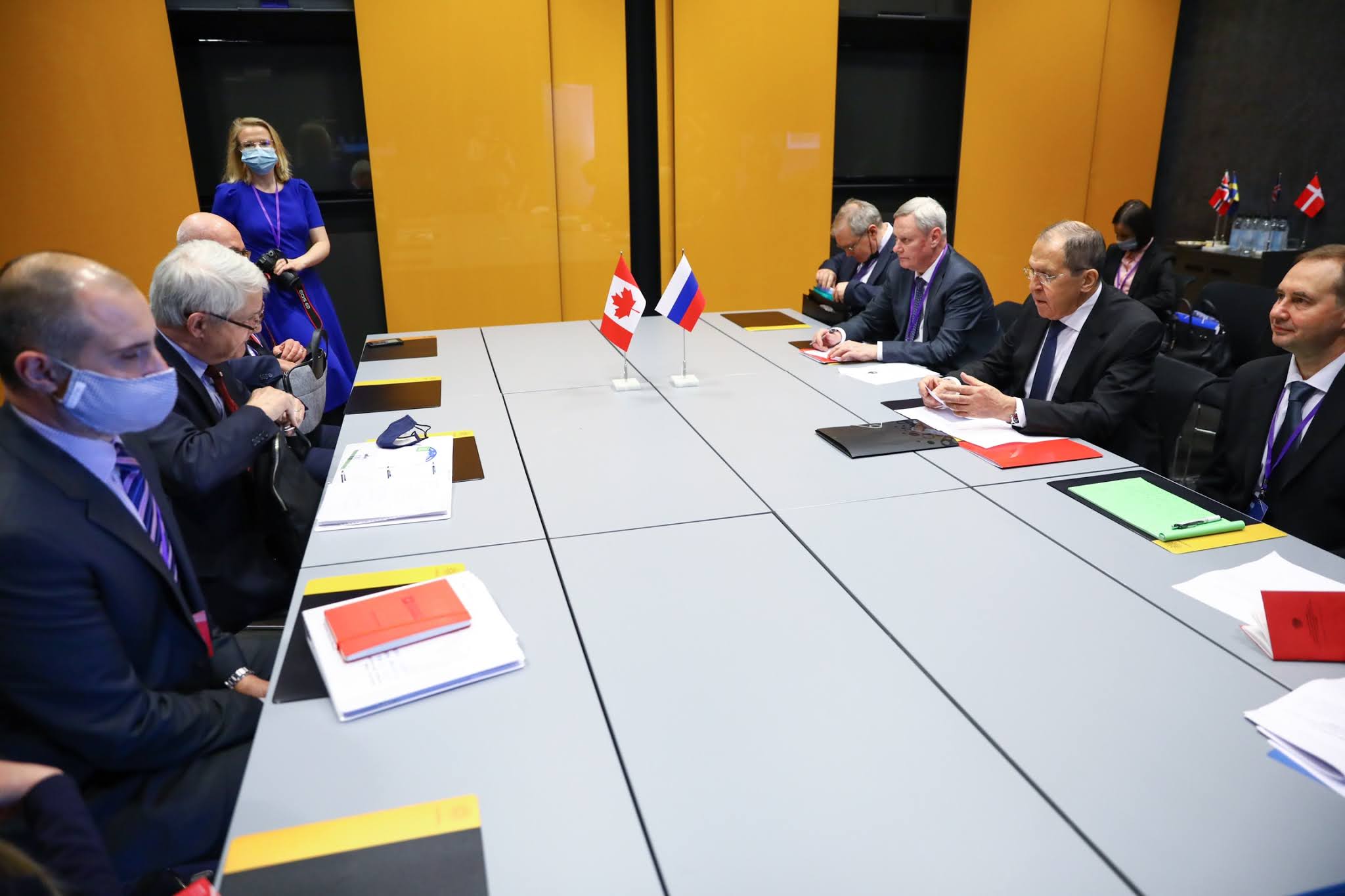
Foreign Minister Marc Garneau also had his bilateral meeting with Foreign Minister Lavrov in Reykjavik. Lavrov pointedly remarked that his last meeting of significance with a Canadian Foreign Minister was with Stéphane Dion in 2016 and alluded to occasional encounters since then with Foreign Minister Christya Freeland. The readout from Global Affairs Canada would suggest that, as expected, Garneau was forceful in advancing strong Canadian views on Ukraine’s conflict with Russia, but also mentions the discussion covering Canadian views in connection with the Nagorno-Karabakh conflict, an issue of significant importance on the Canadian foreign policy agenda. The accomplishment may not be major, but career astronaut Garneau seems to have outperformed his predecessor in terms of diplomatic dialogue.


--o--


UKRAINE-RUSSIA: FROZEN CONFLICT?

Secretary of State Blinken’s visit to Ukraine was widely described as a gesture of support from the US for Ukraine against Russia. Blinken’s presence was of course appreciated by Ukrainian authorities, but there was some evident disappointment at the lack of an unambiguous US support for Ukraine’s accession to NATO and over the guarded commitment to defend Ukraine against possible direct Russian military actions. The frustration would have been compounded later on by the above-mentioned relatively

businesslike meeting between Blinken and Lavrov. The disappointment was confirmed even more clearly by Ukrainian Foreign Minister Kuleba’s complaint at Ukraine not being invited to the upcoming NATO Summit in June.


President Zelenskyy, Secretary of State Blinken, Kyiv, May 2021
© President of Ukraine Website


The restoration of a form of normal dialogue between the US and Russia tends to revive the longstanding fear in Ukraine that a solution to the Ukraine-Russia conflict might be devised without Ukraine. It also raises the more fundamental question about what the US interests are in connection with Ukraine. If, as many would argue, Ukraine matters to the US for the problem it creates for Russia, it is tempting to think that there is little incentive for the US to resolve the conflict. A status quo that keeps Russia under Western sanctions is not such a bad thing after all. Besides, while a solution could be found to the conflict in Eastern Ukraine through some creative interpretation of the Minsk Accords, a solution to the issue of Crimea is far more elusive. It is clear Russia will not give Crimea to Ukraine a second time, no matter who is in charge in Russia. It is also clear that Ukraine is in no position to abandon its rights on Crimea.


US insistence on Ukraine pursuing its fight against corruption and in favour of rule of law seems to have been a key issue in Secretary Blinken’s discussions in Kyiv. Lack of progress was even invoked by a State Department spokesperson to explain the door to NATO not being completely opened: “Ukraine still must "implement the reforms necessary to build a more stable, democratic, prosperous and free country.” There was also some unpleasantness when the US recently remonstrated about the unorthodox replacement of the head of Naftogaz the national natural gas company. Beyond the unanimous support for the fight against corruption, differences of opinion remain between the US and Ukraine on economic management and reform. This does not affect the US political commitment to Ukraine but complicates economic cooperation discussions.


As for Russia’s interests, a hard look at the conflict with Ukraine also suggests that the status quo is not a bad option. In principle, a country that is not in full control of its territory cannot enter the NATO defensive alliance. The Ukraine-related sanction régime has become a new normal. Provided the level of armed conflict is kept under control and there is relative quiet in the rebel regions of Eastern Ukraine, there is no rush to find a solution. Besides, trade between Russia and Ukraine has decreased but it is still very substantial, a rather striking paradox for countries at war.


--o--


OUT WITH THE OLIGARCHS

The recent move by President Zelenskyy to “de-oligarchise” Ukraine has been welcomed at home and abroad. Oligarchic rule in Ukraine is a serious issue. It is widely resented. Going after the oligarchs is a popular move. Zelenskyy’s intention is to propose legislation that would curtail the political influence of oligarchs and eventually target their economic assets if they do not desist. Comparisons have been made with Vladimir Putin’s handling of oligarchs during his first presidential mandate in the early 2000s. The proposed Ukrainian legislation that would first tag oligarchs before going for their assets may be more consistent with the rule of law but would be subject to endless legal challenges. To deprive Ukrainian oligarchs of the fundamental right to be politically active is likely to be electorally rewarding but far more complicated than Zelenskyy would hope.


Even before the proposed legislation on oligarchs is tabled, Zelenskky is taking action against Viktor Medvedchuk the pro-Russia oligarch and personal friend of Vladimir Putin. In February, Zelenskyy closed three television stations believed to be owned by Medvedchuk. The latter has now been accused of treason over business deals in Crimea and is under house arrest. By applying a war-time logic to the treatment of Medvedchuk, Zelenskyy may be getting rid of some unwanted media coverage, earning some points with more nationalist elements as well as positioning himself as a tough guy in his discussions with Russia.


Oligarch Viktor Medvedchuk

--o--


TUNNEL VISION AND EMPTY SKY OVER BELARUS

During Soviet times and before politically correct discourse, it was common to refer to less urbane political leaders as cunning peasants. Alexander Lukashenko, the erstwhile President of Belarus, might pretend to the title were it not for the fact that from the early days of his presidency he was described as “your uncle who could not even run his collective farm”. Yet calling him names does not really explain what we perceive as the insanity of hijacking a foreign civilian aircraft under false pretext in order to arrest an opposition journalist. Lukashenko is not unintelligent but,as Artem Shreibman of the Moscow Carnegie Center observed, the events of recent months have increased the Belarus leadership’s tunnel vision: what matters is to

deal with political enemies such as Roman Protasevich.


It has also been observed that similar or quasi-similar actions have been taken by other state players in the past. Would our collective outrage be selective? Maybe. Yet, hijacking the aircraft of a friendly country to kidnap an individual and blatantly lying about it is pushing the audacity to a point seldom reached in recent history. Besides, there is nothing left in doubt about either the intentions or the facts themselves. There is an “in your face” element here that elicits a strong reaction.The May 23rd forced landing of the passenger plane carrying Protasevich from Greece to Lithuania in Minsk airport was interpreted by the European community as the final fiasco of the Lukashenko regime.


The Belarus leader’s not so credible justifications were, in general supported by Russia, China and some other countries in the Commonwealth of the Independent States and even Turkey. At his subsequent meeting in Sochi with Vladimir Putin, Lukashenko heartily agreed with Putin’s remarks at the lack of outrage over the April 2015 incident during which the presidential airplane carrying back home Evo Morales, President of Bolivia, was forced to land in Vienna on American request. Americans suspected that Edward Snowdon could have been on board the aircraft. He was not.


President Lukashenko, Nikolai Lukashenko, President Putin
Sochi, May 2021 


Putin supported his Belarus colleague and requested a full international investigation of the latest incident that culminated in the arrest of Roman Protasevich and his Russian girlfriend, Sofia Sapega. Meanwhile most Western airlines are circumventing Belarus airspace after the incident. Protasevich is the leading Belarus opposition activist and a journalist. According to an official Belarus newspaper "Belarus Today" Protasevich served with the ultra-nationalist Ukrainian battalion Azov in the war against separatists in Donbass. That was not confirmed, but there is now in Ukraine a growing sense of unease over the future of relations with Belarus.


In general Lukashenko is about to lose the last remnants of his independence and any room for maneuver. Only recently he could play several rather primitive games between Russia and the West in an attempt to squeeze assistance from both sides. Although Lukashenko always prides himself on his independence, his call on Vladimir Putin looked like the rambunctious student coming to meet the teacher. From now on Lukashenko belongs to his true masters in the Kremlin and closer

association between Belarus and Russia is imminent. Lukashenko’s son is a student in Moscow. That, of course, would unavoidably feed rumours of Lukashenko himself eventually moving to Russia.


The Belarus aircraft hijacking incident revealed a practice that was widely suspected, gave rise to some mild Russian displeasure and was concomitant with a decision that surprised Canadians working with Belarus.

.

It was noted that they may have been up to four Belarus KGB agents in the aircraft with Protasevich on board. They would have been tailing him in Greece and the rest of Europe. This would confirm that the Belarus leader will not spare any expense to keep tabs on his enemies living abroad and will not be constrained by legal limits to the conduct of police agents on foreign soil.


The widespread official Russian media coverage initially spent a lot of time on the fate of Protasevich’s girlfriend, a Russian citizen. Russian media tends to obsess with the possible involvement of Russian nationals in any international incident or disaster. The heavy coverage in this case and the focus on the Russian national were a subtle way of expressing irritation while avoiding condemnation. Putin raised the Sapega case with Lukashenko who had to endeavour to look more closely into the matter.


Three days after the hijacking incident the Belarus Foreign Ministry closing announced the closing of the Belarus Embassy in Canada, leaving many puzzled about the meaning of the decision that was purported to have been made the day before the hijacking incident. In the last few years the Embassy had been very active and effective in promoting political dialogue and trade relations with Canada, things that support the opening of Belarus to the rest of the world. In the more distant past it was also keeping tabs on Belarus émigrés in Canada. There would not seem to be obvious financial reasons for the closing, fueling even more speculation.


--o--


US/GERMANY


The US formally blacklisted more than a dozen Russian ships involved in the construction of the Nord Stream 2 gas pipeline, days after exempting the pipeline's Russian operator and CEO.


The widely expected move, announced late on May 21 by the U.S. Treasury Department, came under harsh criticism from congressional Republicans about the White House's earlier announcement that it would not include the pipeline's Russian-owned operator in the new sanctions. Nearly complete, the Baltic Sea pipeline will bring Russian gas directly to Germany, bypassing land routes through Ukraine, Belarus, and other countries.


It is not the illogical idea that gas going to Germany through Ukraine rather than the Baltic Sea does not create German dependence on Russian energy supplies that carried the day. It would seem that Secretary of State Blinken’s view that, in dealing with Russia, it is more important to avoid continuing confrontation with a close ally as Germany, spying notwithstanding, than to pretend supporting other allies.


--o--


EUROPEAN UNION/CHINA


The European Parliament has voted to stop a massive investment deal with China, a move following tit-for-tat sanctions and a prolonged dispute over Beijing's treatment of its Uyghur and Muslim population in Xinjiang Province.


In order for the investment deal to come into effect, it must be ratified by the European Parliament. But under a resolution passed on May 20th, European lawmakers have demanded that "China lift the sanctions before parliament can deal with the Comprehensive Agreement on Investment (CAI)."


The motion to freeze the deal was overwhelmingly passed by a vote of 599-30, with 58 abstentions. Some legislators signaled that they won't support the agreement even if China lifts its sanctions, which were imposed in March against five members of the European Parliament and various institutions.


The vote is a blow to hope that the European Union-China deal,

championed by German Chancellor Angela Merkel and hammered out through seven years of negotiations, could be ratified in the coming months. Instead, the outcome is another sign of deteriorating relations between the EU and China.


--o--


US/ISRAEL: EXIT NETANYAHU

Recent events in Israel led to street protests in London, New-York and Montreal, among others. Some of them were filled with strong anti-Israel and anti-semitic overtones. Despite all of this there was a clear and unmistakable official support for Israeli actions from various European countries and most importantly the US.


As the ceasefire was in effect Joe Biden said the following: "My party still supports Israel. Let's get something straight: until the region says unequivocally they acknowledge the right of Israel to exist as an independent Jewish state, there will be no peace". He added his support for a two-state solution but the message was clear.


The US also blocked three different UN Security Council statements calling for an immediate halt to the fighting without mentioning Hamas or the rockets from Gaza.


From Netanyahu's Facebook Page


The recent confrontation between the Gaza-based Palestinians and Israel confirmed to many in Israel and elsewhere the Netanyahu view that Hamas is an Iran-supported terrorist threat against which Israel, in US words, has the right to defend itself. This, however, would not seem enough to keep Netanyahu in power any longer. He is now expected to lose his job as Prime Minister and to face prosecution on a number of charges, including fraud.


The political leaders that are expected to replace Netanyahu will not have different views on most issues, including Hamas. They, however, maybe less intransigent on Iran. They may also shun Netanyahu’s power-clinging messianistic tendencies.The first advantage though is that they will not have to carry the heritage of Netanyahu’s close friendship with Donald Trump and of his overly frequent contacts with Vladimir Putin in their

conversations with the Biden administration. The latter would welcome the changes and seems to have given it its blessing.


Antony Blinken and Yair Lapid, May 26th
From Yair Lapid's Facebook Page


PERSON OF THE MONTH: ANGELA MERKEL


German Chancellor Angela Merkel may have been our person of the month before, but her departure in a few months offers the opportunity to observe that she could also be regarded as person of the decade. Born in East Germany, the daughter of a Lutheran pastor, she is a true scientist, but even more important and unusual for a politician, an individual with a critical mind and one who has no qualms about going against prevailing views. She has been effective at dealing equally with strong men such as Putin and fools such as Trump. Putin would seem to have kept great respect for Merkel as an engaged interlocutor and one with a good understanding of post-communist societies. Trump was known to despise her as a woman who was far more knowledgeable than him and who could

stand up to him, including on issues such as Nord Stream 2.


She will be remembered for opening Germany to refugees in a manner that

was not necessarily popular.


In the context of more recent events, she may also be remembered as the head of state who expressed doubts about the idea of lifting patents on COVID vaccines. As a scientist, she would have understood the complexity of the process and the risks associated with changing the rules of the game. As a manager, she would have seen that the availability of the vaccine in developing countries was a matter of cost and manufacturing capacity, with intellectual property issues only one part of the equation. As a politician, she would also surmised that making Western vaccines less expensive was a way of curtailing the much cheaper Russian vaccines eventually produced under licence in India, South Korea and Serbia.


Recent revelations that the US may have used Denmark connections to

spy on Merkel are not the first time such allegations are made. Beyond breaking the rules of “not spying on friends” the incident would confirm that the US acknowledged she was her own person and they could not control her.


--o--


BRIEFLY NOTED


ARMENIA-AZERBAIJAN

Russia came out with a proposal to set up a joint commission to demarcate the border between Armenia and Azerbaijan, amid renewed Yerevan-Baku tensions over the past week over an alleged Azerbaijani military incursion.


Armenia has accused Azerbaijani troops of crossing several kilometers into its Syunik and Gegharkunik provinces and trying to stake a claim to territory.


Azerbaijan insists that its troops did not cross into Armenia and simply took

up positions on the Azerbaijani side of the frontier that were not accessible in winter months.


The border dispute emerged months after the two South Caucasus neighbors ended a six-week war over the breakaway region of Nagorno-Karabakh.


The conflict, which claimed some 6,000 lives, ended in November with a Moscow-brokered cease-fire that saw Armenia ceding swaths of territory that ethnic Armenians had controlled for decades.


The announcement came during Lavrov's visit to Tajikistan on May 19th. Russian Foreign Minister said Moscow had proposed setting up a joint Armenian-Azerbaijani border commission, with Russia possibly participating as a "consultant" or "mediator."


The announcement came during Lavrov's visit to Tajikistan on May 19th.

Russian Foreign Minister said Moscow had proposed setting up a joint Armenian-Azerbaijani border commission, with Russia possibly participating as a "consultant" or "mediator."


LATVIA

Latvia has recognized the massacre of Armenians by the Ottoman Empire during World War I as genocide, drawing an angry response from Turkey. The Baltic nation’s parliament passed a resolution on May 6 condemning and recognizing the tragedy with 58 of 100 lawmakers voting for the measure.


The Turkish Foreign Ministry slammed the decision as a "null and void attempt to rewrite history for political motives."


National governments and parliaments in some 30 countries have formally recognized the Armenian Genocide.


KAZAKHSTAN


Kazakh President Qasym-Zhomart Toqaev has signed into law a long-debated and sensitive bill that bans selling and leasing agricultural land to foreigners in the oil-rich Central Asian state.


According to the law, foreigners, stateless individuals, foreign companies, Kazakh companies with foreign ownership, international organizations, and scientific groups that have the involvement of foreign countries cannot own or lease agricultural land in Kazakhstan.


The bill was proposed by Toqaev in February as a five-year moratorium on

selling and leasing Kazakh agricultural land to foreigners introduced in 2016 amid mass protests was expected to expire later in summer.


The moratorium was announced after thousands demonstrated in unprecedented rallies across the tightly controlled country, protesting the government's plan to attract foreign investment into the agriculture sector by opening up the market.


UKRAINE

Ukrainian President Volodymyr Zelenskiy has called Moscow’s recent move to distribute Russian passports to residents in the eastern Ukrainian regions of Donetsk and Luhansk, jointly known as Donbas, "a big problem" and the first step toward the annexation of the area.


Speaking at a wide ranging press conference on May 20th to mark his second year in office, Zelenskiy said resolving the ongoing conflict between Russia-backed separatists and Ukrainian armed forces in the Donbas, the "de-occupation" of Russia-annexed Crimea, and the continuation of the fight against oligarchs remain his priorities.


According to the official TASS news agency, more than 527,000 Russian passports have been distributed in the Donbas since April 2019.


BELARUS

A Belarusian political activist who was sentenced in January to five years in prison for participating in anti-government protests has reportedly died.The precise circumstances of Vitold Ashurak’s death were not immediately clear. The news website Onliner and other media said he suffered a heart attack in a prison facility in eastern Belarus.


Ashurak, 50, was a member of the Belarusian Popular Front opposition

party and a coordinator of the For Freedom movement.


At a closed-door trial in January, a court found him guilty of gross violations of public order and violence against police. Exiled opposition leader Svyatlana Tsikhanouskaya condemned prison authorities for allowing Ashurak’s death.


Tsikhanouskaya has called for new elections, something Lukashenka has refused to agree to. The European Union and the United States have sanctioned Lukashenka and dozens of officials and businessmen with asset freezes and visa bans. In response to Ashurak's death, European Union spokesman Peter Stano said the bloc demands the immediate release of all political prisoners.


RUSSIA


Russian President Vladimir Putin has warned that Moscow would "knock

the teeth out" of any country that tried to take pieces of his country's vast territory.


Putin made the remarks on May 20th during a televised virtual meeting of the National Security Council, saying that foreign efforts to contain Russia date back centuries.


"Everyone wants to bite us somewhere or to bite off something from us. But they -- those who are going to do it -- should know that we will knock their teeth out so that they cannot bite," the Russian leader said. "This is quite obvious, and the key to this is the development of our armed forces.”


Putin also said that Western sanctions against Russia are continuing a longtime historic trend of containing a powerful rival and alleged that some critics of Moscow whom he didn't name have argued that it's unfair for Russia to keep its vast natural riches all to itself.


"Even after we lost one-third of our potential" when former Soviet republics became independent after the 1991 collapse of the Soviet Union, "Russia is still too big for some," Putin said during the meeting.


IRAN

Iran has been using Bitcoin mining to evade crippling U.S. sanctions on its economy, according to a new study. Blockchain analytics firm Elliptic estimates that around 5% percent of global Bitcoin mining takes place in Iran, allowing the country to earn hundreds of millions of dollars in cryptocurrencies that can be used to purchase imports and bypass sanctions.


U.S. sanctions have severely affected Iran’s banking sector and prevented the country from exporting oil, which accounts for 70 percent of the country's revenues.


Bitcoin and other cryptocurrencies are created through a process known as

mining where powerful computers compete to solve complex mathematical formulas or puzzles. The process requires huge amounts of electricity. Iran’s crypto mining industry has grown in recent years, with the government providing the industry with cheap electricity and demanding that it sells mined bitcoins to the central bank.This also attracted Chinese investors.


--o--


THE AUTHORS

Ilya Gerol, former foreign editor of the Citizen in Ottawa, syndicated columnist in Canadian, US and European media specializing in international affairs. His area of expertise includes Russia, Eurasian Economic Union, Eastern and Central Europe.  Ilya Gerol has written several books, one of them, The Manipulators, has become a textbook on relations of media and society.

During his career in the Canadian Foreign Service, Gilles Breton had three assignments at the Canadian Embassy in Moscow. His first posting there began during the Soviet period, in 1983. His last was from 2008 to 2012 as Minister-Counsellor and Deputy Head of Mission. He also served as Deputy Director responsible for Canada’s relations with Russia from 2000 to 2008. As an international civil servant, he was Deputy Director of the OSCE Office for Democratic Institutions and Human Rights in Warsaw from 1994 to 1997.

Gilles Breton also currently serves as Chairman of the National Board of the Canada-Eurasia-Russia Business Association. The views expressed in this newsletter exclusively reflect the opinion of the authors.