Monday, April 30, 2018

Issue 18

THE BRETON/GEROL NEWSLETTER


SHOOT FIRST, ASK QUESTIONS LATER


The use of chemical weapons is absolutely condemnable. In Europe and North America, Bashar al Assad generally has a terrible reputation, on several accounts. The President of France has previously stated that the use of chemical weapons is a red line not to be crossed. On April 7th allegations emerge that chemical weapons have been used by the Assad forces in Eastern Ghouta. An amateur video seems to confirm this. What more is needed to launch retaliatory strikes against Assad’s alleged chemical weapons research facilities and installations? If at the same time the opportunity exists to show common resolve between the US, France and the UK, what can go wrong?

A few things can go wrong. More and more reputable observers, including Western military specialists, have begun to cast doubt on the reality of the April 7th incident, underlining the fact that it made no sense from either a military or political point of view, since the Eastern Ghouta battle was virtually over. Other observers have begun to cast doubt on the effectiveness of the military response, the April 14th targeted missile strike. The Syrians have even boasted to have sent to Moscow an unexploded Tomahawk missile, so that it could be thoroughly analysed by Russian specialists. Poor Secretary of Defense Mattis, who probably played a crucial role in making this a sensible strike, was left trying to answer the question as to how you can destroy a chemical weapons storage facility without causing the accidental release of deadly chemicals. “We do our best! “is the only answer he could give. Public opinion polls also showed that there was not a very strong popular support for the strikes.

What started as “Trump, Macron and May more decisive than Obama story” moves to the back pages of the newspapers, if such things still exist. Yet, in the meantime, not having awaited the outcome of expectedly futile UN Security Council discussions, the OPCW decides to send its own inspectors to the Eastern Ghouta. After having met the exigencies of the UN Security Division the inspectors finally gain access to the area where chemical weapons were allegedly used. The OPCW is however no different than any other fact-finding entity. It can find evidence of the use of chemical weapons and make a definite statement about that. If it does not find such evidence, it can only say that it has not found evidence, but cannot make a definite statement to the effect that chemical weapons were not used. The public relations battle will not stop with the tabling of the OPCW report, for sure.

Throughout this process, Macron claims to have convinced Trump to keep US forces in Syria. Finishing off ISIS and working for long-term peace in Syria would be the objectives. Yet, Trump’s instincts would have him leave Syria. It is easy to understand why there would be limited interest in continuing being involved in the Northern Syria standoff between the Kurdish forces and the Turkish army and its local allies. In Southern Syria, it might make more sense to keep a military presence near the Iraq border. That might serve as a tool that could limit the ambitions of Iran and Hezbollah. How effective that presence would be is a big question. Ultimately though, for Macron, the issue is not the US military presence per se but the continuing involvement of the US in the overall discussions on Syria, more specifically in the recently inactive UN-led Geneva peace process. Macron clearly has a preference for that process over the Russia/Iran /Turkey-led Astana peace process. There are serious issues at stake: who participates and whether a durable peace arrangement can be achieved.

Since the US-UK-France strikes, the Syrian forces have continued their offensive against the remaining pockets of rebel resistance, especially in the southeast of the country, in areas that are relatively close to Damascus. Whereas there may little progress in the peace and reconstruction process, the Assad regime is progressively regaining control of its territory, strengthening its position whenever it has to sit down at a negotiating table, if ever.

Even though Turkey joined Western countries in condemning the alleged use of chemical weapons in Eastern Ghouta, this did not prevent the Foreign Ministers of Turkey, Iran and Russia having a meeting in Moscow on April 28th. On the occasion, they agreed on holding another high-level meeting of the Macron-disliked “Astana format peace negotiations “in Astana in mid-May.
Ultimately, in themselves, the alleged chemical incident, the military response and the ensuing public relations battle that follows do not so much matter for the future. What will matter more is whether France having used the incident to keep the US in Syria will be able to take advantage of that to give new life to its preferred peace process. Given the evolution of the situation in Syria, there may not be a lot of time left to do that.


--o--

ARMENIA ON EDGE


Serzh Sargsyan only recently completed the major reform of transforming Armenia from a presidential republic into a parliamentary one. Despite having given prior assurances to the contrary, he then moved from the position of President to that of Prime Minister, de facto remaining in power. He now has admitted his error and resigned in order to quell massive street protests.

Sargsyan led Armenia for 10 years with two main principles in mind: close relations with Russia and steadfast defense of the status quo in the bitter conflict with Azerbaijan over Nagorno-Karabakh. Sargsyan is himself a native of Nagorno-Karabakh.

Sargsyan’s “clinging” to power triggered popular discontent that quickly morphed into demands for radical improvements in living standards as well as more political freedom. With the lack of real progress on the economic front for the whole period of Sargsyan’s presidential tenure as well as the widespread perception of pervasive corruption, the prospect of his use of constitutional reform to remain in power indefinitely brought the situation to a breaking point. The Government in Yerevan could not use violent force against protesters for many reasons, one being that on April 24th Armenia marks the anniversary of the 1915-1923 genocide perpetrated by the Ottoman government. On that occasion, thousands of Armenians from France, Russia, Germany and the United States arrive in the country. The presence of uniformed soldiers among the protesters may also have been cause for restraint.

With the resignation of Sargsyan, a new Prime Minister has to be chosen by Parliament. This is to be done on May1st. If no candidate receives a majority of votes, there will be a second attempt 7 days later. If that attempt also fails, Parliament is dissolved and new elections are held. Since the last parliamentary elections were held in April 2017, there is some normal pressure for this “young” legislature to sort out the matter. This is also what President Putin suggested in his call on Acting Prime Minister Karapetian on April, along with the insistence that the crisis be resolved exclusively through legal means. Later on, the State Department issued a roughly similar statement. If new elections have to be held, the coalition of reformers led by parliamentarian Nikol Pashinyan, the leader of the recent protests could well win, but Pashinyan himself has insisted that he should be appointed Prime Minister since he is the people’s choice. This is becoming more likely. Armen Sarkissian, the President of Armenia, is reported as trying to facilitate dialogue between the parties.

Whoever becomes Prime Minister, be it sooner or later, there is no expectation of a major change in Armenia’s geo-political positioning. If compared to its ancient predecessors, modern Armenia is a small country. It is in conflict with two neighbours, Turkey and Azerbaijan, and gets along with the third one, Georgia, more by necessity than by affinity. Russia is the only strong economic and military ally and support base. Russia is generally wary of situations where street protests run the risk of creating unpredictability and eventually political chaos. Its reaction this time has been guarded. Russia has no reason to be overly concerned by even very significant re-alignments on the internal political scene. This is not likely to become another battlefield between the US and Russia.

Even if Russia may not be overly pleased with the current crisis, the departure from power of Sargsyan may not be considered as a terrible loss. Despite the perception of Sargsyan’s strong pro-Russian inclinations, there were issues. Ultimately, one might even contend that outgoing Prime Minister Sargsyan’s profile is similar to that of several regional leaders that have been sacked by Vladimir Putin. Furthermore, should events in Armenia lead to a turn towards more openness and liberalization, Russia may rather welcome a more dynamic yet still friendly partner, something that certainly corresponds to the traditional image of Armenia as a place of initiative and creation, even during the Soviet period.


--o--

UNTYING THE KOREAN KNOT


Kim Jong-un and Moon Jae-in, Panmunjom, April 27th

In his last act as CIA director Mike Pompeo made a secret visit to North Korea during the recent Easter holiday and met with Kim Jong-un. The purpose of the trip was to set up the expected meeting between President Trump and Kim. This odd summit will take place in June. For its location, Ulaanbaatar, Mongolia’s capital is currently the first choice, with Singapore in second place. (It looks as though Trump may want a more spectacular location.) Kim's unexpected decision to discuss denuclearization has been prompted by a combination of factors such as the heavy pressure from China, the main ally and support base of the North Korean regime, the discrete diplomacy of Russia that sent several delegations to meet its former client and, of course, the never seen before credible threat of US military action. This last point will be conveniently re-reinforced during the negotiations with North Korea by the recent strike on Syrian targets by an American-led coalition: the threat had been made, it was carried out quickly, without the need for a formal UN approval.

Washington also gave its blessing to the inter-Korean summit which just took place in the demilitarized zone between North and South. Technically both countries are still in a state of war. The armistice signed in 1953 at the conclusion of a 3 year-long conflict is the only formal agreement between the two states. This time the Korean leaders agreed on the principle of denuclearization of the Korean peninsula and on the proposal to pursue talks with the US and China toward the negotiation of a real peace treaty that would bestow normalization of economic, political and cultural relations. The idea of such a negotiation has already been endorsed by President Trump.

There are reasons to believe that Kim may do away with his nuclear program in exchange for the end of sanctions, massive economic and financial assistance from the US, South Korea and Japan and firm guarantees for his regime's security. The idea of allocating fewer resources to the military may eventually come up, but not immediately as it raises some fundamental questions about the very nature of the North Korean regime.

As for possible obstacles in the peace process, observers have mostly raised the question of the genuine nature of North Korea’s commitment to peace. Only time will tell, but current indications are indeed positive. A problem may, however, still arise on the other side. For now, there are seemingly no difference between the US and South Korean positions. In light of his recent highly-visible success, Moon Jae-in could become too enthusiastic and less uncompromising. In that context, keeping some of the limelight for Donald Trump might not be a bad idea.


--o--

TRADE WITH RUSSIA GROWS DESPITE SANCTIONS


It is a common view that the worsening of international relations and the wide spread use of economic sanctions rapidly downgrades bilateral trade. In the case of trade relations between Canada and Russia the reverse dynamics appear to take place. According to Eurasian Union statistics, Russian exports to Canada have been steadily increasing and reached over $1 billion in 2017, roughly 50% more than in the previous year. Russia sells to Canada mineral products, chemicals, machinery, plastic and base metals. Meanwhile Canadian exports to Russia also have increased by over 35%, with machinery and transport equipment in the lead. It is worth recalling that Canada lost pork exports to Russia as the main element of Canadian export structure. In 2012-2013 Russia purchased almost $500 million worth of pork. These sales were lost due to counter sanctions introduced by Moscow in response to Canadian measures put in effect immediately after the beginning of the Russian-Ukrainian conflict.

The International Economic Forum in St. Petersburg (May 25-26) will address this new reality: how to manage the growth of international trade in a sanction-ridden world. More on that will follow in next month’s issue.


--o--

UKRAINE UPDATE


Patriarch Bartholomew, President Poroshenko, Istanbul, April 9th

There have been serious efforts to move along the proposal for a peacekeeping contingent in Eastern Ukraine. There are indications that the proposal may be closer to reality than ever before. It could well be that, after the appointment of the new government in Russia in mid-May, the matter will receive increased attention. This being said, the overall prospects for peaceful settlement of the conflict in Eastern Ukraine are as remote as ever. As noted before, in the current circumstances in Ukraine, there is no appetite for any form of compromise with rebel regions. There is also no outside pressure on Kyiv authorities since they enjoy the unconditional support of their Western allies. There are as well occasional rumours that the presidential and parliamentary elections that are scheduled for 2019 could be held at an earlier date. In the context of this pre-electoral atmosphere, there is no likelihood whatsoever of any change in the position of Kyiv on how to reintegrate the Donbass into Ukraine.

An example of the unconditional support extended to Kyiv was given at the recent meeting of G7 Foreign Affairs ministers in Toronto. On the occasion, the chair of the meeting, Canadian Foreign Minister Freeland invited the Foreign Minister of Ukraine to address the meeting. The objective was clearly to firm up G7 support for Ukraine and to keep “the disruptive influence of Russia on the West” as a top agenda item.

As for President Poroshenko, it seems as though seasoned political observers in Ukraine are already writing his political obituary, as his chances for re-election seem to get slimmer every month. Poroshenko himself does not however seem to want to give up and has turned to a highly symbolic, sensitive and complex issue to restore some of his credentials.

During his April 9th visit in Istanbul, Poroshenko met Oecumenical Orthodox Patriarch Bartholomew in Istanbul to discuss the possibility of granting the tomos of autocephaly i.e. independence to the Orthodox Church in Ukraine, with a view to creating one independent Ukrainian Orthodox Church. There are currently three Orthodox churches in Ukraine, each one with its own patriarch. Only one of them formally recognizes the authority of the Moscow Patriarchate. Following consultations with the three patriarchs and with parliamentarians, Poroshenko sent one of his officials to Istanbul to deliver his appeal for the tomos of autocephaly to the Oecumenical Patriarch. This will likely be followed by elaborate consultations, including discussions between the Oecumenical Patriarch and the Moscow Patriarch. Should the Oecumenical Patriarch agree to granting independence to a united Ukrainian Orthodox Church, deciding which of the three patriarchs should head that entity is going to be a most difficult process. Even if the patriarchs were to agree among themselves, there is no guarantee that their followers would. The Moscow Patriarchate would most likely never accept a decision that would affect its jurisdiction. There could follow a serious and lengthy inter-confessional crisis in Ukraine, where the animosity between Ukrainian and pro-Moscow Orthodox Churches is deeply set.


--o--

PERSON OF THE MONTH: EMMANUEL MACRON

Presidents Macron and Trump, Washington, April 23rd

The youthful president of France is steadily taking over the leadership of contemporary Europe. Germany's Angela Merkel has been retreating from this role due to the weakness of her coalition and her somewhat strained relations with Donald Trump. The recent joint attack on Syria by US, UK and France has propelled Macron into a strategic parity with his more global allies.

Macron’s recent visit to the US reinforced his growing influence with Trump. Macron managed to steer Trump away from withdrawing American troops from Syria and making coalition strikes less devastating and away from Russia's zones of control in order not to risk all out conflict with powerful Russia. His best efforts to persuade Trump not to leave the nuclear deal with Iran were not successful, but he not giving up. He is now taking the approach that it might be possible to negotiate an even better deal for the future, while keeping the current arrangement on the understanding that the "imperfect deal is better than no deal at all".

He also wants to play a peacemaker role with Russia and wants to work with the Kremlin to fix Middle East and Ukrainian issues. In late May, Macron will go to the St. Petersburg Economic Forum to promote growing French trade and investment interests in Russia as well as for a meeting with his Russian counterpart Vladimir Putin.


--o--

BRIEFLY NOTED


AZERBAIJAN


In April 2018, after the targeted strike on Syria, Azerbaijan hosted high level talks between Russian Chief of Staff General Gerasimov and NATO military Commander General Scaparrotti, the first such talks since 2013.The parties discussed issues of military activities of NATO and Russia in the European region as well as raising the level of confidence and prevention of incidents. They also exchanged views on Syria and the fight against international terrorism.
Separetely Gerasimov held talks with Azerbaijan President Aliyev and his military advisers on cooperation between Russia and Azerbajan. When Armenia is in a state of political turmoil, Russia's military assistance to Azerbaijan can become a very delicate issue.

BELARUS


Aleksandr Lukashenko who has led  Belarus since 1994 said in his televised address to parliament that his country will try to keep good relations not only with Russia, its traditional ally, but with the EU and United States. He accused Russia of unfairness and economic discrimination against Belarus dairy and other industries. He promised to develop better ties with the EU in the sphere of exports of Belorussian agricultural products. He also confirmed that Belarus could be part of peacekeeping force in Ukraine should the UN so require.

RUSSIA-US


The US Treasury Department announced that the sanctions recently introduced against the Russian aluminum giant Rusal could be lifted providing that Oleg Deripaska, the main shareholder and the CEO, would leave the company. It was explained that the main target of sanctions was Deripaska himself, as a member of Putin's inner circle, not the company as such. This decision could save thousands of jobs in many countries, including the United States. Russian officials indicated that such a compromise maybe in the works.

KAZAKHSTAN


Human rights observers reported about the increasing tensions between Kazakhstan and China in connection with ethnic Kazakhs' in their border provinces. More than 1 million Kazakhs now reside in China. Growing prominence of Kazakhstan on the international arena gave rise to local Kazakh nationalism in China. Some Kazakhs there demand more cultural autonomy and closer ties and travel privileges with their native Kazakhstan. China wants to downplay these nationalistic tendencies. For its part, Astana welcomes the influx of Chinese Kazakhs as a means of offsetting its large Russian speaking population. 

CANADA-RUSSIA


On a slightly lighter and musical note, the Vancouver Courier just recently published an article with the heading “Vancouver Opera Festival colludes with Russia”. This has nothing to do with Donald Trump or fake news, but refers to a major cultural festival being held in Vancouver. We offer you a direct quote from the Vancouver Opera website:
From April 28 to May 6, under the banner of the Russian White Nights, the second annual Vancouver Opera Festival celebrates Russian composers with a Russian classic opera, a much anticipated opera premiere, a series of instrumental and vocal chamber music concerts, and much more.  https://www.vancouveropera.ca/


THE AUTHORS


Ilya Gerol, former foreign editor of the Citizen in Ottawa, syndicated columnist in Canadian, US and European media specializing in international affairs. His particular area of expertise includes Russia, Eurasian Economic Union, Eastern and Central Europe.  Ilya Gerol has written several books, one of them, The Manipulators, had become a textbook on relations of media and society.

During his career in the Canadian Foreign Service, Gilles Breton had three assignments at the Canadian Embassy in Moscow. His first posting there began during the Soviet period, in 1983. His last was from 2008 to 2012 as Minister-Counsellor and Deputy Head of Mission. He also served as Deputy Director responsible for Canada’s relations with Russia from 2000 to 2008. As an international civil servant, he was Deputy Director of the OSCE Office for Democratic Institutions and Human Rights in Warsaw from 1994 to 1997.


Thursday, March 29, 2018

Issue 17

THE BRETON/GEROL NEWSLETTER


THE ASSASSINATION ATTEMPT THAT POISONED EVERYTHING


The mysterious assassination attempt, using a rare neurological agent, on former Russian military intelligence officer turned British agent, Sergei Skrypal, and his adult daughter Julia in a Salisbury park triggered an unprecedented uproar not only in the United Kingdom but world-wide. London's reaction, unlike in 2006 when another high profile Russian intelligence defector Alexander Litvinenko was poisoned with the exotic Polonium-210 agent, was swift and decisive: 23 Russian diplomats were expelled, the visa regime for Russian visitors was tightened and the UK announced a boycott of the Soccer World Cup in Russia by its high-level officials, not the team itself. The Russians reciprocated immediately. They expelled 23 British diplomats, closed down the British consulate in St. Petersburg and suspended the activities of British council in Russia. The UK was thereafter successful in organizing a collective response that has seen so far the expulsion of over 150 Russian officials from over 25 countries.

The initial version offered by Prime Minister May blamed Russia for the attempted murder. Foreign Minister Johnston went further: he accused Putin directly. The truth that will come out sooner or later will probably be more complicated. The wild world of intelligence services very often plays its dangerous games outside political considerations. Moreover the structure of Russian power radically differs from your average Western European state: in Russia, the Intelligence services, rich oligarchs, criminal world and some echelons of power often intersect in unusual ways. It is not unlikely that this brazen assassination attempt came from within those murky structures and could have been designed as an act of vengeance or an act of sabotage, or even an act of insubordination. For the time being, what matters though is that Western public opinion sees a direct link between Putin and the poisoning incident. Whether it is direct guilt or a more general liability is of limited relevance at this stage. It is unlikely as well that we will get any clarification on the questions of timing and motivation, at least in the near future.

PM May in Salisbury, March 15th
© Facebook 
The poisoning itself is, however, no longer the main story. Previous allegations of Russian misbehavior have as well been invoked. The unprecedented collective expulsion of Russian diplomatic staff and the closing of yet another Russian consulate in the US are getting most of the attention. The short-term political success accruing to Prime Minister May amidst a show of European solidarity should not obscure the fact that, despite their spectacular nature, the measures taken by Western countries are so far cautiously avoiding touching economic cooperation with Russia. The hope might be that once the dust settles over the incident it will be ‘business-as-usual’ again. The upcoming Russian counter-measures may not allow for that.

In the specific case of Britain, a lot of Russian money is concentrated in London with scores of Russian billionaires roaming the streets with massive investments in every sector of the economy. Even if concrete measures are not immediately taken by the British authorities against this type of foreign investor, the extra scrutiny, the possible threats and the overall atmosphere may significantly alter the situation. According to latest information one of the top Russian billionaires, Roman Abramovich, who resides in London and is owner of Chelsea soccer team, and Igor Shuvalov, the first deputy prime minister of Russia who owns some prime real estate in UK, are already under investigation.


--o-- 

PUTIN'S LANDSLIDE VICTORY OVER MARGINAL CANDIDATES


March 18 celebrations, Moscow
© President of Russia Website
No one doubted that Vladimir Putin would be re-elected for a fourth term, making him the longest serving Russian leader since Stalin. Few people however expected such a high turn-out (67%) and the stratospheric percentage of the vote (76%) collected by the incumbent. It was particularly interesting that this time around all registered candidates had free and unrestricted access to TV time and other forms of media. At the same time the main opposition candidate, Alexei Navalny was banned from running due to a criminal conviction that many believe was politically motivated for the very reason to prevent him from participating in elections. The Levada polling center calculated that even if Navalny had been allowed to run, he might have raised the opposition participation level, but his numbers were probably enough to take a distant second place (around 10% of the vote). Surely that would not have been enough to change the overall result.

March 18 celebrations, Moscow
© President of Russia Website
The outcome of the Russian elections deserves serious analysis. What is evident right away is that massive anti-Russian (more precisely anti-Putin) stand and rhetoric of the West brought Russians together and solidified their support for Putin as reflected in the high turn-out and Putin's personal numbers. The feeling of "besieged fortress" is something that is deep within Russian history and mentality from Czarist times to the Soviet reality and all the way to the modernity (the post-Soviet collapse and expansion of NATO for example). It has been proven time and time again that the soft power approach in West East relations worked better.

Most probably the upper echelons of power will undergo certain changes after Putin's inauguration. Premier Medvedev could be moved from his post to the position of the Constitutional Court Chairman. At 80, Valery Zorkin, the current chairman will soon retire. Two senior members of government will most likely keep their positions: Sergei Lavrov, the irreplaceable voice of Russian diplomacy and Sergei Shoigu, the very capable Defense Minister.

Putin's first order of business will likely be to address the challenges of the Russian economy in the negative post-Skrypal international context. The recent horrific fire at Kemerevo shopping center in Siberia that took lives of 67 people, mostly children, substantial undermined Putin's post election joy. 

--o--

PYRRHIC VICTORY


The Arbitration Institute of the Stockholm Chamber of Commerce conducts its dispute resolution process procedures on a confidential basis. The Institute itself does not acknowledge the handling of a dispute. It does not publish its decisions. To find out what happened you have to look at the reaction of the parties. In the case of its dispute with Gazprom/Russia, Naftogas/Ukraine was quick to announce its February 28th victory and its expectation that it would soon receive the 2.5 billion that Gazprom was ordered to pay. Gazprom immediately complained that the decision was based on asymmetric principles and that it should not be expected to foot the bill for the decline of the Ukrainian economy. The arbitrary decision would indeed seem to have given some weight to the argument that Ukraine could justify buying less gas than originally foreseen on account on a lower domestic demand. It accordingly lowered the minimum amount of gas Ukraine had to purchase from 41.6 billion cubic meters to 4.

Gazprom quickly announced its intention to appeal the decision of the Stockholm arbitration institute (through a local Swedish court) as well as its intention to end its contract with Naftogaz. President Poroshenko, hailing the Stockholm decision as a major victory, suggested Ukraine might seize Gazprom assets in Ukraine. That process is apparently under way.

The Russian position as the supplier of gas is relatively simple. The more pipelines the better, be it Nord Stream 2 across the Baltic Sea or Blue Stream through Turkey. The president of Gazprom stated as well that, should Ukraine demonstrate the economic viability of continuing the transit of Russian gas through Ukraine, Gazprom would be ready to consider such a proposal.

Nord Stream ship laying pipes in the Baltic Sea
© Nord Stream


The Ukrainian position is a bit more complicated. Even though it is ostensibly dismantling its economic relationship with Russia, it wants to continue as a transit area for Russian gas to Western Europe. It is firmly against the construction of Nord Stream 2, that it considers would offer unwelcome competition and make Soviet-era transit installations on Ukrainian territory less essential, if not obsolete. The problem is that as transit country, Ukraine is in a fundamentally weaker position. In making its case it has to argue that the transit of Russian gas on its territory is important for Europe, but that Russian gas going through Nord Stream 2 is somehow dangerous for Europe, as if the transit of Russian gas through the old pipelines somehow cleansed it of some sulfurous odour and made it less of a threat to European energy security.

Landfall of Nord Steam1in Germany
©Nord Stream

The Stockholm decision may have been a clear victory for Ukraine. At the same time, by making it less attractive for the Russian supplier, it may well have sealed the fate of Ukraine as an important long term transit area for Russian gas. Even more important, it may well even further reinforce the view, especially in Germany, that a direct intermediary-free and conflict-free line such as Nord Stream 2 is a desirable long-term objective, despite the objections of Ukraine, Poland, the US and even Canada.

--o--

FROM SAAKASHVILI TO SAVCHENKO


Mikheil Saakashvili is still running an anti-Poroshenko opposition campaign from his Western European exile, but he briefly had serious competition for public attention from an unexpected source in the person of Nadia Savtchenko.

Nadia Savtchenko, 2017
© Wikipedia
Savtchenko has an unusual curriculum vitae: she is a military aircraft pilot, was peacekeeper in Iraq, was member of the private battalion Aidar fighting in Eastern Ukraine, was captured by Donbass rebels, was convicted in Russia for having been instrumental in the killing of two Russian journalists, achieved celebrity as a prisoner-of-war, was elected to the Ukrainian parliament during her captivity, was exchanged back to Ukraine for two Russian military intelligence officers, was given the honorary title of Hero of Ukraine. In December 2016 she left former Prime Minister Tymoshenko’s political party after admitting she had secretly met with Eastern Ukrainian separatist leaders in Minsk. She has indirectly accused current lawmakers, including Parliamentary Speaker Parubiy, of having been involved in the shooting of protesters and policemen during the December 2014 Maidan demonstrations. In March 2018 she was accused by the Prosecutor General of preparing a terrorist attack on the Ukrainian parliament. She may indeed have entered the Parliament building with weapons in her possession. Criminal proceedings were initiated after her parliamentary immunity was lifted. She now sits in jail for a few months at least, unlikely to be able to run for the presidency of Ukraine in 2019, as she had announced.

As an outsider opposition candidate Savtchenko did not stand much chance to win. She would, however, have made the electoral process much livelier. As it stands now, Tymoshenko, the only political leader with a rating above 20%, looks well positioned for the March 2019 presidential election.

--o--

YOU ARE FIRED !


Rich on events the month of March began with the long anticipated firing of American State Secretary Rex Tillerson. The most average and passive State Secretary in modern history. Tillerson failed to become a counterbalance to his impulsive and superficial boss. Sometimes he tried to rebel (on the Iranian Nuclear Treaty or NAFTA for example) but did not succeed. He once mentioned to his friends that Trump was not interested in talented people around him, but those who think like him.

Mike Pompeo
Official Picture
Mike Pompeo, former head of the CIA and appointed to replace Tillerson, was described by Trump himself as a man "who thinks like me". He probably will encourage Trump to withdraw from the treaty with Iran signed by US, Russia, France, Great Britain and Germany. It will certainly deepen disagreement between US and the European Union as well as provoke Iran to become far more aggressive and persistent in its nuclear and missile re-armament programs.

As far as Washington relations with Ottawa are concerned, NAFTA will now come under bigger threat than it was in Tillerson's time. Pompeo shares Trump's that the US trade deficit in trade with Canada is seriously weakening the American economy and should be urgently balanced out.
Even in the current environment the Russians also should have very limited expectations: Pompeo is far more decisive and negative towards Russia than his predecessor who knew Russia better through decades of oil business. 

Next in line for dismissal was H.R. McMaster, National Security Adviser.  Constantly shuffling the deck is not the best way to bring about political stability. Trump thinks otherwise. It looks sometimes that he thrives on chaos and unpredictability.

--o--

KIM JUNG UN EXPRESSED READINESS TO DENUCLEARIZE THE KOREAN PENINSULA


Kim Jung-un recently completed his first visit outside North Korea since he took power in 2011. He took his father's armored train to Beijing where he was met with all ceremonial trappings including guard of honor. He met Chairman Xi and according to official Chinese statement Kim confirmed once again his readiness denuclearize Korean peninsula. China's support gives considerable weight to Kim's position ahead of pending summit with US President.   

In a most unusual twist, the North Korean dictator announced that he would not mind if both Koreas become a nuclear-free zone. This was immediately welcomed by Seoul. Such an announcement certainly may contribute to the success of the announced summit between Trump and Kim. It is widely believed that the CIA is leading the preparatory work for the summit rather than the State Department. This is most likely due to Trump's overall mistrust of the diplomatic establishment in general (that extended, by association, to Tillerson). The second reason for the CIA active role in doing the briefing for the summit is simple: North Korea is not your average state, but probably the most secretive and mysterious country on the planet.

It may look like Trump’s threat to use American military might against North Korea and his tough language have been rewarded. Did the Chinese finally managed to relay to Kim the full seriousness of his predicament? Was it the Chinese carrot or the American stick that worked? Or did Kim have his own plan all along.

In any event, North Korea played the Olympic reconciliation very well, completely changing the tone of the discussion. As for Kim, he now has plans for a meeting with the US President, something that neither his father nor his grandfather could achieve. The closest ever such a meeting looked possible was at the end of the Clinton presidency. At the time, North Korea only had the threat of nuclear weapons and ballistic missiles. It now has them. In addition, it has a clear defense commitment from Russia that a nuclear attack on one of Russia’s allies (there are few candidates for such) would be met by a corresponding response from Russia.


Kim goes into his meeting with Trump in a much stronger position than would have been thought possible a few months ago. The nervous reactions in the Washington foreign policy establishment were revealing, reflecting the concern that Trump had agreed to something that his predecessors had always rejected. The only thing Kim needs to achieve is an agreement to start negotiations on the denuclearizing of the Korean peninsula, a process that could well last extend beyond the Trump presidency, but that could open the door to economic assistance and cooperation that could improve his county's long-suffering economy. 

For the time being, the Korean crisis, that seemed to bring us almost on the verge of nuclear war just few weeks ago, has subsided and given place to cautious optimism and hope. The main question is whether the negotiation process will survive hawkish John Bolton’s appointment as Trump’s national security advisor.

--o--

PERSONALITY OF THE MONTH: JOHN BOLTON


John Bolton
© Wikipedia
John Bolton is 69 and a lawyer by education. He was America's 25th Ambassador to the United Nations during the second term of the second Bush president (2005-2006). He becomes President Trump’s National Security Adviser, effective April 9t
Bolton also held several top positions within the State Department. Currently he is a senior fellow at the American Enterprise Institute, senior advisor for Freedom Capital Investment Management, counsel to the influential Washington D.C. law firm Kirkland & Ellis and a political commentator on Fox News. Aside from that, John Bolton is involved with several conservative think tanks and interest groups such as the National Rifle Association, the Project For the New American Century, the Jewish Institute for National Security of America and the Committee for Security in The Gulf, to name a few.

If McMaster was a foreign policy realist who often clashed with his unpredictable and not too knowledgeable boss by introducing him to truth-to-reality version of world affairs, John Bolton with his credentials and Fox news mindset is exactly the opposite. Just like Mike Pompeo, newly appointed Secretary of State, Bolton shares Trump's "strategic vision" of the world. His appointment was conveniently accelerated in order to get the newcomer up the speed before crucial summit with Kim Jong-un.

The appointment of John Bolton will be welcomed in Jerusalem and Riyadh and loathed in Tehran, as it will most likely put an end to the Obama-era nuclear deal with Iran, which Trump considers grossly inadequate. Moscow will probably not care much as the relations between two nuclear giants are at such dismal point, no individual will really matter as it would only take overall change of thinking to fix that relationship.

In many European capitals, the appointment of John Bolton will be seen as pouring kerosene on open fire, but, due to their cultural upbringing, polite nature and tendency to play diplomacy, the Europeans will cringe, but take it. Maybe only in London, where another front of the ongoing Cold War 2.0  has just opened up, Bolton will be surprisingly appreciated as the truly historic Anglo-American alliance is about to get a second wind.

In conclusion, John Bolton's appointment (just as Mike Pompeo's) signals that the US is ready and willing to play hard ball on the international scene. Looking at some unresolved issues in the world and the general passivity of the previous administration on several fronts, it may be viewed as a necessary development. It can also mean a dangerous gamble.

--o--

BRIEFLY NOTED


CHINA


The Chinese Communist party broke with post-Mao tradition and removed the two-term limit for the position of President of China.  This came after Xi Jinping’s political thoughts were incorporated into the Communist Party Constitution. This provides Xi with unchallenged authority and the opportunity to carry out his ambitious vision of turning China into a socialist superpower.

USA/RUSSIA


President Trump phoned Vladimir Putin and congratulated him, characteristically against the official advice he had received, on his victory in the Russian election. Trump also mentioned the possibility of a meeting with Russian president "in a not too distant future". During the phone call Trump avoided mentioning the poisoning of Skrypal or the fall-out from Russian meddling in the US elections, but picked up Putin’s post-election remark about avoiding a new arms race, in the aftermath of Putin’s his own recent announcement about new Russian weapons.

UZBEKISTAN


President Shavkat Mirziyoyev announced amnesty for all former exiles including religious dissidents and human rights activists. This follows on recently-initiated radical economic reforms and justice system modernization.

SLOVAKIA


The government of Slovakia resigned as the result of massive street protests in light of the brutal murder of Slovakian journalist and his girlfriend who conducted an investigation into state corruption that involved shady dealings with Italian organized crime.


POLAND/GERMANY


Polish government decided to claim hundreds of billions Euros from Germany as reparation payments for German occupation of Poland during WW-2. Chancellor Merkel replied that according to the 1953 treaty Germany had completed its reparation payments to Poland and all further claims are null and void. Warsaw justifies its claim by the fact that the Soviet Union forced Poland to sign the 1953 treaty. This conflict brings additional tensions to the German-Polish relations.

--o--


THE AUTHORS

Ilya Gerol, former foreign editor of the Citizen in Ottawa, syndicated columnist in Canadian, US and European media specializing in international affairs. His particular area of expertise includes Russia, Eurasian Economic Union, Eastern and Central Europe.  Ilya Gerol has written several books, one of them, The Manipulators, had become a textbook on relations of media and society.


During his career in the Canadian Foreign Service, Gilles Breton had three assignments at the Canadian Embassy in Moscow. His first posting there began during the Soviet period, in 1983. His last was from 2008 to 2012 as Minister-Counsellor and Deputy Head of Mission. He also served as Deputy Director responsible for Canada’s relations with Russia from 2000 to 2008. As an international civil servant, he was Deputy Director of the OSCE Office for Democratic Institutions and Human Rights in Warsaw from 1994 to 1997.


Wednesday, February 28, 2018

Issue 16

THE BRETON/GEROL NEWSLETTER


RELATIONS BETWEEN WEST AND RUSSIA IN 2018: CAN IT GET ANY WORSE?

It has become trivial to compare the current crisis between Western capitals and Moscow with the lowest points of Cold War 1.0. There were, of course, situations like the Cuban or Berlin crisis in the 1960s as well as a close call in 1983 when Washington and Moscow came dangerously close to a nuclear exchange. Yet, at that time both superpowers and their blocks were relatively equal in a military sense. That was the constraining factor.

Today, in a more fragmented, unpredictable and infinitely complex world with its economic interdependence, to solve international conflicts takes more efforts and participants. While the Korean crisis looks more dangerous, the situation in Ukraine is where the divisions between Russia and the West are most acutely visible. It looks like Russia tacitly supports North Korea while it publicly continues to condemn its nuclear ambitions. South Korea makes it even more complicated when it tries to convince Washington and Tokyo to be patient with the North and leave some room for dialogue.

The Ukrainian civil war, or as Kyiv calls it, "separatist uprising", has created a serious European conflict that has marred relations between Russia and Europe and deeply involved the United States. The Minsk I and Minsk II agreements have largely failed, with both sides blaming each other. The US and Canada have begun to supply Ukraine with lethal weapons that will most likely inflame the war even further as the flow of weapons from Russia to the separatists could increase accordingly. This month could bring some hope. At the conference in Munich both sides were to discuss the possibility to bring some type of peacekeepers into the confrontation zone.

The last, but not least, dangerous spot that could trigger wider confrontation between major international and regional powers is Syria. It takes two long paragraphs to just list the number of alliances and their proxies, zones of influence and various configurations of interests that intersect there. The short list consists of Russia, US, Turkey, Israel, and Iran.

Judging by the first month and a half 2018 offers little hope that things will get better.


--o--

THE MUELLER INDICTMENTS


In a heavily polarised political environment as that of the US at this time, the action taken by Special Prosecutor Robert Mueller on February 16th to indict the St. Petersburg-based Internet Research Agency and 13 Russian citizens for their illegal activity interfering with the US political system unavoidably gave each side an occasion to spin their story. The anti-Trump camp immediately saw the indictment as the confirmation of Russian meddling in the 2106 presidential election. Donald Trump kept repeating “no collusion”, as no US citizen was indicted for cooperation with the Russians, a point stressed by Deputy Attorney General Rosenstein.

A few observations might help put the indictment in its proper context.

The indictment is a 37-page document, but it does not provide a clear idea as to the real magnitude of the alleged criminal process. If one reads the indictment along with the evidence that was recently provided by social media managers, it looks as though the Russian effort did not amount to much if one compares it to the amount spent by the candidates themselves. The Internet Research Agency's Project Lakhta would have had a total monthly budget of roughly 1.25 million dollars. The Clinton and Trump campaigns spent a combined $2.4 billion.

Again, as Deputy Attorney General Rosenstein stated, the operation that is the basis for the indictment did not have an impact on the outcome of the race.

That which seems to disturb most US observers is the idea that the accused were intent on disrupting the US political process. No matter how much US observers see their democracy as a sacred process, but are not necessarily willing to confer the same hallowed status to the process in other countries, it is taking a rather dim view of the US democratic process to allow oneself to think that the operation that is covered in the indictment amounted to a real threat to US democracy. Granted, for the principle and regardless of the real impact, it might be seen as un-patriotic not to be upset. Yet, this is far from the equivalent of Pearl Harbour, as some have tried to argue.

The indictment will unlikely be prosecuted, as the defendants will never travel to the US or to a country from where they could be extradited to the US. The indictment was, however, useful for the Special prosecutor and the Department of Justice to ward off any idea of cutting short the Russia inquiry.

The dismissive reaction of senior Russian officials is, of course, not surprising. From a Russian point of view, the actions being reproached to the accused are not plausible. They would seem to serve no useful purpose. It is indeed difficult to find a rational explanation as to why the Russian government or private Russians could think they could influence or disrupt the US democratic process with what amounts to a pocketful of change. The Internet Research Agency is indeed a well-known troll farm that engages in online influence operations on behalf of Russian interests, and in that context uses social media. In earlier times, this would have been called propaganda. One is almost tempted to think that the problem is not with the veracity of the evidence collected by the Special Prosecutor, but with the interpretation given to it in order to fit the Russian meddling narrative.

The alleged Russian intervention that probably had some impact, even though it is also difficult to quantify, is that through which the emails of Clinton campaign chair John Podesta were made public through Wikileaks. That intervention, however, is far more difficult to prove and related indictments may not be forthcoming.


--o--

MUNICH SECURITY CONFERENCE 2018


President Poroshenko, Munich, February 16th 2018
©President of Ukraine Website

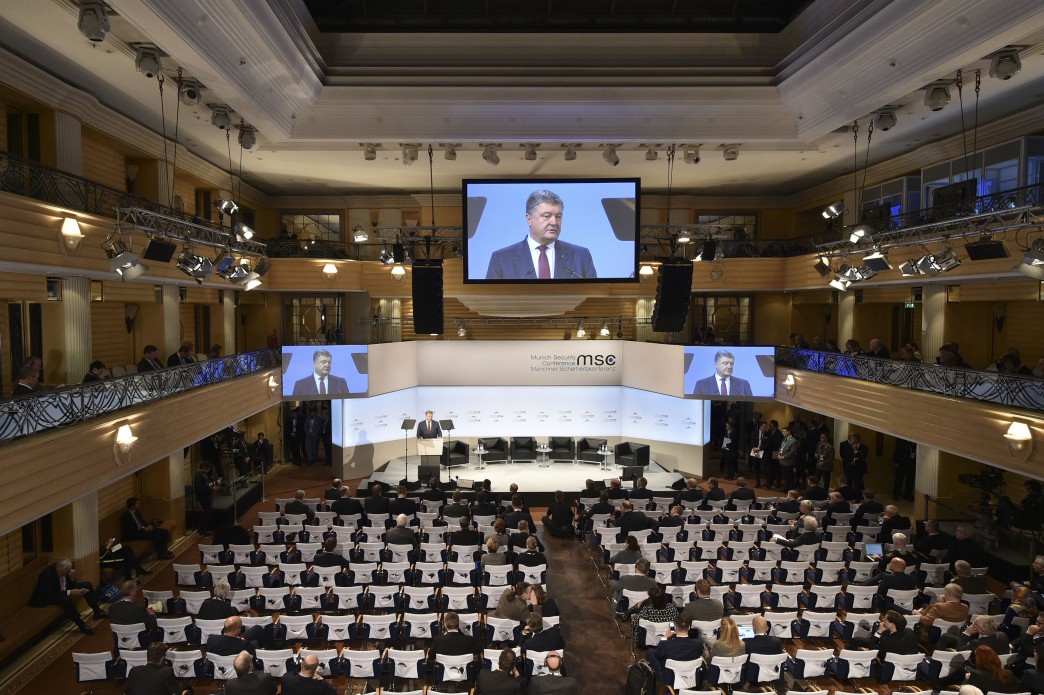
At this year’s Munich Security Conference in mid-February, President Poroshenko seems to have met with all the people he would have wanted to meet, from the NATO Secretary General to US Congressmen. Ukraine’s traditional supporters have not changed their position of principle and will meet with the President of Ukraine. Poroshenko, however, ended up giving his “comment from Ukraine” to an half empty auditorium. That could be explained by many factors including a less than ideal timing for his address. Occasional indifference to another speech would not bear mentioning were it not accompanied by rumours suggesting that the US and the EU are “dropping” Poroshenko. Dissatisfaction with the expulsion from Ukraine of egocentric opposition leader Mikhail Saakashvili would not in itself have been enough to cause this turn of events. Yet, it could well have been the proverbial straw that broke the camel’s back. Dissatisfaction with Poroshenko has, however, been building up for some time both at home and abroad. Interestingly enough, the main opponent to Poroshenko, former Prime Minister Yulia Tymoshenko was also in Munich.

Among the meetings that Poroshenko had in Munich, the most remarkable one is probably not the one that received the most attention in Western media. Poroshenko had what was described as a constructive meeting with the new Prime Minister of Poland during which one particularly sensitive issue was discussed. There has been a lot of coverage of the dispute between Israel and Poland over the new Polish law that establishes what can or cannot be said about “Poles being responsible or complicit in the Nazi crimes committed by the Third German Reich”. Very little has appeared, however, about a controversy closer to home. The new Polish law also makes it illegal to deny war crimes committed by Ukrainian nationalists. It refers to “acts committed by Ukrainian nationalists between 1925 and 1950 which involved the use of violence, terror or other human rights violations against individuals or population groups” as well as to the fact that “participating in the extermination of the Jewish population and genocide of citizens of the Second Polish Republic in Volhynia and Eastern Malopolska [Lesser Poland] also constitute a crime committed by Ukrainian nationalists and members of Ukrainian units collaborating with the Third Reich”. Relations between Poland and Ukraine are obviously more than that controversy, but the strong diametrically opposed feelings continue to exist in both countries, complicating the political dialogue.

Another issue that was discussed in Munich was the UN peacekeeping arrangement for Eastern Ukraine. President Poroshenko continues to promote actively such an arrangement. The Ukrainian Foreign Minister had a detailed discussion of the matter with his Russian counterpart, according to the Russian side. There are, however, growing signs that some supporters of Ukraine are concerned that a Cyprus-type of peacekeeping accord, if successfully implemented, would essentially freeze the conflict for the foreseeable future, and would remove any incentive for its resolution.


--o--


SYRIAN SHADOWS


With the fight against the Islamic State no longer being the central issue, the underlying complexity of the situation in and around Syria has become more evident. A few observations may help clarify some aspects of the conflict. First, long-term Russian objectives in Syria have not changed. Russia wishes to preserve the existing state structure for fear that the implosion of Syria would plunge the region into total chaos. This means, accessorily, keeping Assad in power. There is no special attachment to the Assad family. This has been made clear on several occasions. Second, there is not always full convergence between the positions of Russia and those of the Assad government. Whether this is a bad cop/good cop show is possible. What matters more is that Russia can be the interlocutor for the international community. This has been demonstrated in the context of the Eastern Ghouta humanitarian crisis. The Syrian government did not conceal the intention to apply in the Eastern Ghouta the same ruthless level of military force as was deployed in the case of East Aleppo. In the view of the Damascus authorities, the continuing existence of a rebel enclave in close proximity to the capital and one from where the rebels could bomb the outlying residential areas of Damascus could no longer be tolerated. (See above map. Douma is a city in Eastern Ghouta.) It will make the implementation of any ceasefire extremely difficult. Nevertheless, Russia was not fully aligned with its Syrian ally on this issue. That is why it was able to vote in favour the Security Council resolution calling for a ceasefire, still with the caveat that the cease-fire does not apply to terrorists. Sensing the slight difference of opinion, that is why thereafter Western powers called on President Putin to exercise maximum influence on its Syrian ally. This is why, after a Macron-Merkel-Putin conversation, there was the announcement by Russia, not by Syria, of a five-hour a day humanitarian corridor to allow for the departure of civilians and the provision of humanitarian assistance. Ultimately though, the resolution may have to come from the rumoured indirect negotiations between some rebel groups and the Syrian government.

Russia and Syria do, however, share the desire to see uninvited foreign troops on Syrian territory. That applies first to US troops. Although Donald Trump has recently stated that US troops should deal with ISIS and leave, there is long-term US interest in a military presence that allows to rein in Iran and to prop up a US-friendly Kurdish entity, as a counterweight to all the other less US-friendly and less-Israel friendly entities. Keeping in mind the Afghanistan precedent, it is difficult to imagine an early departure of US troops.

When it comes to the Turkish presence in Northeastern Syria, the interests of Russia, Syria and even possibly Turkey may eventually coincide. Even though Syria and Russia do not share Turkey’s animosity towards the Kurds, the Turkish objective of doing away with the Kurdish threat could possibly be reconciled with the Syrian opposition to a Kurdish entity that could permanently jeopardize its territorial integrity. This is why Russia is supporting current attempts to re-establish a political dialogue between Damascus and Ankara. The Turkish side has already confirmed that there were direct contacts between the Turkish and Syrian intelligence agencies. This could become very significant, but, once more, the Kurds may have their future decided by others.


--o--


THE RUSSIAN ECONOMY, A POLITICAL TAKE


It is generally estimated that economic growth for 2017 in Russia will be around 1.5%, the first time in three years when growth is registered. In simple terms, the Russian economy shows resilience, but not dynamism.

The national unemployment rate is estimated at 5.2%. This would be very good, but the problem is that unemployment is virtually inexistent in large urban centres, yet considerably higher in areas such as the Causasus. Ingushetia unemployment, for instance, is estimated at 27%.

High inflation prevailed for most of the post-Soviet period. In a “new” consumer society, this has been a constant source of public concern. Inflation for January 2018 reached a record low of 2.2% well below the 4% target set by the Central Bank.

Despite the low inflation, disposable income is stagnating. The official poverty rate nevertheless decreased slightly in the first half of 2017.

The overall financial situation of the country is relatively sound. It has the sixth lowest level of national debt and the sixth highest level of financial reserves. On February 23rdth, Standard and Poor raised the credit rating of Russia from BBB- to BB+, taking the country out of the “junk” area and into investment territory.

Government expenditures are under control, with the federal budget inching towards equilibrium in 2017 and expected to be in a surplus condition in 2018. Dependence on oil revenues is slowly decreasing.

Structural issues obviously need to be addressed, even in the agriculture sector that, for instance, turned Russia into the largest wheat exporter in the world. In order to meet Innovation objectives, the economy will have to address demographic challenges, including skilled labour shortages. The continuing prevalence of state-owned enterprises, the limited availability of local capital are also factors that are seen as limiting growth.

All things considered, the Russian economy is showing some positive signs. Overall, it is moving in the right direction, albeit at a slow pace.

The relatively slow economic growth has not been an issue in the current presidential election campaign. It is becoming increasingly clear, however, that there is a growing expectation in the population that significant economic growth will return in coming years. This will be the main challenge of the (likely) last Putin presidency.


--o--


PERSON OF THE MONTH: CZECH REPUBLIC PRESIDENT MILOS ZEMAN


Milos Zeman, aged 73, the Czech Republic’s populist president, has been narrowly re-elected in late January 2018 in a close battle against a liberal opponent.

This is significant because Zeman's campaign was conducted on a clearly anti-immigrant and even anti-Western platform, potentially steering the country in an anti-western direction.

Zeman needed a second round runoff victory against Jiří Drahos, a former head of the Czech academy of sciences, a chemist by profession. The final vote count was: 51.5% to 48.5% in Zeman's favor.

Zeman is openly pro-Putin and promotes better ties with China. Significantly he called for referendums on the Czech Republic’s membership in the EU and NATO. He is a vocal critic of Islam and believes that unchecked immigration from Muslim countries threatens cultural cohesion of Europe and undermines its security.

The above-mentioned election will unlikely change the country's politics and alliances overnight as the position of Czech president is more ceremonial and actual power here is wielded by the Prime Minister and Parliament.


--o--


BRIEFLY NOTED


RUSSIA


The Levada center, an independent, non-governmental, polling and sociological research center in Moscow published some estimates for the upcoming presidential elections. The eight opposition candidates in combination could receive about 20% of popular vote. If Alexei Navalny, the popular opposition leader, who is banned from taking part in the election, was running, the opposition could amass nearly 40%. In the eyes of the Russian establishment that could be defined as a defeat for Putin. Stanislav Belkovsky, chief adviser to presidential candidate Ksenia Sobchak and one of Russia's leading political analysts, stated that if Putin failed to gather more than 60% of the popular vote, he would resign in the same way French president Charles De Gaulle resigned after collecting only 52% of the votes in the constitutional referendum in 1969. Most Russian observers, however, believe that Putin is slated to collect around 70% of the vote.

The Levada Center has now suspended its polling for the election, since under the new law on non-governmental organisations, it is considered as a “foreign agent” for having received some funding from abroad.


LATVIA


The Governor of Latvia's Central Bank Ilmars Rimsevics was arrested on charges of receiving and demanding bribes worth almost $200,000. Considering that Mr. Rimsevics has been head the bank since 2001, this scandal threatens to tarnish the reputation of the Latvian banking sector.

ROMANIA


The Romanian Minister of Defense and his Moldovan counterpart announced the creation of joint units as the nucleus of a potential unified army within a unified state of Romania and Moldova. The next parliamentary elections in Moldova will show whether the majority supports the reunification of the two countries. The current polls show that the Moldovan socialists led by President Igor Dodon have better chances. If they win, reunification will be put on the back burner. If they lose, great Romania may become a reality.

KAZAKHSTAN


President Nursultan Nazarbayev signed the historic law switching the Kazakh alphabet from Cyrillic to Latin letters The latter was in use in Kazakhstan before 1940 when Stalin ordered Kazakhstan's forced russification.

UZBEKISTAN


The open door policy for international business will become the main political course of the state for years to come, according to the Government in Tashkent. After many years since the Soviet industrial and scientific infrastructure was destroyed, Uzbekistan is turning to Western investors to fill the vacuum and to begin reconstruction of Uzbekistan's industrial, scientific and agricultural sectors. Starting this year the government liberalized the visa regime in order to attract foreign investors and tourists. For the latter, Uzbekistan has unique historical sites, such as the ancient cities of Bukhara and Samarkand.


NORD STREAM 2


After a long protracted political debates and strong US opposition, the natural gas pipeline from Northern Russia to Germany will go ahead as German construction permits were obtained. It will be a dual pipeline that will be laid at the rate of 3 km per day from special floating factories. Pipes will be welded and tested on ships and laid through the Baltic sea.

The main sticking point of that project was the EU concern that Ukraine could lose the transit of Russian natural gas to Europe and hard currency that it brings. In political terms the EU wanted to show support for Ukraine by opposing the Russian gas transit which bypasses Ukraine. The most active opposition to Nord Stream-2 came from Poland and Baltic countries. They do not fancy the idea that the most powerful European economy (Germany) could fall into even more substantial energy dependence on Russia's energy carriers.

Russia assured the EU that their Ukrainian gas transit will stay in place.

NORTH KOREA 


The noose is tighening. Not waiting for the Winter Olympics games to end President Trump announced a new set of crushing sanctions against North Korean shipping and scores of firms dealing with North Korea. According to Steve Mnuchin, US Treasury Secretary, this measure will significantly cripple North Korean ability to conduct evasive maritime activities, preventing North Korea from bringing coal and other energy supplies into their ports. The ships that were sanctioned are registered in North Korea, China, Taiwan, Marshall Islands, Tanzania, Panama and Comoros.
The sanctions also blocked certain companies’ assets and forbade US citizens to deal with the hermit kingdom. The $64,000 dollar question here is whether this step influence in any way the certain detente that has been developing of late between the two Koreas.


--o--

THE AUTHORS

Ilya Gerol, former foreign editor of the Citizen in Ottawa, syndicated columnist in Canadian, US and European media specializing in international affairs. His particular area of expertise includes Russia, Eurasian Economic Union, Eastern and Central Europe.  Ilya Gerol has written several books, one of them, The Manipulators, had become a textbook on relations of media and society.

During his career in the Canadian Foreign Service, Gilles Breton had three assignments at the Canadian Embassy in Moscow. His first posting there began during the Soviet period, in 1983. His last was from 2008 to 2012 as Minister-Counsellor and Deputy Head of Mission. He also served as Deputy Director responsible for Canada’s relations with Russia from 2000 to 2008. As an international civil servant, he was Deputy Director of the OSCE Office for Democratic Institutions and Human Rights in Warsaw from 1994 to 1997.