THE BRETON/GEROLNEWSLETTER
SUMMIT OF HOPES AND DISILLUSIONMENT
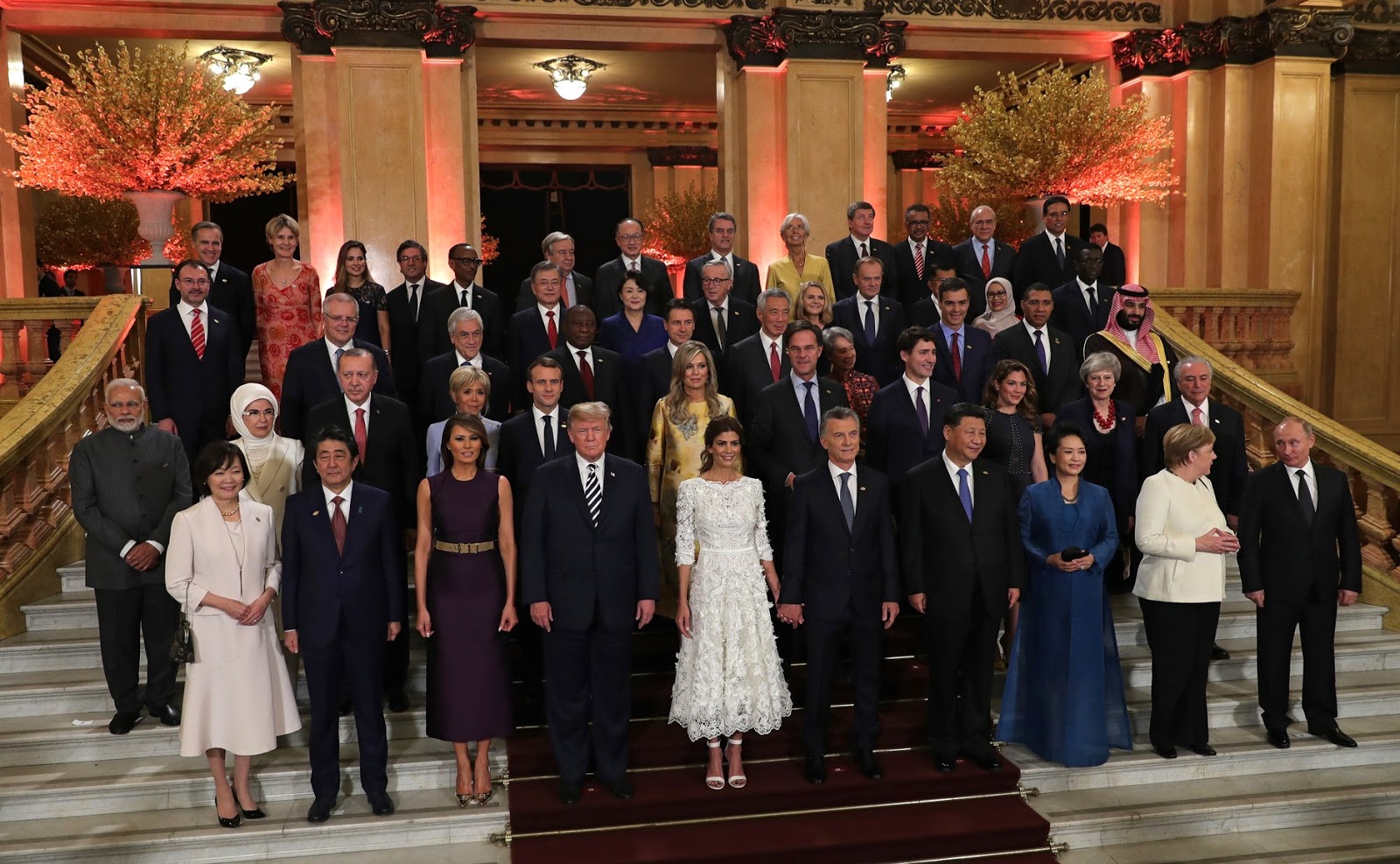 |
| G20 participants prior to Gala Concert December 1st 2018, Buenos Aires ©President of Russia Website |
On the eve
of the G20 Summit in Buenos Aires expectations were unusually and somewhat
unreasonably high. The reality of this gathering was, however, much more
subdued due to a couple of factors. The summit began in the shadow of a fresh
escalation in the Ukraine-Russia conflict, this time in Kerch Strait. Due to
this development, and simultaneously pressured by bad news from the Mueller
inquiry, President Trump cancelled his scheduled meeting with Putin. The
presence of Mohammed Bin Salman, Crown Prince of Saudi Arabia, also added to
controversy. His presence proved once more that in today's political climate the double standard is the only standard. It was evident that even after the gory
and premeditated murder of Saudi journalist and dissident Jamal Khashoggi (on direct
orders from Bin Salman, according to the CIA) he was personally met by Trump,
Macron, Putin and May.
It was business as usual. Meanwhile Putin got the cold shoulder from Trump who, despite the urgency of such important issues as the ballistic missile treaty and other non-proliferation agreements, refused to even say hello to Putin in public. It was obvious that domestic political considerations related to Michael Cohen’s plea agreement and Trump's fear of the Mueller inquiry played a key role in his overtly aggressive stance towards Russia, at least for now. The Europeans displayed a more even-handed approach. Chancellor Merkel stressed that both Kyiv and Moscow have to negotiate since there cannot be a military solution to their conflict. In contrast Chinese President Xi met Putin twice in Buenos Aires underlining a steady move of Russia into ever closer ties with its neighbour.
 |
| Mohammad Bin Salman, Vladimir Putin, Moon Jae-in G20 Summit, November 30th, 2018, Buenos Aires ©President of Russia Website |
It was business as usual. Meanwhile Putin got the cold shoulder from Trump who, despite the urgency of such important issues as the ballistic missile treaty and other non-proliferation agreements, refused to even say hello to Putin in public. It was obvious that domestic political considerations related to Michael Cohen’s plea agreement and Trump's fear of the Mueller inquiry played a key role in his overtly aggressive stance towards Russia, at least for now. The Europeans displayed a more even-handed approach. Chancellor Merkel stressed that both Kyiv and Moscow have to negotiate since there cannot be a military solution to their conflict. In contrast Chinese President Xi met Putin twice in Buenos Aires underlining a steady move of Russia into ever closer ties with its neighbour.
Canada,
Mexico and the US used the opportunity to sign the new treaty replacing NAFTA,
an agreement more favorable to the US, as Trump correctly predicted.
The US and China called a truce in their trade war on Saturday after President
Trump agreed to hold off on new tariffs and President Xi Jinping pledged to
increase Chinese purchases of American products. The two also set the stage for
more painstaking negotiations to resolve deeply rooted differences over trade. The
compromise, struck over a steak dinner after the G20 meeting, was less a
breakthrough than a breakdown averted.
--o--
THAT MBS/PUTIN FRIENDLY HANDSHAKE
Seldom has a handshake between two leaders caused such a worldwide reaction. At the outset, let us be clear; it confirms that Vladimir Putin does not see the Khashoggi affair as a reason no longer to be a friend of Mohammad Bin Salman (MBS). What does it say about Putin’s view of the murder of the Saudi journalist? Some have argued that the President of Russia and the Saudi Crown Prince have identical views about torturing and killing journalists. There might be a few nuances to add, but that interpretation will remain the prevailing one.
A few days later, the handshake is not so much remembered for its moral implications as f or the political ones, especially in the US. The Anti-Trump group will deplore the fact that the US President and the Russian President fall in the same moral category. Pro-Trump factions, and maybe Trump himself, will be upset that the Russian President seems to have such a genuine, warm friendship the Saudi Crown Prince and, as one famous US comedy show already suggested, that they might make fun of him in private.
A few pictures taken at the time of the Football World Cup in June 2018 would tend to confirm that the Putin-MBS handshake is the confirmation of a strong personal connection.
 |
| Half-Time Break, Saudi Arabia-Russia Game June 14, 2018, Moscow ©President of Russia Website |
 |
| Informal Chat, Saudi Arabia-Russia Game June 14th, 2018, Moscow ©President of Russia Website |
TEMPEST, IN THE KERCH STRAIT
Unavoidably,
the dispute over the conditions under which non-Russian vessels including
especially Ukrainian military vessels can cross the Kerch strait to enter the
‘’historic waters’’ of the Sea of Azov was going to become a more serious
matter at some point. The absorption of Crimea by Russia followed by the
construction of a bridge linking Crimea with the rest of Russia was bound to
cause a significant rift between the official legal positions of Ukraine and
Russia in an area of international maritime law where conflicts are not
uncommon. In addition to having to insist on free access to the Azov Sea for
trade reasons, Ukraine was going to have to take issue with the Russian
position at the risk of acknowledging that Crimea is de facto part of Russia. Beyond the defence of its new territorial
claims, Russia was going to have to take restrictive measures with respect to
transit through the strait in light of security concerns over the integrity of
the bridge, a colossal infrastructure undertaking whose completion does not sit
well with Ukraine. Whereas Ukraine initially moved in September 2016 to have
the dispute resolved through an international tribunal, things took a different
turn in on November 25th.

In light of
what was described as an increasingly restrictive approach on the part of Russia, the Ukrainian authorities sent some military ships in the direction of the Kerch
strait to exercise what they see their legitimate rights of passage, without
effectively coordinating this with Russia as they had done earlier in the
summer. The confrontation that ensued led to the capture by Russia of three
Ukrainian vessels and their crews as well as injuries to some crew members.
Criminal proceedings have been initiated in Russia/Crimea against the Ukrainian
crews.
 |
| President Poroshenkp meeting with relatives of a captured Ukrainian sailor November 30th, Kyiv ©President of Ukaine Website |
In sending
his ships, Poroshenko knew there would be an incident. He also knew that any
Russian action against the incoming Ukrainian ships would be presented as an
act of aggression by Russia and that all the supporters of Ukraine would join
in the usual chorus. This was a no-lose proposition.
On the
internal political scene, a border clash with Russia would not in itself have a
major impact either on the current low rating of the president or the conduct
of the March 2019 presidential election. Poroshenko, however, quickly submitted
to the Parliament a proposal for the imposition of martial law in light of
the’’ imminent threat of a military offensive’’ on the part of Russia. Fears
were expressed by some that martial law might be used to cancel the March 2019
presidential election. In any event, the Ukrainian parliament only approved
martial law for 30 days rather than the 60 requested by Poroshenko and only in
half of the country, namely the areas contiguous with Russia or considered at
greater risk. Assurances were offered that the election would be held as
planned.
 |
| President Poroshenko Handing over of new equipment, December 1st, 2018 ©President of Ukaine Website |
In
resorting to the call for martial law, Poroshenko could turn a no-lose
proposition into a win-win proposition. As one observer put it, if there is no
Russian invasion, martial law will have prevented it. If there is a Russian
invasion, even a limited one, incredible foresight was exercised.
To outside
observers who may view the martial law response (and the ensuing ban on
able-bodied Russian men aged 16 to 60 from entering Ukraine) as incommensurate
with the naval incident or with any real threat from Russia, it would be useful
to note that for many Ukrainians the idea of a Russian invasion is a far more
credible reality than it generally is to foreigners.
At the
domestic level, Poroshenko may have been able to burnish his image in
preparation for the upcoming electoral contest, but at the price of imposing
martial law. The real gain is not clear.
At the
international level, some Europeans have voiced the idea of new sanctions. There
would seem little enthusiasm for that. It was left to Chancellor Merkel to seek
assurances from Poroshenko and Putin that the situation would not be allowed to
deteriorate. Poroshenko actually claimed he sought Merkel‘s intervention
because he could not get through to Putin. Merkel did not however respond
favourably to the Ukrainian suggestion of sending NATO ships to the area,
arguing that a military solution was not what was needed.
As could be
expected, Russia, including Putin himself but not only, quickly suggested that
the whole affair was orchestrated by Poroshenko to salvage his dismal
re-election prospects. From the point of view of Russian national interest,
there is nothing to be gained by escalating matters. Protecting the Kerch Strait Bridge already has significant costs. Any further military action would bring
no benefit, but would entail monumental costs.
President
Trump cancelled his planned bilateral meeting with President Putin on the
margins of the G20 meeting in Buenos Aires on November 30th. Some in Ukraine
will see this perceived upset for Russia as a victory and some justification
for whatever happened in proximity of the Kerch Strait, as if a meeting with Trump
was a favour to Putin. Chancellor Merkel confirmed that she would meet with
Putin precisely to discuss the Kerch strait issue. Trump’s cancellation of his
meeting is more a confirmation of his precarious political position when it
comes to relations with Russia and his lack of capacity to enter into a
credible discussion with his Russian counterpart. Considering Trump’s current
Mueller inquiry-obsessed state of mind, the cancellation may be a blessing for
all.
All things
considered, Poroshenko may have scored a symbolic political victory, but could
not turn the naval incident into a game-changing event either for himself or
for Ukraine.
At the G20
Summit in Buenos Aires on December 1st, Merkel said she had suggested and Putin
had agreed that discussions about the dispute should continue at the advisor
level in the four-way Normandy format that is intended to ease tensions between
Ukraine and Russia.
--o--
NATURAL GAS, AS ALWAYS
During
Ukrainian Foreign Minister Klimkin’s recent visit to Washington, Secretary of
State Pompeo said among other things: “We’ll keep working together to stop the
Nord Stream 2 project that undermines Ukraine’s economic and strategic security
and risks further compromising the sovereignty of European nations that depend
on Russian gas.’’ Nord Stream 2 may indeed be detrimental to the interests of
Ukraine, but criticising it is not doing much to advance the interests of
Ukraine. Advancing the interests of Ukraine when it comes to the transit of
Russian gas would imply securing a suitable contract with the owner of the gas.
Furthermore there are two questions raised by Pompeo’s statement. In what way
prolonging the dependence of the strategic and economic security of Ukraine on
the transit of Russian gas is it in Ukraine’s long-term interests? In what way
the gas transiting on a Ukrainian-located pipeline is it creating a lesser dependence than the
gas transiting through the Baltic Sea?

During a
recent visit to Istanbul President Putin celebrated the completion of the
maritime part of the Turkish Stream gas pipeline that will eventually deliver
Russian gas to Western Turkey and to Southeastern Europe. Another pipeline,
Blue Stream, already delivers Russian gas to Eastern Turkey. Just like Nord
Stream 2, Turkish Stream will reduce the volume of gas that needs to transit
through Ukraine. There has not been the same level of criticism from the US
against Turkish Stream as against Nord Stream 2, likely because Turkey as a new
customer on the market could not be denied its own access to Russian gas. Yet
the US is nevertheless trying to convince Southern European countries not to
connect with Turkish Stream, but with little chance of success.
 |
| Presidents Erdogan and Putin November 19th, 2018, Istanbul ©President of Russia Website |
Beyond the
plans and discussions over new pipelines, the matter of where Ukraine is getting
its natural gas for next winter is a serious issue. There were already in early
November public protests over the fact that local utilities in some cities
could not turn on the public heating systems for the fact they were not in
a position to pay their gas bills. President Poroshenko ordered that the
systems be turned on. Public utilities and individual customers will indeed
have to pay more for gas this winter. It is not clear that presidential
intervention will be enough to resolve all problems. For his presidential
election campaign, in addition to a political miracle, President Poroshenko
also has to hope for a mild winter.
--o--
RUSSIA: A NEW COURSE?
On November
29thPresident Vladimir Putin unexpectedly summoned a congress of the
People's Front (strictly speaking not a political party, but a public
organization headed by Putin that allows him to distance himself from the
official United Russia Party headed by Prime Minister Dmitry Medvedev). In his
opening address Putin proclaimed the necessity, after a decade of strengthening
military defense capabilities, of dedicating comparably similar resources to
the modernisation of the economy with the
emphasis on high-technology and scientific achievements.
 |
| President Putin adrdressing People's Front Assembly Novmeber 29th, 2018, Moscow ©President of Russia Website |
According
to Putin, the Russian economy has grown by 1.75 % during the last 9 months. This
is certainly not enough to reach the promised objective of joining the top 5
economies in the world. Russia intends to cut its military spending and to
invest more into scientific research and development. Andrei Kostyn, the
president of VTB Bank and probably the closest financial adviser to Putin,
stated with unusual bluntness: "We have 10 years to modernize our economy,
improve the investment climate and triple spending on science and education. If
we don't do it we will fall behind for good".
Such a
serious turnaround will certainly require improving relations with the West, with
all the compromises that will come with any such process.
--o--
CHINA-RUSSIA ENERGY FORUM
A group
representing the major players in the Russian energy sector met with their
Chinese counterparts in Beijing this month. On the agenda was the
synchronization of efforts in order to create an ambitious network of power
stations in both countries (where Russian Far East borders China), a system of
gas and oil pipelines, search and development of new oil and gas deposits in
Siberia and the Russian Arctic backed up by heavy Chinese financing in a long
term development trajectory. Igor Sechin, a leader in Russia’s oil industry as
the President of Rosneft and a close associate of Putin, indicated in his
interview with Russian journalists that China is considering investing in the
construction of the Nord Stream 2 underwater pipeline between Russia and
Germany. Some American observers believe that such a decision is in response to
the trade war that Trump unleashed against China.
--o--
DONALD, THE ICONOCLAST
Donald
Trump’s frequent railing against the European members of NATO for, in his view,
their failure to contribute their fair share of in terms of military
expenditures reveals as usual his shallow understanding of complex issues. One
also gets the impression that his objective is not so much to have allies spend
more, but rather to have the US spend less on European territory. No wonder
then that he would get upset when
President Macron recently said: ‘’We have to protect ourselves with respect to
China, Russia and even the United States of America […] we need a Europe which
defends itself better alone, without just depending on the United States, in a
more sovereign manner’’.
Beyond the
statements of the presidents there is a fundamental question about the future
of transatlantic defence and as to what rapport de force will
develop between EU defence institutions and NATO.
According
to Lord Ismay, NATO’s first Secretary General, NATO was created to “keep the
Soviet Union out, the Americans in, and the Germans down.
Trump’s
criticism of his European allies casts a doubt about the Americans wanting to
stay. Macron‘s statement casts its own doubts about whether the Europeans
should insist on keeping them in. This is not to say that a strictly European
Defence arrangement will soon replace NATO. There is, however, concern that the
current US President could cause, wittingly or not, lasting damage to the overall commitment to the Transatlantic Alliance. For instance, it seems that NATO will
not be holding a 70th-anniversary celebration, because as one seasoned observer
put it ‘’the president of the United States cannot be trusted not to bring the
temple down upon all our heads’’.
--o--
PERSON OF
THE MONTH: NANCY PELOSI

Pelosi was
born Nancy Patricia D'Alesandro in 1940, in Baltimore, in a largely Roman
Catholic neighborhood and the center of social and economic life for
Italian-American families. She was the last of six children, and the first
daughter. The family lived in Little Italy, in a neighborhood that was a loyal
Democratic Party stronghold in Maryland politics.
In 1976 she
worked for the presidential campaign of California's popular governor, Jerry
Brown. Because of her political connections back in Maryland, she was asked to
organize a "Brown for President" campaign there. Brown went on to win
an unexpected primary victory in Maryland, thanks to Pelosi. Later that year he
lost the Democratic Party's presidential nomination to Georgia's governor,
Jimmy Carter.
The
experience boosted Pelosi's reputation as a behind-the-scenes dynamo. In 1977
she became chair for the northern section of the California Democratic Party,
and four years later became the chair for the entire state. She later served in
a national party post as the finance chair for the 1986 congressional
elections. Known for her top skills in recruiting candidates and getting them
elected, Pelosi had never considered running for office herself. That changed
when one of her long-time political allies was diagnosed with cancer and
suggested that Pelosi run for the seat in the coming special election. It was
not a local or state office, it was for a seat in the U.S. House of
Representatives.
In 2002
Pelosi was elected minority whip and, in 2007, Speaker of the House. She served until the Democrats lost their
majority in 2011. Her biggest achievement at that time was her work on the Obama
health care reform that was adopted in 2010. The historic bill extended health
care to some 30 million previously uninsured Americans.
As the
Democrats won back the majority in the House of Representatives this year Nancy
Pelosi returned as Speaker. She is a strong critic of Donald Trump and has supported many liberal causes. As the Democratic Party has drifted more
to the left, especially since the 2016 election of Trump, Pelosi has come to represent
the voice of moderation and the values of old school Democrats. (The fact that
close to 30 Democrats voted against her as Speaker highlights the future
struggle within the party between moderate and more 'progressive' members.)
This struggle will play out in full as the 2020 presidential election draws near.
Nancy
Pelosi as the Speaker of the House of Representatives and as one of the most
influential democratic leaders will play an essential role in shaping the Democratic
Party's attempt to wrestle the American presidency away from the Republicans
and to make Donald Trump a one-term president or even, depending of the conclusions
of Mueller investigation, start an impeachment process.
--o--
GEORGIA, MOVING ALONG
Although
she was the candidate of the ruling party, Salome Zurabishvili ‘s election as
the first woman president of Georgia marks the country's entry into a new era.
While the post of president in Georgia will from now on be mostly a ceremonial
one, Zurabishvili’s second round victory likely means the end for former
president Mikhail Saakashvili’s ideology as well as for his chances of
returning to Georgia from exile. Saakashvili's presidential candidate suffered
a resounding defeat.
 |
| President Salome Zurabishvili ©Wikipedia |
Salome Zurabishvili was born in France to Georgian émigrés and served as France's ambassador in Tbilisi before becoming Georgia’s foreign minister in the first Saakashvili government.
Her position vis a vis Russia is less confrontational. She supports broader economic ties with Moscow while maintaining an overall pro-Western political orientation.
In the
official statement from the Russian Ministry of Foreign affairs her election
was presented as "a moderately positive development".
--o--
ARMENIA, AIMING FOR RADICAL CHANGES
 |
| Acting PM Pashinyan ©Wikipedia |
On November
24th thousands of supporters of acting Armenian Prime Minister Nikol
Pashinian rallied in Yerevan ahead of next month's snap general elections.
Addressing the demonstrators, Pashinian said that the movement that came to
power by riding on a wave of peaceful street protests last spring
"returned power to the people."
Pashinian announced in October he was resigning from the post of Prime Minister in order to dissolve parliament and force early elections. He has continued to perform his prime-ministerial duties until a new parliament and Prime Minister are elected.
Pashinian announced in October he was resigning from the post of Prime Minister in order to dissolve parliament and force early elections. He has continued to perform his prime-ministerial duties until a new parliament and Prime Minister are elected.
Pashinian
pushed for early parliamentary elections following his bloc's landslide victory
in the mayoral race in Yerevan. The objective is to unseat his political
opponents in the Republican Party (HHK), who have held a majority in parliament.
--o--
RUSSIA/SYRIA
Russia announced it has sent military chemical experts to Aleppo after reports that
shells fired by insurgents in the Syrian city left dozens of people with
breathing and vision problems. Defense Ministry spokesman Igor Konashenkov said
on November 25th that specialists from Russian nuclear, chemical and biological
warfare protection units had arrived at the scene of the attacks after Syrian
state TV broadcast footage of medics treating people for what appeared to be
injuries related to the use of chemical weapons.
The rebels
rejected the allegations that they had used chemical weapons on November 24th,
and instead accused government officials of staging the attack to undermine a
cease-fire. Around 100 Syrians were hospitalized with breathing difficulties,
Syria’s state news agency SANA and a British-based monitor said.
The Syrian
Observatory for Human Rights said most have been discharged and the 31 cases
that remained were not critical.
Soon after
the incident, Russian Air Force struck bases of anti-Assad rebels in Idlib.
Without
confirming all that Syria and Russia have said about the use of chemical
weapons on Syrian territory, the incident gives some credibility to the
allegations that rebels had some low-grade chemical weapons in their
possession.
--o--
UZBEKISTAN
The chief of the rotating European Union presidency, says the "overall human rights situation” in Uzbekistan has shown improvement in the last two years.
"We
see a release of most detainees who have been on the EU list of prisoners of
concern. I am aware of one person who is left on that list, and it would be
definitely very helpful if these lists were no longer needed and if all persons
released were fully rehabilitated,” Austrian Foreign Minister Karin Kneissl
said on November 22. She made the comments at a press conference with Uzbek
Foreign Minister Abdulaziz Kamilov after an EU-Uzbekistan Cooperation Council
meeting in Brussels. Kneissl said the European Union “will do its utmost” to
support “the very ambitious reform program” the Uzbek government has launched.
“It was confirmed to us in all the details that it is ambitious and we wish the
government all success in order to implement it in an effective way,” Kneissl
said. “What we have been observing shows that things are on the right track,”
she added.
There is
similar ongoing enthusiasm in the business community for committing resources
to developing economic relations with Uzbekistan.
--o--
THE AUTHORS
Ilya Gerol,
former foreign editor of the Citizen in Ottawa, syndicated columnist in
Canadian, US and European media specializing in international affairs. His
particular area of expertise includes Russia, Eurasian Economic Union, Eastern
and Central Europe. Ilya Gerol has
written several books, one of them, The Manipulators, had become a textbook on
relations of media and society.
During his
career in the Canadian Foreign Service, Gilles Breton had three assignments at
the Canadian Embassy in Moscow. His first posting there began during the Soviet
period, in 1983. His last was from 2008 to 2012 as Minister-Counsellor and
Deputy Head of Mission. He also served as Deputy Director responsible for
Canada’s relations with Russia from 2000 to 2008. As an international civil
servant, he was Deputy Director of the OSCE Office for Democratic Institutions
and Human Rights in Warsaw from 1994 to 1997.
Gilles
Breton also currently serves as Chairman of the National Board of the
Canada-Eurasia-Russia Business Association. The views expressed in this
newsletter exclusively reflect the opinion of the authors.


