Tuesday, July 31, 2018

Issue 21

THE BRETON/GEROLNEWSLETTER


HELSINKI SUMMIT: NEW INSIGHTS AFTER THE DUST HAS SETTLED


Presidents Trump and Putin, Helsinki, July 16th
©President of Russia Website


Now, as the wave of indignation and wide-ranging accusations against Trump, not all of them evidently unfounded, has subsided, we can calmly discuss the outcome of that controversial meeting. Former State Secretary Henry Kissinger recently said that the Helsinki summit had to take place in any event, yet Trump's approach, as all of his foreign policy in general, marks the beginning of a new geopolitical era. Unfortunately, Kissinger added tongue in cheek, Trump most likely is not even aware of it. 

Trump, in his awkward ways, is trying to re-introduce a series of bilateral agreements by circumventing old political and military alliances. Some of them were introduced a long time ago at a time of totally different political realities and, according to Trump's thinking, exist mainly due to American financial and military assistance. As well, the Administration in its heart of hearts believes the real threat to the West comes from a re-surging China, not Russia.

In fact the Helsinki Summit had two agendas; one for the immediate public consumption that included Russian involvement in American elections (Trump agreed with Putin that there was no involvement by Russians at the state level, though later under pressure Trump said he misspoke), cooperation on Syria in connection with the security of Israel.

Two weeks after the summit we are beginning to gather more information of the most important part of that meeting-what was said behind closed doors. Trump and Putin made some attempts to find a compromise on the most acute crisis in Europe, the one that divides West and Russia more than anything else,-Ukraine. Mike Pompeo informed the Senate that Trump and Putin agreed to disagree on the Ukrainian issue. Moscow suggested holding a referendum in Donbass (that includes two unrecognized Donetsk and Lugansk republics) under international supervision on the political future of that region. Washington in turn offered to provide 20 to 40 thousand international peacekeepers for the Donbass region and international administration without any NATO or Russian representation.

There was no agreement reached on that issue, but at least it could be offered to Ukraine for consideration and discussed at the upcoming Normandy format meeting between foreign ministry representatives of France, Germany, Ukraine and Russia.

Not widely publicized but discussed during the summit's closed door session was the nuclear disarmament issue.

The New START treaty signed between then Russian President Dmitry Medvedev and then U.S. President Barack Obama in 2010 will not survive automatically on its own. The agreement, which reduced the number of strategic nuclear weapons to 700 deployed launchers and 1,550 warheads, is set to n expire on February 5, 2021, if it is not prolonged by decision of the parties. Should this come to pass, the multi polar international system will be thrown into chaos.

To prevent a disastrous clash, the two countries need to maintain and strengthen the arms-control safety net. This also includes resolving disputes over the implementation of the Intermediate Nuclear Forces Treaty (INF) a cornerstone of European security. That is why it is necessary to resume the Russia-US dialogue that will lead to official negotiations. For now, the agenda should be narrow, prioritizing three key issues: the prolongation of the New START treaty, the preservation of the INF Treaty, and the prevention of dangerous military accidents.

With this in mind, and brushing aside internal American squabbles and concerns, real or not, on the merits of the Russian involvement in 2016 American elections, the Trump administration had decided to invite Vladimir Putin to Washington for another summit where those concerns, mainly nuclear safety, reduction and arms race control would be high on the agenda.

However the next summit between Trump and Putin was abruptly postponed by the Administration in order to give Mueller Inquiry time to conclude its investigation into Russian election meddling. As John Bolton, National Security Adviser, put it: “The President believes that the next bilateral meeting with President Putin should take place after the Russia witch hunt is over, so we have agreed that it will be after January 1st, 2019".


Presidents Trump and Putin, Helsinki, July 16th
©President of Russia Website


--o--

IRAN-SYRIA ISRAEL FOOTNOTE


Donald Trump may like to present himself as the best friend of Israel. In the discussions around military developments in the south of Syria and their impact on the security of Israel, it is, however, far from clear that he is the main player. President Putin and Prime Minister Netanyahu have been frequent interlocutors and seem to have developed a strong relationship. Once they have had their discussion about what to with Iran in Syria, one has the impression that they will play Trump, but not expect him to influence decisions. This leaves Trump to do the posturing, that he does rather well. Unfortunately, it also can incite him to believe he has to take the initiative on the broader issues underpinning the US-Iran conflict. His recent offer to meet Iranian President Rouhani is consistent with his belief that he personally can resolve any problem. After North Korea, US national security specialists may be in for another interesting ride.


--o--

LIAR, LIAR OR MR. TRUMP’S TRUTH MANAGEMENT SKILLS


After his controversial statement during the press conference following his meeting with Vladimir Putin in Helsinki on July 16th, Donald Trump was accused of high treason by John Brennan, the former head of the CIA, for appearing to believe the Russian President more than his own intelligence services on the matter of Russian meddling in the 2016 US presidential election.
Despite Trump’s later explanation about having meant to use a double negative, it is abundantly clear that he indeed believes Putin more than US intelligence. For him, though, this is not a matter of disloyalty to the US security establishment. This is a matter of him believing what suits him best, what he wants to believe. The US intelligence story would suggest that Russia influenced the outcome of the Presidential election in several ways. For Trump the legitimacy of his presidency and the belief that he won “hugely” matter more than the truth, in this case as in many others.

Ironically, one learns more about the Russian meddling in the 2016 election from Putin’s interview with Fox News later on the day of the Summit than from any of Trump’s statements. Whereas Putin expectedly denies any official Russian government involvement in the election, he avoids, as before, denying involvement by Russians in the hacking of Democratic National Committee (DNC) email servers. Instead, rather than addressing the issue head on, he keeps insisting on the fact that the emails that were eventually made public are a true record. In other words, Russians most likely did it, but, by getting access to the emails and publishing them, only made the truth available to the American public. In Putin’s mind, this is clearly a lesser sin, if one at all. Whether Trump likes it or not, Russian hackers exposing the duplicity of the DNC and, separately but even more, FBI Director Comey’s last minute flip-flop on Hillary Clinton’s emails had an influence on the election outcome. By comparison, the alleged Russian use of social networks appears much less significant in terms of its overall scope and impact.


Presient Putin interviewed by Fox News/Chris Wallace, July 16th
©President of Russia Website


Putin’s virtual back-door admission of a general Russian responsibility for hacking the DNC servers, but not of a Russian government specific action, would be good enough for Donald Trump, even though it would be difficult for him to admit that he owes even part of his Electoral College victory to Russia. For Trump’s adversaries, confining Russian responsibility to one successful but relatively circumscribed action and attributing it to non-government actors is far from satisfactory. To many, it might indeed be inconceivable to believe that there are non-state actors in Putin’s Russia. The incident also inconveniently exposes some Democratic Party leaders’ questionable behaviour. One should bear in mind, however, that Robert Mueller’s investigation mandate includes finding possible links between Donald Trump’s campaign and the Russian government, the collusion that Trump constantly denies. Ultimately, despite the serious allegations supported by US intelligence and already 15 months of work, Mueller may never find anything that can reasonably be prosecuted in a US court, but the scrutiny to which it exposes Trump’s entourage has already revealed enough turpitude and poor judgment to justify its continuation. For Trump’s political opponents, the Mueller inquiry serves too many purposes to be abandoned. To them, the fact that the current climate prevents the President from taking any significant, even necessary, new Russia-related initiative and that it essentially makes US-Russia relations dependent on a highly partisan US debate is only collateral damage. The above-mentioned postponement of the proposed Putin visit to Washington is only an example of that.

--o--

TRUMP'S TRADE WARS-UPS AND DOWNS


After announcing the raise of tariffs on aluminum and steel produced in Canada, China, Russia and Europe President Trump continues to threaten to introduce even harsher measures against European cars imported to the US. The main target of his trade hostilities has become China; he announced his intentions to apply higher tariffs to all goods imported from China. Trump's calculations are based on the fact that China is no position to reciprocate in kind; Chinese exports to the US by far exceed the stream of American goods to China. Yet Beijing, according to insiders, is preparing to retaliate in different way: Chinese are ready to withdraw almost a trillion dollars’ worth of investments in the US economy and banks.

In a most unexpected twist of his global trade war, Trump recently announced that he could be ready to abolish all tariffs if other trade partners would do the same.

Jean-Claude Juncker, the chairman of European council, had commented: every madness has a system. The correctness of this statement had been immediately confirmed by Trump's sudden suggestion, during his meeting with Juncker in the White House, that all tariffs between US and EU could be abolished should both sides agree to it. In fact such a radical measure cannot even be implemented without long and painstaking negotiations. The situation is made even more unrealistic by the fact that tariffs on Canada, Mexico and China are already in place.

--o--

UKRAINE  UPDATE


There may be some perverse irony, but there is also some astuteness in the alleged Russian proposal to hold a popular democratic referendum in the rebel regions of Eastern Ukraine to ascertain the wishes of the population as to its political future. Russia was not unaware of the fact that the proposal would be met with a negative reaction in Kyiv. Its rejection is not a surprise. It, however, serves to highlight the fact that there is no political support in Kyiv for a negotiated political settlement of the conflict with the rebel regions, to the point where direct political dialogue with the leaders of the rebel regions is anathema. In that context, the idea of the referendum would be formally to bypass the rebel authorities and hear directly from the people living in the region and give them a voice in the attempts to settle the conflict. Such a “concession” is not currently acceptable to Kyiv authorities. With the presidential and parliamentary elections around the corner, the likelihood of a substantial change in Kyiv’s position is even more unlikely. There is, however, the outside chance that one influential oligarch might pick up on the idea. The Russian proposal, in any event, puts Kyiv on the defensive. As a central government apparently unwilling to hear the views of the inhabitants of one of its regions, it puts Ukraine in the same camp as Spain in its conflict with Catalonian independence partisans. All in all, Russia has lost nothing by making the proposal, but has scored if nothing else a small political argument.

The allegations to the effect that the current authorities in Kyiv harbour a significant number of fascists, anti-Semitic or xenophobic elements have often been written off as part of the Moscow propaganda. Granted, the composition of the Ukrainian government and the historical views of some of its members do not change substantially the nature of its current conflict with Russia. Nevertheless, the glorification of certain WWII actors that are considered in Ukraine as national heroes, but are considered elsewhere, including in other countries such as Poland and Russia, as war criminals will not cease to be a most controversial and sensitive issue. So is the relative greater frequency of a political discourse that is associated with far-right ideas, even though it should be noted that such a discourse also exists in neighbouring countries. The recent occurrence of racially-motivated incidents and the publication of articles in the Western press condemning them has highlighted the problem and the fact that it is not exclusively a matter of Russian propaganda. This in itself will not change the course of events or the support Ukraine unconditionally receives from its North American allies. It can, however, have a long-term impact on the public opinion debate in which Ukraine has been doing very well so far.

On the separate matter of Crimea, cracks are continuing to appear in the relatively unanimous support Ukraine initially received. Matteo Salvini, Italy’s Interior Minister and once political ally of Marine Le Pen, created an uproar by his statement that referred to “some historically Russian zones with Russian culture and traditions which legitimately belong to the Russian Federation” as well as to the legitimacy of the 2014 Crimea referendum. He was critical of the Crimea-related sanctions calling them “not useful and as hurting Italian exports”. He also went as far as to call the 2014 Ukrainian revolution a "pseudo-revolution financed by foreign powers". Italian Foreign Minister Enzo Moavero Milanesi swiftly replied by reiterating Italy’s support for the EU position on Crimea and that Rome "respects" Ukraine's right to sovereignty.

We had already reported on President Trump’s remarks about Crimea “being Russian because they speak Russian there”. In the aftermath of the Putin Trump Summit, Secretary of State Pompeo had to reiterate publicly and firmly the US position on Crimea. Canada did it a few days later. Rumours will nevertheless continue to circulate about a possible Crimea/Donbass trade-off between Ukraine and Russia. Such a trade-off remains unlikely, at least for the foreseeable future.


President Poroshenko, Mrs. Poroshenko leading the procession
Kyiv, July28th
©President of Ukraine Website


The public celebrations on the occasion of the1030th anniversary of the adoption of Christianity in lands that are now part of Belarus, Ukraine and Russia highlighted once more the political sensitivity of jurisdictional issues in the Ukrainian religious domain. On the occasion of this solemn anniversary, two separate processions were organised in Kyiv, the first one by the Church that remains affiliated to the Moscow Patriarchate, the second one by the two independent Ukrainian churches. There was a large difference of opinion between the organisers and the police authorities as to the level of attendance for the first procession (250,000 vs 25,000). President Poroshenko attended the second one and reiterated the call for the recognition of an independent Ukrainian Orthodox Church by the Patriarch of Constantinople. Yet, Poroshenko’s activism on religious matters does not seem to have had any effect on his popular rating.

--o--

BRICS-ONE OF THE ALTERNATIVES IN THE MULTI-POLAR WORLD

BRICS family photo, leaders andi nvited participants, July 27th


The July summit of BRICS (Brazil, Russia, India, China and South Africa) in South Africa stressed the necessity to develop closer cooperation between its members with the objective to become a financial and industrial hub that could attract more members and partners. The financial locomotive of this organization is naturally China. Together with Russia, Beijing will increase the role of high technology in that group in order to work towards some competitive level with such alliances as the EU and ASEAN.

According to the latest information Turkish President Erdogan applied for his country's membership in this group. Apart from the substantial economic weight that Turkey carries, Ankara joining BRICS would solidify this alliance's political significance. This turn of events takes on special significance in light of Turkey's repeated statements that the country may consider leaving NATO.

--o--

OIL AND POLITICS


Rebels in Yemen attacked two Saudi oil tankers in Bab-el-Mandeb strait and forced them to return to port. Riyadh decided to take their oil through the Red Sea, a lengthier route that will surely increase transportation costs and consequently oil prices at world markets. At the same time India, one of the most stable buyers of Iranian oil has announced its decision to decrease its purchase of Iranian crude in favor of Saudi or Russian suppliers. Major international industrial companies hastily retreating from Iran are not even waiting for November 4th, the deadline for American sanctions against Iran to come into effect. This has already brought the Iranian currency to its lowest level in 15 years. The Iranian government reacted by introducing strict hard currency exchange rules. This in turn will contribute even more to the currency's downfall and worsen the economic situation in the country. There is little doubt that Iranians will come out to the streets to protest economic hardships. Many political observers believe that Tehran will provoke a military clash or even a war at Hormuz or Bab-el-Mandeb straits, to deflect popular attention by whipping out nationalism, to suppress dissent and also to help increase oil prices.


--o--

WORLD CUP TOURISM


For Russia as the host country, this year’s edition of the World Cup of Football was a success, only mitigated by the defeat of its national team in quarter finals. The fact that the defeat was in overtime, at the hands of Croatia, and that the Russian team accomplished much more than expected softened the blow.

Media widely reported that a large number of the first-time visitors to Russia were suitably impressed by the welcoming nature of the country and by the efficient organisation of the tournament. Many observed on the contrast between the image of Russia as presented in Western media and the reality they could observe with their very eyes. President Putin himself could not resist mentioning it. The impact of the World Cup 2018 on the image of Russia will not wipe out overnight any disagreement Russia may have with its Western adversaries. It may however affect the tone of the world media coverage in the long term.

--o--

PERSON OF THE MONTH:

 VIKTOR ORBAN
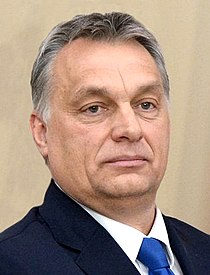


The controversial Hungarian Prime Minister has become one of the most talked about political leaders in Europe. Media likes to describe him as "Soft Eurosceptic". On some issues he is not so soft: he leads the anti-Ukrainian campaign in NATO and the EU on account of the alleged discrimination against Hungarian speakers in the Carpathian region of Ukraine. Orban leads the Eastern European opposition to the mass influx of illegal migrants from the Middle East, Africa and other Third World countries. His opposition to EU immigration policies, widely condemned by most Western countries, is based on his vision of security and cultural balance inside Hungary.
Orban is largely supported in Slovakia, the Czech Republic, Poland and by some populist parties in Western Europe.

Born in 1963, Viktor Orban transformed himself from a young communist at the age of 15 to an established conservative leader of his country. He maintains a balance between Hungary's membership in NATO and the EU with good relations with Moscow. Also, in spite of some accusations of antisemitism, Orban became the first European leader to officially visit and pray at the Western wall in contravention of long standing EU policy that considers this part of Jerusalem occupied territory.

--o--

BRIEFLY NOTED


RUSSIA


The unpopular pension reform that was cleverly introduced without too much fanfare during the World Cup of Football has now triggered mass demonstrations in Russia cities. The protests are led by the Communist Party and other left wing political organizations that are coming back from political oblivion by riding the wave of current rallies. The Russian government, bearing in mind historical precedents in the country, takes such demonstrations seriously. It was therefore decided to re-work certain provisions of the reform and to delay the vote in Parliament.

UKRAINE


According to sources in Minsk where the contact group on Donbass conflict had an emergency meeting there is a planned exchange of political prisoners between Russia and Ukraine slated for August 2018. This means that Oleg Sentsov, the Ukrainian film director who was sentenced by a Russian court to 20 years for "terrorist activities" and whose release was demanded by many across the world finally could be freed.

RUSSIA-SYRIA 


Meeting in the Russian Black Sea resort of Sochi, representatives of Russia, Iran, and Turkey have kicked off two days of talks on issues related to the war in Syria. The gathering comes as Turkey announced on July 29 that it is planning to hold a summit with France, Germany, and Russia in early September to discuss the Syrian conflict and other regional issues. The Russian delegation in Sochi is headed by the Kremlin's special envoy for Syria, Aleksandr Lavrentyev. Iranian Deputy Foreign Minister Hossein Ansari and his Turkish counterpart, Sedat Onal, were also expected to attend, along with the UN special envoy for Syria, Staffan de Mistura, and representatives of Syrian President Bashar al-Assad’s government.

ARMENIA


Former ex-president Kocharyan was detained in Yerevan on charges of bribery and money laundering. This announcement comes amid large scare anti-corruption measures by the new Government of Nikol Pashinyan, that came to power on the wave of mass street demonstrations. Scores of current and former Armenian politicians were recently purged or arrested on various corruption and abuse of power charges.

KAZAKHSTAN-KYRGYZSTAN 


Kazakh Defense Minister Saken Zhasuzaqov traveled to Bishkek on July 25, making the first official visit by a Kazakh defense chief to Kyrgyzstan since the two Central Asian nations gained independence in the 1991 after the collapse of the Soviet Union.
Zhasuzaqov's talks with the chief of the Kyrgyz armed forces' General Staff, Raiymberdi Duishenbiev, focused on regional security and military cooperation, the Kyrgyz military said. An agreement on military intelligence cooperation was signed after the talks.
The two countries are members of the Collective Security Treaty Organization (CSTO) along with Russia, Armenia, Belarus, and Tajikistan.

SOUTH OSSETIA

Syrian President Bashar al-Assad has met with the visiting head of the Georgian breakaway region of South Ossetia on July 23rd, two months after Damascus become one of only a handful of countries to recognize the region's declared independence.

Assad's office revealed that Anatoly Bibilov, the de facto president of South Ossetia, was in Syria on a three-day visit. Assad thanked him for backing his government in its seven-year civil war against various rebels and for recognizing Syria's "sovereignty" and "unity." Venezuela, Nicaragua, and the Pacific island of Nauru are the only other states that have also recognized Abkhazia and South Ossetia as independent states.


--o--

THE AUTHORS

Ilya Gerol, former foreign editor of the Citizen in Ottawa, syndicated columnist in Canadian, US and European media specializing in international affairs. His particular area of expertise includes Russia, Eurasian Economic Union, Eastern and Central Europe.  Ilya Gerol has written several books, one of them, The Manipulators, had become a textbook on relations of media and society.

During his career in the Canadian Foreign Service, Gilles Breton had three assignments at the Canadian Embassy in Moscow. His first posting there began during the Soviet period, in 1983. His last was from 2008 to 2012 as Minister-Counsellor and Deputy Head of Mission. He also served as Deputy Director responsible for Canada’s relations with Russia from 2000 to 2008. As an international civil servant, he was Deputy Director of the OSCE Office for Democratic Institutions and Human Rights in Warsaw from 1994 to 1997.


Friday, June 29, 2018

Issue 20

THE BRETON/GEROL NEWSLETTER


SEASON OF THE SUMMITS : AFTER CHARLEVOIX, FROM SINGAPORE TO HELSINKI THROUGH BRUSSELS


President Trump arriving at the G7 Summit in Charlevoix, June 8th
©Facebook
President Trump is scheduled to attend the NATO summit on July 12th. On the occasion he is bound to encounter serious disagreements with US allies from old Europe. The main difficulty is the financial contribution of other member states along with the growing US unwillingness to pay the lion's share of the organisation’s budget. New tensions may arise if Trump insists on member states fulfilling their financial obligations by contributing 2% of their budgets to defense. Immediately after the NATO meeting Trump will fly to Helsinki where he will sit down with Vladimir Putin. It will be the first official summit of the two leaders. They previously met only briefly on the sidelines of various conferences. The major topics of discussion will range from restoration of nuclear restraint, the Syrian situation and the conflict in Ukraine as well as the overall improvement in relations between old Cold War foes.

Any possible improvement in relations between the two nuclear super-states is a positive step. However, due to a lot of skepticism or outright opposition to such overtures from the American political establishment and key American allies, primarily Great Britain, Poland and the Baltic States, not to mention Ukraine itself, it is hard to foresee a breakthrough. This is not easy to admit, but, as for the US political establishment, it was rather astute on Trump’s part to have his meeting with Putin arranged by John Bolton, the one US Republican politician who could have otherwise been the most critical of such a move. 

Ultimately, one thing is clear: in the geopolitical sense if we are to overcome this chaotic period and lay foundations for conflict resolution in the Middle East and Eastern Ukraine, participation of both Moscow and Washington and productive interaction between them is needed.

On the specific issue of Syria, the question whether there is much left to discuss is worth asking. The Syrian government is slowly, but surely, regaining control of its territory, one region at a time. Some Arab commentators have even already observed that the US is abandoning its Syrian opposition allies. Syria in itself may no longer be the real issue, but it provides a useful cover to discuss the security concerns of Israel as well as the concerns about Turkey and its recently re-elected President. Iran was not mentioned by the US president in his first comments about the upcoming summit. For Trump himself, it might not be such an enticing prospect to discuss the Iran nuclear deal, that he just denounced, with one of its steadfast supporters.

Another issue of utmost importance for the agenda will be an attempt to craft some sort of cyberwarfare "rules of the road", or at least a truce, considering the stakes involved. While there is no doubt that Russian actors tried to interfere in the 2016 US presidential election, the US also has incredible cyberwarfare and information warfare capabilities that could create havoc across the globe. There is little doubt that the next major conflict will start in cyberspace. The US and Russia must begin to work together to draft an agreement, one that hopefully virtually all other nations can support, that limits hostile state actions in cyberspace.

No government should attack another nation’s election system, banking, infrastructure, hospitals or other critical systems that depend on the Internet. Just one false move, either by accident or on purpose, could spark a crisis where lives could be placed in harm’s way, and lead to a shooting war. In the worst case scenario this could escalate to nuclear conflict. The fundamental problem has been, however, that in the absence of a minimum of mutual trust, neither side is in a position to begin sharing information about what it knows and what it can do. 


As in traditional arms control negotiation, it may well be necessary to initiate the process through confidence-building measures. 

--o--

CURB YOUR ENTHUSIASM

The euphoria of the Singapore summit between Donald Trump and the North Korean leader who is often referred to by his people as  "Yŏngmyŏng-han Tongji" (영명한 동지), which loosely translates to "Brilliant Comrade" is fading. Aside from blowing up two nuclear testing sites and some underground facilities, the North so far has not disclosed locations of other key sites and has not even begun returning remains of American servicemen killed during the Korean War. Moreover, according to a recent Wall Street Journal report, satellite imagery shows that North Korea began upgrading its main nuclear research center and adjacent site. Meanwhile Kim visited Beijing to update Chairman Xi Jinping on the results of the Singapore summit. China, not waiting for international sanctions against North Korea to be lifted, has resumed purchase of Korean coal and eased certain food deliveries to its peculiar neighbor. 


Just as it was emphasized by more knowledgeable commentators, not prone to sensationalism, it will be a long process with many ups and downs before the two main objectives of denuclearization and a formal peace treaty between both Koreans can be achieved. 


Presidents Kim Jong-un and Trump, Singapore, June 12th
©Facebook


--o--

STRUGGLING ALLIANCES IN THE AGE OF TRUMP


G8 leaders in Charlevoix, June 8th
©Facebook

The established system of high-level consultations, such as the G7 (formerly G8) and G-20, political military alliances such as NATO, international treaties such as NAFTA and other multilateral and bilateral free trade agreements, and finally the WTO, all of them, looked unassailable not so not long ago.  They now begin to look shaky and vulnerable. It is easy and fashionable to lay blame at the feet of Donald Trump. After all he is erratic, unpredictable, not very knowledgeable and has questionable advisers around him. The situation is by far more complicated than that. Trump continues to find support among a sizable part of the American electorate, his own party and some in Europe (particularly in the Central and Eastern part of the continent). Newly elected populist and right of center governments in several European countries share a similar view of the world order with Donald Trump, especially when it comes to immigration and anti-globalism in the economic sphere.

Relations with Russia have also become a divisive point in the Western alliance. When in Quebec for the G7 Summit, Trump suddenly expressed his support for re-inviting Russia back to the G7, making it again the G8. Only Italy did not object. Privately however France and Germany are looking for an opportunity to make this possible, provided there is some real progress in the Ukrainian conflict.

Canada, under PM Justin Trudeau, lost the ability to see nuances in the complex world of international politics, banking solely on its uncompromising support for Ukraine and ignoring certain elements of realpolitik and geopolitical realities. This makes current Canadian stand within the G-7 smack of provincialism. If you add to this the unfolding economic drama between Canada and US where Canada holds a much weaker hand and faces some tough choices ahead, one is inclined to think that things will most likely get even worse before they get better. As for the future of the Western alliance, at least in the short term, it looks bleak. 


--o--

OLD AGE IS NOT JOY (OLD RUSSIAN SAYING)


The age at which Russian residents can receive a government old age pension is one of the few things that have not changed since Soviet times. Men can still retire at 60, women at 55. The government has now proposed to raise the pension age progressively, beginning in 2019, to bring it to 65 for men by 2028 and 63 for women by 2034.


Government authorities are well aware of the unpopularity of such a change. Canadians will recall that one of the measures taken by the new Trudeau government in 2016 was to cancel the Harper government decision to raise the pension age from 65 to 67. In Canada, the idea of raising the pension age was not overly popular, but it did not create the same level of controversy and debate as the current Russian government proposal. President Putin himself is confronted with his own 2005 statement that he would not countenance a change in pension age. The statement was made at a time when the Russian government was going through the also unpopular process of monetizing some of the social benefits that were a legacy of Soviet practices.

Government pensions are one of the most difficult issues left over from Soviet times and one around which there has probably been the greatest popular resentment. Soviet-era pensions were relatively generous. Nowadays, more important than the occasional delays in payment, the main problem is that the value of the pension itself, for a person retiring at this time, no longer corresponds to the income that could allow a person to live comfortably. Yet, it is still a considerable burden for the state as there is no dedicated pension fund from which to draw. Touching an acquis social such as early age for retirement is not only controversial for the fact that it affects a fundamental right of the worker. In a country where life expectancy overall has grown but still is at 71.6, the argument is being made that a large proportion of men whose life expectancy is lower than that of women would never receive a pension. The counter argument is that life expectancy is on the rise and that the expectation is that Russia is well on its way to catch up. That is the justification for raising the pension age to the accepted international level in order to protect the long-term viability of the system.

The government is trying to sell its proposal by offering assurances that pension amounts will continue to grow significantly in coming years. It also is taking measures to protect the pension system by modernizing it and by making it more similar to pension systems in the rest of the industrial world. This being said, the issue will be remaining at the top of the political agenda for the foreseeable future.


--o--


GAS GUZZLERS


Along with Saudi Arabia and the US, Russia is, year in year out, one of the three largest oil producers. The government recently announced two measures that are related to oil production and consumption. The first part of the plan is a so-called fiscal maneuver that will change the structure of taxation for the oil industry. The rather complex exercise is intended to bring substantially more revenue to the government, facilitate modernisation of the industry as well as promote exports. It also incidentally is intended to help companies that have been subjected to Western sanctions. The whole matter is, however, still the subject of negotiations between the government and oil sector companies.

The second part of the plan is to reduce excise taxes on fuel, creating a budget shortfall of approximately USD$2.2 billion, in order to ensure the stability of gasoline prices on the retail market, a matter of some serious concern since the beginning of 2018. The intent of this second measure is to appease consumers. It may however be seen as encouraging the consumption of more fossil fuels.

--o--

OUT OF UKRAINE ISSUES


The stalemate in the conflict between Kyiv and its Eastern rebel regions means not only that the issue ends to drop from world attention. It also means that the discussion in Ukraine and in Russia tends to shift to issues that are not necessarily central to the conflict, but have large symbolic value. The completion of the bridge linking Crimea to the Russian mainland comes to mind. One could understand that this engineering achievement would receive considerable attention in Russia and would be greeted there with suitable satisfaction. In Ukraine, the news was received with more resignation than anger and soon became the subject of mockery directed at the public figures who had stated that the construction of such a bridge was impossible.

The Crimean Bridge
© Preisent of Russia Website


On an issue that has little to do with the Ukraine-Russia conflict, there were in Ukraine many doubters about the capacity for Russia to host successful Football World Cup events. The idea that Russia might fail at this would have comforted those who tend to view that anything that is good for Russia must be bad for Ukraine, and that the reverse is also true. There were even rumours that Ukraine may take advantage of the Russian leadership being focussed on entertaining a large number of foreign guests to launch a new government-led military offensive in Eastern Ukraine. Although there was increased activity on the front line, no new significant military action was undertaken. There was in fact renewed diplomatic activity. We now even have yet another ceasefire agreement set to begin on July 1st.

We had noted before that there were rumours of frequent phone calls between Presidents Poroshenko and Putin. Through their web sites, the two presidents acknowledged that they indeed spoke by phone on June 21st. The focus of the conversation seems to have been on the issue of political prisoners detained by both sides. The lack of success of the discussion was confirmed by Poroshenko immediately thereafter, as he ordered sanctions against most Russian political parties.
With the announcement of a Putin-Trump summit in July, and Trump saying that Ukraine will be on the agenda, Ukrainian authorities may experience some trepidation. Having seen what happened in the US-North Korea discussions and having heard the rumour that Trump told his G7 counterparts in Charlevoix that “Crimea is Russian because everyone who lives there speaks Russian”, there may indeed be some cause for concern on their part.

Of note for Canadians, the Putin-Trump summit removes another leader from the short list of heads of government who are not in direct contact with Vladimir Putin: Theresa May and Justin Trudeau are the ones left. Despite the recent silence about the Skrypal affair, the matter still justifies May’s reluctance. As for the Poroshenko-Putin phone call, it would seem to undermine the Ukrainian rationale for asking Canada not to engage with Russia.

--o--

THE WORLD CUP IN RUSSIA, SPORT BUT NOT ONLY

So far the Russians have excelled in organizing this World Cup. The logistics were not trivial: 11 cities, some 3,000 kilometers apart, covering 3 time zones, and hundreds of thousands of tourists from all corners of the world. Security, safety and services, according to participants and journalists, have been top notch as well. Previously feared Russian soccer hooligans are also kept in check. Many British soccer fans, on the advice of their Foreign Service, decided to not to go, but those who went have experienced a warm welcome at the sites where England played. Many Russians even cheered for the English team. 


This World Cup also has helped Russia conduct some very important diplomatic activities. Putin was seen at his VIP box with the likes of Crown Prince Salman of Saudi Arabia, President of Azerbaijan Aliev and newly elected PM of Armenia Pashinyan. In fact Putin managed to bring Aliev and Pashinyan together for a handshake during a game in an attempt re-start the negotiation about the endless conflict over Nagorno-Karabakh. Putin also extended an  invitation to Netanyahu and Mahmoud Abbas. Netanyahu has yet to accept, but Abbas already confirmed his attendance. There is little doubt that a lot of less visible yet significant meetings are taking place on the sidelines of this tournament.

--o--


PERSON OF THE MONTH: MOHAMMAD BIN SALMAN BIN ABDULAZIZ AL SAUD


©Wikipedia
The 32-year old Crown Prince Salman of Saudi Arabia has introduced several revolutionary reforms in his conservative kingdom: legalizing rights of women to drive, female concert performances, hiring women in civil service, including the police force. He also significantly restricted the powers of the religious police, also known as vice squads. On the international scene he directly confronted Iran for its involvement in Yemen's civil war and together with Israel strongly lobbied president Trump to withdraw from the Iranian nuclear deal, going as far as to say that if Iran will be allowed to move towards nuclear weapons, Saudis will do the same. In fact Prince Salman almost makes no secret of his strategic alliance with Israel in its confrontation with Iran. He twice hosted in Riyadh Yossi Cohen, the head of the Mossad (Israeli Intelligence Agency) and other Israeli security officials. Recently it has been rumored that Bin Salman secretly met with Israeli PM Netanyahu. In a surprise visit to the World Cup in Moscow for the opening game between Russia and Saudi Arabia, he stoically and with humor endured the Russian thrashing of his team (final score was 5-0 for Russia), while discussing oil business, Iran and Syria with Vladimir Putin. 

--o--

BRIEFLY NOTED


ARMENIA


Prime Minister Nikol Pashinyan unleashed an unprecedented anti-corruption campaign. His security forces have arrested Manvel Grigoryan, the previously untouchable Defense Minister and several other key bureaucrats and relatives of former Prime Minister Serzh Sargsyan.

This is only the beginning as indictments are being prepared against the mayor of Yerevan (who happens to be the son of the arrested defense minister) and scores of others.

TURKMENISTAN


Turkmenistan introduced tough new austerity measures: food rationing, currency exchange control and limiting electricity use by private citizens. The reason for such draconian measures is the ongoing financial crisis affecting such mega projects as new pipelines and construction of southbound roads.

BELARUS


President Lukashenko met with EU representatives to announce that his country was ready for political reforms that could bring Minsk closer to the standards of European Union. He also stated that Belarus would not object to Ukraine joining NATO in the future, an unusual view for a close Russian ally

GEORGIA


A Georgian court sentenced in absentia former President Mikheil Saakashvili to 6 year imprisonment for abuse of power. It is believed that the real objective of Georgian authorities was to prevent the eccentric, yet popular politician from returning to his native country. He is currently residing in the Netherlands, but is still actively involved in political controversy in both Georgia and Ukraine.

UZBEKISTAN


Uzbekistan has emphasized its readiness to host direct peace talks between the government of neighboring Afghanistan and the Taliban, after both sides announced a cease-fire for the Eid al-Fitr holiday. Although the Taliban withdrew from the ceasefire itself, the negotiations in Tashkent are ongoing. The Foreign Ministry of Uzbekistan confirms its full readiness to create, at any stage of the peace process, all the necessary conditions for setting up direct talks between the government of Afghanistan and the Taliban. The former Soviet republic is seeking to raise its international profile as part of President Shavkat Mirziyoyev’s campaign to open up the nation of 32 million after decades of isolation.

NORTH MACEDONIA 

The Macedonian and Greek parliaments ratified a long-awaited agreement to re-name the Former Yugoslav Republic of Macedonia as North Macedonia. Since the collapse of Yugoslavia, Greece refused to recognize independent Macedonia because it claimed for one of its regions the historic name of Macedonia. After years of tortuous negotiations both sides reached a compromise that culminated in the country of Macedonia renaming itself to North Macedonia. However, the President of Macedonia has refused, so far, to ratify the name change.


THE AUTHORS

Ilya Gerol, former foreign editor of the Citizen in Ottawa, syndicated columnist in Canadian, US and European media specializing in international affairs. His particular area of expertise includes Russia, Eurasian Economic Union, Eastern and Central Europe.  Ilya Gerol has written several books, one of them, The Manipulators, had become a textbook on relations of media and society.

During his career in the Canadian Foreign Service, Gilles Breton had three assignments at the Canadian Embassy in Moscow. His first posting there began during the Soviet period, in 1983. His last was from 2008 to 2012 as Minister-Counsellor and Deputy Head of Mission. He also served as Deputy Director responsible for Canada’s relations with Russia from 2000 to 2008. As an international civil servant, he was Deputy Director of the OSCE Office for Democratic Institutions and Human Rights in Warsaw from 1994 to 1997.


Thursday, May 31, 2018

Issue 19

THE BRETON/GEROLNEWSLETTER


THE WINDOW ON THE WEST, BUT NOT ONLY


President Putin, Plenary Session of SPIEF, May 25th
© President of Russia Website

St. Petersburg is the city that Peter the Great built to give Russia a window to Europe. Nowaday the leaders of the city are adding a slightly different political touch to reflect their current mood: St. Petersburg was built to counter the European powers that wanted to restrain Russia and keep it a lesser kingdom without ready maritime access to the rest of Europe. President Putin himself did not go as far in his remarks and there was more self-confidence than defiance in his approach to this year’s late May St. Petersburg International Economic Forum (SPIEF). The moderators of the main plenary session noted that it looked as though Donald Trump had managed to get people together that would not normally meet on one open stage: Putin was hosting French President Macron, Japanese Prime Minister Abe, Chinese Vice President Wang Qishan as well as the Director General of the International Monetary Fund Christine Lagarde. Putin may have found the remark about Trump amusing, but would probably take the credit himself for bringing together in his home town  all that want to do business with Russia, thus comforting his own position in the world even in the company of some that have taken sanctions against Russia.

For a North American visitor the most striking thing at the SPIEF was probably the impression of onset of acute schizophrenia. The conversation in St. Petersburg was truly a world away from the issues that daily give Russia a bad press in Western Europe and North America. It was about how to engage Russia politically and economically. The attempt to belittle the significance of the consensus by suggesting it did not come together as a formal alliance misses the point: despite the serious disagreements over specific issues world leaders minus two maybe three are comfortable engaging in a political dialogue with Russia. Business leaders from virtually everywhere are keen to do business with Russia, including even those from the US, the UK or Canada whose leaders are not politically engaged with Russia at this time. The convergence of interests is perfectly sufficient in itself and does not need a formal instrument.

There was of course some discussion about sanctions against Russia. The only practical recommendation was that business interests in the US should lobby their government to review its position, in view of the fact that sanctions are disruptive, but do not achieve any of their announced goals. As for sanctions that target individual oligarchs allegedly belonging to Putin’s inner circle, the response is clear: Russia will protect its enterprises, oligarchs are on their own. From all appearances oligarchs will manage to survive one way or another, as Roman Abramovich’s timely acquisition of Israeli citizenship to counter British measures against him just shows.

SPIEF serves as a platform for discussing economic issues, delivering economic messages and for promoting economic cooperation in the form of investment and trade. In addition to the above-mentioned confidence displayed by President Putin, the other overall message was one of optimism, coming from the record number of attendants at this year Forum, over 17,000.

Not unexpectedly, this was also the time for Russia to receive very good marks from international observers, including from the IMF, for its macroeconomic management in the current difficult environment: Russia’s budgetary stance has been rigorous, its financial position is sound with good reserves and low liabilities. Furthermore, the economic consensus on which the president has based the orientation that he has given to the new government is that the focus for the next few years should be on investing in infrastructure. A few months ago the concern was that the funding for infrastructures investment might be difficult to generate. The conjuncture has changed: the recent rise in the price of oil is creating an unexpected surplus that the government is already setting aside precisely for infrastructure needs.

All in all, for Russia and for Putin himself, the event was a success. For a native of Russia’s Northern Capital, things could hardly have been better: the city of St. Petersburg came first on the annual Russian Regional Investment Climate Index competition.

JOURNALISM AND JOURNALISTS, AS VICTIMS OF WAR: UKRAINE UPDATE


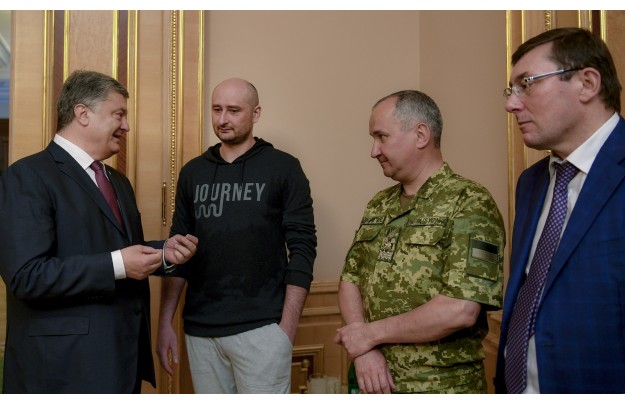
President Poroshenko, Arkady Babchenko, Security Service Head Hrytsak, Prosecutor General Lutsenko
Kyiv, May 30th
©President of Ukraine Website

The May 29th staged contract killing of Russian journalist Arkady Babchenko will most likely not win Kyiv any new friends. It may even lose some old friends for having resorted to an extreme tactic to procure the arrest of the single individual that is alleged to have received an advance payment for the killing of Babchenko. The day after Kyiv even drew sharp criticism from the OSCE and Reporters Without Borders for manipulation of information.

As expected, Kyiv will continue to blame Moscow for the whole incident, but by playing a game Kyiv has damaged its own credibility. Babchenko apparently did not tell his wife about the sting operation. One can speculate that she may not be the only one to have been kept in the dark about the plans for smoking out a Russian agent. As for Moscow, it initially called the whole affair idiotic, but reacted relatively calmly in the circumstances. Ultimately, it is difficult to believe that the operation was the only way to save Babchenko’s life and to arrest the potential killer.

Truth is often noted as the first casualty of war. Journalists are not far behind. Ukraine and Russia continue to arrest, detain and prosecute journalists and various artists from opposing sides. Kirill Vyshinsky, the chief RIA (Russian press agency) representative in Kyiv was arrested and charged with espionage while Ukrainian film producer Alexei Sentsov was sentenced by a Russian court to 20 years in prison on terrorism charges. Human rights organizations accuse Russian and Ukraine of what they call "hostage taking" in order to facilitate potential prisoner exchanges.

News stories can indeed have a major impact. The news that President Poroshenko seems to have arranged for the payment of somewhere around $400,000 to secure a longer meeting with President Trump during his June 2017 visit to Washington did more damage to Poroshenko’s reputation than any of the accusations leveled by his erstwhile ally Mikheil Saakashvili. The latter, in his usual egocentric manner, is now calling for Europe to take sanctions against Poroshenko for having violated his human rights. In any event, short of a war or some cataclysmic political development, Poroshenko is now firmly on track to join the group of former presidents of Ukraine. Rumours abound that he may be focusing on comforting his financial position as an oligarch, that of which Saakashvili has been accusing him for a while.

In the meantime, the war in Eastern Ukraine is acquiring all the features of a frozen conflict. In the absence of any solution in Ukraine itself, many Ukrainians seem to see some hope in the activity of Kurt Volker, the US Special Representative for Ukraine. This does not take into account that Volker as a hardliner on Ukraine seems to be in his current position mostly to show that President Trump is not under Russian influence. Real concern for Ukraine itself does not seem to be on Trump’s mind. A solution to the conflict is unlikely to come from Washington.

There are also rumours that, in a country where oligarchs have been calling the shots, some oligarchs may be considering re-aligning their interest with those of Moscow. One should not forget that Babchenko’s enemies may not only be in Moscow.


KOREAN ROLLER-COASTER


Presidents Kim Jung-un and Moon Jae-in
April 26th, Panmunjom


President Trump changed his views and expectations for his historic meeting with North Korean leader Kim Jong Un several times. In the beginning it was a traditional assortment of adjectives "brilliant", "excellent" and "tremendous". Suddenly it has changed to different definitions: "threatening", "insulting" and "rude". This was followed by a threat to use the immense American nuclear arsenal if things do not work diplomatically. Finally, all the accessories of a traditional business deal have been used in full, and the June 12 summit in Singapore is back on the agenda with teams from both countries hurriedly working on its planning. South Korean president Moon should be credited with putting June 12th meeting back on track by staying in touch with both sides while explaining to Trump, who evidently lacks in-depth understanding of North Korea and its psychology, the intricacies of Korean negotiating tactics.

According to South Korean sources, Kim Jung Un will agree to the main demand by the American president to fully denuclearize his country, under the formula of denuclearization of the whole Peninsula.

Most experts agree that the most challenging aspect of any future deal will the realistic verification of North Korean compliance.

Nobody needs this deal more than Kim. He promised his people to improve their desperate living conditions, improve the overall economy and the food supply. In order to introduce something similar to the Chinese-style reforms he has to deliver a diplomatic victory, as only the US, South Korea and Japan can be of real assistance.


THE KAZAKHSTAN MODEL


President Nazerbayev, May 17, Astana
Facebook


Kazakhstan does not often make headlines in international news, but its positive role and influence deserve mention.

Kazakhstan is a country with a Muslim majority population, but with a secular form of governance. Since it became independent in 1991, it has had only one president. Nursultan Nazerbayev has, however, managed to address the multiple challenges of a post-Soviet state in a manner that has earned him a relatively enviable reputation.  An illustration of his style of management and openness to the outside world is the convening every year of the Astana Economic Forum (now called the Global Challenges Conference).

Kazakhstan has also endeavoured to play a positive role in international affairs. Astana continues to host representatives of Syrian political and economic sectors plus delegations from Russia, Iran and Turkey in the search of a peaceful solution to the ongoing Syrian civil war, now in its 7th year. The US is not taking part in this 9th round of negotiations. Parallel UN-sponsored talks are going on in Geneva as well.

Kazakhstan has announced its new regional doctrine aimed at improving relations with all Central Asian countries in order to counter the powerful economic influence of China in the region. In this respect, the recent liberalisation efforts of the new President of neighbouring Uzbekistan are especially good news for Kazakhstan. Considering that Kazakhstan shares one of the longest borders in the world with China, Astana fears that the powerful economic sway of China could eventually lead to unpredictable political changes not exactly favorable to the political aspirations of Kazakhstan and of Russia, its other major neighbour and its associate in the Eurasian Economic Union. For many historical reasons, a more concerted approach among Central Asian countries has been difficult to generate. With the more open approach emerging in Uzbekistan, positive developments may be around the corner.

IRAN AND EURASIAN UNION


The new reformist government in Armenia confirmed its adherence to the Eurasian Economic Union. As Iran faces the threat of new, harsher economic sanctions and limitations by the United States, it looks at its border with Armenia border as a promising gateway for its products into Eurasian markets. Though not in the headlines of world events a conference is taking place in Yerevan with the participation of the Iranian business community and officials of the Eurasian Economic Union. One of the most significant issues discussed is a joint investment project for the restoration of the railway link from Armenia to Russia via Georgia. The implementation of this project would substantially increase the trade volume between Iran and Eurasian countries. In addition, on May 17 in Astana, on the margins of the Astana Global Challenges Conference, Iran had signed a provisional free trade zone agreement with the Eurasian Economic Union.

US MOVE AGAINST IRAN STRAINS THE TRANSATLANTIC ALLIANCE


President Trump and the Iran Executive Order, May 9


At the St. Petersburg Economic Forum, French President Macron said it better than anybody else. The only reason why Trump got out of the Iran deal is because it was concluded under Barack Obama’s presidency. There is nothing wrong with the deal itself. Secretary of State Pompeo’s recent demands to Iran regarding ballistic missiles, support to Hezbollah or military presence in Syria were not part of the original discussion.

Not since the 2003 controversial US invasion of Iraq the unity of Western allies was subjected to such a strain. This time however the rift is much more pronounced and the consequences maybe more serious than 15 years ago. The European reaction could summarized in the stern words of French foreign minister who said: "We are allies not vassals". Paris, London and Berlin would like you stay within the framework of the Iran treaty if some aspects like the Iranian ballistic missile program and the nuclear breakout timing could be re-negotiated. Moscow and Beijing are against any changes in the agreement.

What makes European position vulnerable, and Americans new that very well in advance, is that major European companies like Total, BP and Airbus go where the money is. That is why they have quickly announced cancellation of their multi-billion dollar projects with Iran not risking the wrath of American sanctions. In this situation European leaders are trying somewhat to stabilize their relations with Russia. Angela Merkel met Putin in Sochi in early May. Macron flew to St. Petersburg for the International Economic Forum where he held prolonged in-depth talks with the Russian President.  

President Trump openly disregards feeble European attempts to save the Iranian deal. In the short term Trump is having his way, but a long term prognosis may spell serious decline of the Western alliance that has dominated international politics for over seven decades.


PERSON OF THE MONTH: ANTON SILUANOV


Anton Siluanov
© Roscongress

The 55 year old soft-spoken professional financier and economist, Anton Siluanov was appointed by President Putin to be First Deputy Prime Minister responsible for economic reforms. He remains Russia's Finance Minister as in the previous Medvedev's government. For all his professional life Siluanov has worked in various branches of the Ministry of Finance or associated entities. He could be defined as a modern, Russian technocrat who has developed and sharpened his skills in the post-Soviet reality. He is at the top of the class of well-educated and well-qualified group of relatively young professionals who have taken over the Ministry of Finance. They uphold the standards set by Alexei Kudrin when he led the Ministry from 2000 to 2011. At the recent St. Petersburg International Economic Forum, Christine Lagarde, Director General of the IMF, heaped praise on Siluanov as an exemplary Minister of Finance.

The next six years of this government in Russia will demonstrate if this statement was correct.

BRIEFLY NOTED


OPEC-RUSSIA

On May 25th, in St. Petersburg, Russian minister of energy Aleksandr Novak met his Saudi counterpart Khaled-Al Fateh. They discussed the best way of implementing the OPEC initiative to gradually raise oil production in order to ease consumer worries over higher oil prices world-wide. Ongoing tensions between US and Iran endanger the Iranian oil supplies to markets while pushing prices up. Currently a barrel of crude trades on the London exchange close to $ 80.

BULGARIA

Rumen Radev, President of Bulgaria asked Vladimir Putin to come back to the idea of a pipeline supplying this Balkan country with Russian natural gas. The very same Bulgarian administration turned down this idea two years ago out of solidarity with its NATO allies. This time the economic realities prevailed.

BELARUS

#MeToo comes to Belarus. Olga Korbut, a household name in Europe and beyond as a world famous Soviet-era gymnast, presently residing in Belarus, has accused her former coach of sexual assault dating to the time when she was 14 years old. Some of her teammates support her allegations and have accusations of their own. The coach denies the wrongdoing.

AZERBAIJAN


The gas pipeline between Azerbaijan and Turkey became operational and construction of an additional link to Southern Europe should be completed in two years. Potentially this pipeline from Shah-Denis natural gas deposits represents serious competition for Russia’s Gazprom.

GEORGIA


The Republic of Georgia cut off diplomatic relations with Syria right after Damascus had extended its recognition to the two breakaway regions of Abkhazia and South Ossetia that split from Georgia in the aftermath of brief 2008 Russia-Georgian war. From now on Syria and Russia are establishing direct trade lines from Syria to ports in Abkhazia as well as Crimea.

MOLDOVA


Moldova obtained a status of "observer" within the Eurasian Economic Union. This paves the way for Moldova to gain better access to Eurasian markets including especially Russia, Kazakhstan and Belarus.


THE AUTHORS

Ilya Gerol, former foreign editor of the Citizen in Ottawa, syndicated columnist in Canadian, US and European media specializing in international affairs. His particular area of expertise includes Russia, Eurasian Economic Union, Eastern and Central Europe.  Ilya Gerol has written several books, one of them, The Manipulators, had become a textbook on relations of media and society.

During his career in the Canadian Foreign Service, Gilles Breton had three assignments at the Canadian Embassy in Moscow. His first posting there began during the Soviet period, in 1983. His last was from 2008 to 2012 as Minister-Counsellor and Deputy Head of Mission. He also served as Deputy Director responsible for Canada’s relations with Russia from 2000 to 2008. As an international civil servant, he was Deputy Director of the OSCE Office for Democratic Institutions and Human Rights in Warsaw from 1994 to 1997.