Thursday, April 27, 2017

Issue 6


THE BRETON/GEROL NEWSLETTER


WHITE HOUSE 1, KREMLIN 0


Secretary of State Tillerson and Foreign Minister Lavrov, Moscow, April 11th,

If any Russian politician still harbored some remnants of hope that Donald Trump's ascendance would improve relations between US and Russia, that ended with Rex Tillerson’s April 11th visit to the Russian capital.

It is not the unusually chilly atmosphere of the posh mansion of the Russian Foreign Ministry reception house where the ministers held their meeting and in the Kremlin, where the Russian President, after a long hesitation, received Tillerson for a two-hour long discussion that will be remembered. It will rather be the fact that at no time did the parties show any serious will to compromise on main issues: Syria and Ukraine. It was confirmed by both Donald Trump and Vladimir Putin as well as by their foreign ministers that never before in modern history the relations between two leading nuclear powers were at such a dangerously low level. Even during the Cuban missile crisis (1962) President Kennedy and Russian leader Khrushchev looked for a compromise and finally found it. Today's ultimatum-like formula several times repeated by Rex Tillerson during his meetings at G-7 in Italy and in Moscow sounded far more threatening; "either you are with us or you are against us". Even more dangerous was the fact that Tillerson's formula was interpreted by Sergey Lavrov as a direct threat.

In many ways the Russian position was even more blunt and stubborn. Moscow continued to categorically deny any possibility that Assad's government used Sarin gas, despite strong evidence and some classified documents that were introduced by the American side such as intercepted conversations between Syrian military command and specialists on chemical weapons. Even China was convinced that Assad crossed the line. Consequently Beijing abstained during the vote at the UN Security Council condemning Syria (Russia used its veto for the 8th time during the last 6 years of the Syrian conflict).

A couple of positive points in the overall grim picture: both sides' realistic assessment that relations between those two nuclear heavy-weights cannot deteriorate any further, agreement to create working groups to determine the exact irritant points in the relationship, while Russia promptly restored the lines of communications between military commands in Syria.

Considering what Russia had hoped to gain by seeing Donald Trump as president, the result of the US State Secretary's visit and the overall anti-Russian tone of the Administration can be interpreted as a huge political setback for Putin's Russia. The unfolding crisis in the Korean peninsula only adds to that tendency.  

--o--

CASUALTIES OF A DIFFERENT ORDER


A crater is seen at the site of an airstrike, after what rescue workers described as a suspected gas attack in the town of Khan Sheikhoun in rebel-held Idlib, Syria April 4, 2017. © Ammar Abdullah / Reuters
US Ambassador Haley at the special meeting of the Security Council on Syria, April 5th, 2017

Western media and Western governments unreservedly attributed the responsibility for the April 4th use of chemical weapons in Khan Cheikhoun to Syrian government actors. Russia was later on mentioned as complicit, possibly. Contradicting statements from the President of Syria and the President of Russia followed. Since then the UN Independent International Commission of Inquiry on the Syrian Arab Republic has stated it could not come to a clear conclusion. The OPCW (Organisation for the Prohibition of Chemical Weapons) has stated that the results of the analysis of bio-medical samples of seven individuals by certified laboratories indicate that the victims were exposed to Sarin or a Sarin-like substance. On April 26th, French authorities claimed they had some evidence about the origin of the Sarin gas found on the scene of the April 4th incident and claimed it led directly to the Assad regime.The OPCW is however not yet sending its experts to Syria, to the chagrin of the Russian authorities. In other words, without receiving a lot of media attention, a vigorous diplomatic and technical debate is still going on.

Given the gravity of the accusations as well the outright denials by the leaders of Syria and Russia, a minimum of circumspection might have been expected before action is taken. In a case like this the international community might also have been expected to achieve a consensus over the need to seek a thorough examination of the facts.

Casualties related to the use of chemical weapons understandably carry a far greater emotional charge. Extreme indignation is a natural reaction. There are some problems with the reaction of the US President.

Trump said “that the video of children suffering from the chemical attack has changed very much his view of Syria and Assad”. Of all the evidence that has been produced thus far, the incriminating video turns out to be the one piece that raised the most questions, unlike the intelligence-based evidence that Secretary of State Tillerson brought to Moscow a week after the incident.

Furthermore, the military response, within 72 hours, was unusually quick for an event of this nature. As noted above, The French government only produced its evidence three weeks after the incident.

The response was spectacular: the early morning launch of cruise missiles was even described as beautiful by one senior US commentator.

The response was targeted, but altogether ineffective. The response, in the form of 59 Tomahawk cruise missiles, was clearly directed at the alleged perpetrators’ base, the Syrian Air Force facilities in Shayrat. It was even claimed by some senior US officer as having destroyed the means for Syria to deliver chemical weapons. Planes were, however, flying out of that base the day after the US attack. Ultimately, the military reaction, which was spun as the act of a decisive leader, was not even commensurate with the alleged level of indignation.

The US President’s decision in favour of a military response also contradicted his own previous September 2013 calls for President Obama not to attack Syria.

The indignation over the tragic incident in Khan Cheikhoun will taper off, as is always the case. Despite what Trump said, there will likely be no fundamental change to US policy in relation to the Syria conflict. There are too many other factors in play. We will be left with the confirmation that we have a US President who has a superficial and volatile understanding of world affairs, seems to make decisions on the basis of what he sees on television, and will do what makes him look like a strong leader.


--o--

HISTORY VS PSYCHIATRY

Kim Jung-un saluting participants of the military parade marking the 105th anniversary of his grand-father
Pyongyang, April 15th, 2017


Neglect or ignorance of history seems like an integral part of today's approach to key world events. There is some attraction in discussing the psychopathic behavior of Kim Jong-un; his Chaplinesque look and semi-idiotic smiles, for example. But to those who are familiar with the last year of the Korean War (1950-1953), the current situation is not unusual. Chairman Mao explained in his letter to Joseph Stalin the stubborn behavior of the besieged North Korean leader Kim Il-sung (the grandfather of current Kim): "he is obsessed by petty calculations rather than a strategic approach". At that time it took Mao some serious efforts to force Kim to the negotiating table. China even threatened to cut military aid leaving the North to its own destiny. As the result the armistice agreement was signed in Panmunjom (the Demilitarized Zone which still divides North and South Korea). The current Kim's "petty calculations" are part of the same pattern used by his grandfather: military threats used to secure concessions and economic aid from the West. This time however China has more to lose and it seems like it is applying unseen before political and economic pressure on its stubborn ally. This probably will be the best way to avoid all out war.   

--o--

UKRAINE:  ARE THERE OTHER PIECES TO THIS PUZZLE?
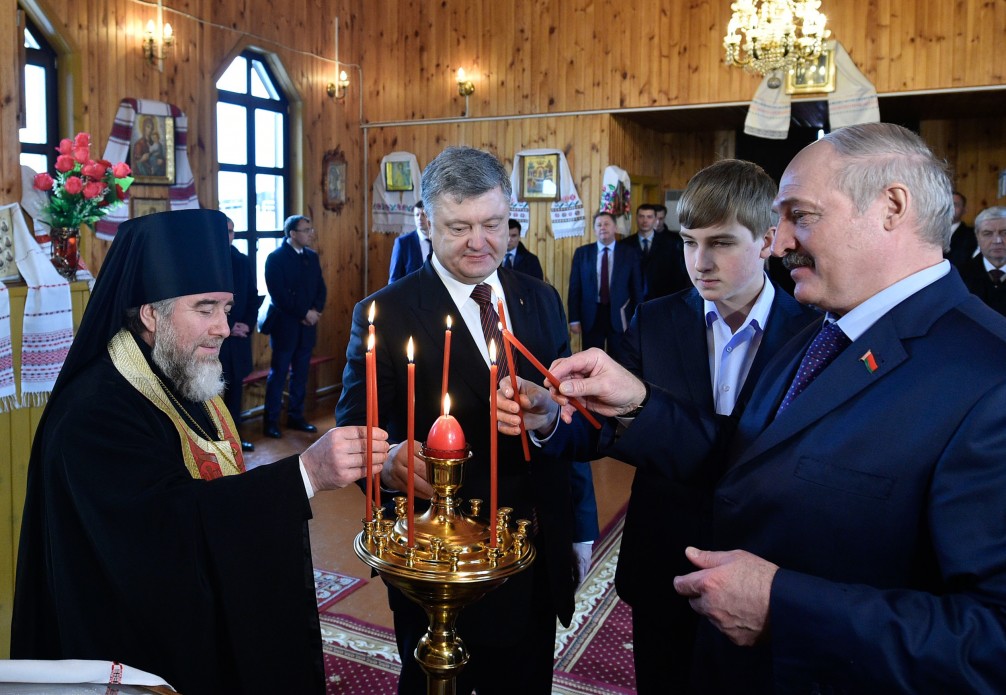

President Porosheko and Belarus President Lukashenko
Kyiv, April 26th, 2017
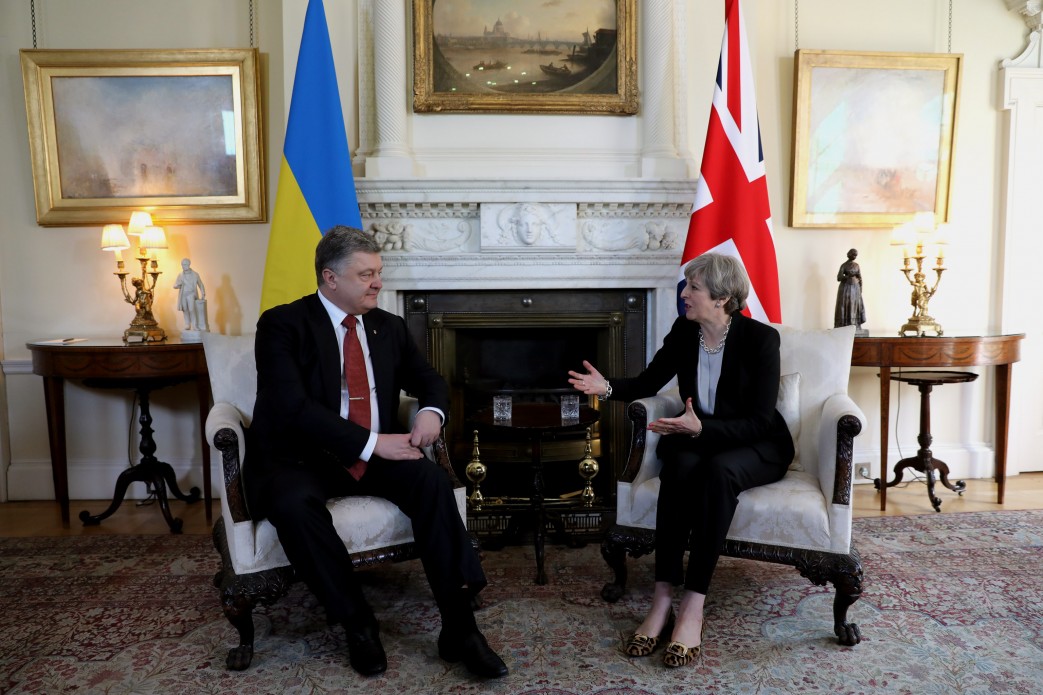
President Poroshenko and UK Prime Minister Theresa May
London, April 19th, 2017
Preisent Poroshenko and Danish Prime Minister Rasmussen
Copenhagen, April 5th, 2017
At the G-7 foreign ministers’ meeting in Italy on April 11, Secretary of State Rex Tillerson asked his counterparts: “Why should U.S. taxpayers be interested in Ukraine?” Later on, this was confirmed by his spokesperson, but described as a “rhetorical” question. A strong impression nevertheless remains. This would be one of the few cases where the Trump administration has been consistent with the Trump campaign’s “America first” mantra.

On April 25th, 2018 USAID budget proposals were made public. The budget for Ukraine would plummet from $570 million to $177 million.

Around April 21st, the rumour surfaced that the Trump administration might appoint a special envoy to communicate directly with Vladislav Surkov, President Putin’s point man on Ukraine. The idea would be to negotiate an end to the conflict in eastern Ukraine, a matter which has been the raison d’ĂȘtre of the “Normandy Four”(France, Germany, Russia and Ukraine) discussions, but in which the US has not been a direct participant.

The coincidence of the Trump administration disinterest in Ukraine and its interest in direct discussions with Moscow offers little to cheer about in Kyiv. This would explain why President Poroshenko has kept a very busy schedule of meeting with his European counterparts, ostensibly working to firm up the support for Ukraine among European allies and neighbours (including Belarus). 

There has now been on April 23rd a phone conversation between Tillerson and Poroshenko. For Poroshenko, the main objective was to set a date for his first meeting with Trump. This was also the occasion for Poroshenko to seek a reiteration of the “nothing on Ukraine without Ukraine” US policy, a reflection of the preoccupations in Kyiv about the approach of the Trump administration. In the immediate aftermath of the deadly incident involving a US member of the OSCE Special Monitoring Mission, he also took advantage of the moment to re-launch the idea of a UN Peacekeeping Mission for the Donbass.

In the meantime, on the ground in Eastern Ukraine the military stalemate is showing no signs of alteration. The economy and the infrastructure of the rebel regions are increasingly becoming more dependent on Russia. The indeterminate suspension of electrical power supplies to the insurgent-run area of the Lugansk region, as of April 25th, is the most recent example of this.

In all the above-noted existing or proposed conversations, it is difficult to find any sign of a possible political resolution of the conflict. Even the rumoured more regular direct conversations between Presidents Putin and Poroshenko do not seem to bring any result, other than preventing a worsening of the situation.

Whereas the UN Peacekeeping proposal would run the risk of freezing the conflict for many more years, it might be the way for the government in Kyiv to rein in the private militias and give the official army a greater role or, if nothing else, to create embarrassment  in Moscow. Russia has already made clear that peacekeeping arrangements would have to be agreed with the authorities in the rebel regions, an unlikely scenario as Kyiv remains unwilling to have direct exchanges with these authorities.

--o--

PERSONALITY OF THE MONTH

Emmanuel Macron, Facebook photograph
Though the second round of elections in France will take place on May 7th, it can already be stated with a great degree of probability: Emmanuel Macron will become the 5th Republic's 8th president. Of course it is not exactly the same 5th Republic envisioned by General Charles de Gaulle in 1958 when he introduced the most radical political reforms, but it is still a strong presidential system. 

For the first time since 1958 in France and first time ever in Europe voters decisively rejected both mainstream political parties (in France it was Socialists and Republicans) while catapulting two outsiders into the final round.

Emmanuel Macron, born in 1977, is an economist and former investment banker. Until he formed his political movement En Marche! a year ago, he never had political affiliations. At the same time, the outgoing Socialist president, Francois Hollande, publicly threw his support behind the candidacy of Macron going into the second round.

Emmanuel Macron is pro-EU, he supports cultural integration of immigrants and though not overtly against Russia is critical of Putin's steps in Syria and Ukraine.


It has to be noted that Jean-Luc Mélanchon the left-wing candidate and a practicing Marxist who surprisingly collected slightly more than 19 % of popular vote in the first round refused to endorse Macron against Le Pen mainly because his anti-EU stand is very much similar to Marine Le Pen's.

Nevertheless, barring some extraordinary events or cataclysms that are always possible, Macron has a chance to become a successful and a long term president of his currently polarized country.


--o--


BRIEFLY NOTED

KAZAKHSTAN-TURKMENISTAN

Kazakhstan President Nursultan Nazarbayev and Gurbanguly Berdymukhammedov, his Turkmenistan counterpart, have signed a strategic partnership treaty on April 18 in Astana, capital of Kazakhstan The treaty is designed to resolve long lasting border disputes between the two countries. In answering questions from the press, Nazarbayev declared that Kazakhstan and Turkmenistan will be the only two countries in Central Asia without border problems. The second phase of the negotiations will deal with agreements combating cross-border money laundering  and the financing of terrorist-related activities in the region. Altogether eight other documents are expected to be signed, including an information sharing treaty between branches of both countries' foreign ministries. 

KAZAKHSTAN

President Nazarbayev has publicly supported the long proclaimed desire of Kazakh intelligentsia and youth to switch the Kazakh language from the Cyrillic to the Latin alphabet. He has now instructed the government to initiate the move. In his article for Kazakh newspaper Egemen Kazakhstan, he outlined that now when all young people are familiar with English the switch would be more natural and beneficial to the country's future. The process will go on for a decade during which the Cyrillic alphabet will be in use as well.

TURKEY-RUSSIA

For the first time since the early 40s representatives of all Kurdish factions will assemble in Moscow. The meeting could be considered as semi-official. It has, however, already raised some eyebrows in Turkey: even the remote possibility of independent Kurdistan is considered by Ankara a national nightmare.

The increasing cooperation between Moscow strategists and Kurdish nationalists will undoubtedly become a serious issue preventing further improvement of relations between Turkey and Russia. Kurdish nationalist factions have begun to attract an array of rather contradictory forces: Russia, US, Israel, Europe and even China. The only player which finds itself excluded from that amalgamation is Turkey, the country that stands to lose the most should independent Kurdistan become a fact.

MONGOLIA

It was proudly announced in Ulaanbaatar, capital of Mongolia, that the country had launched its first satellite (Mongol Sat-1). For that land-locked country this satellite will improve its communication systems and bring it closer to the world community of nations.

RUSSIA

Sergey Lavrov, Russian Foreign Minister made a controversial visit to the breakaway republic of Abkhazia - one of the two enclaves that separated from Georgia and proclaimed independence in 2008 after a brief war between Russia and Georgia. This visit however was carried out with one intention in mind: to emphasize that while South Ossetia, the other enclave, will probably be soon incorporated into Russia, Abkhazia will remain quasi independent for the time being.

MOLDOVA

On April 3rd President Dodon signed a memorandum on cooperation between Moldova and the Eurasian Economic Union, effectively undermining further ties between his country and Brussels. It came with one condition attached: Moldova insisted that Russia would not extend recognition to the so-called Trans-Dniester republic, the enclave that split from Moldova in the early 1990's after the collapse of the USSR.


--o--

THE AUTHORS

Ilya Gerol, former foreign editor of the Citizen in Ottawa, syndicated columnist in Canadian, US and European media specializing in international affairs. His particular area of expertise includes Russia, Eurasian Economic Union, Eastern and Central Europe.  Ilya Gerol has written several books, one of them, The Manipulators, had become a textbook on relations of media and society.


During his career in the Canadian Foreign Service, Gilles Breton had three assignments at the Canadian Embassy  in Moscow. His first posting there began during the Soviet period, in 1983. His last was from 2008 to 2012 as Minister-Counsellor and Deputy Head of Mission. He also served as Deputy Director responsible for Canada’s relations with Russia from 2000 to 2008. As an international civil servant, he was Deputy Director of the OSCE Office for Democratic Institutions and Human Rights in Warsaw from 1994 to 1997.


Wednesday, March 29, 2017

Issue 5

THE BRETON/GEROL NEWSLETTER


BUSINESS AS USUAL


The Oval Office (Official White House Photo)
Trump's grand promises of fundamental changes to US foreign policy came to nothing but a poor imitation and rehashing of policies of his predecessors.

His pre-election criticism of NATO validity and role ended up in traditional praise of the alliance and promise of firm support and participation. Trump came to accept some token increase of expenditures by certain alliance members. In his statement in respect to the next NATO summit Trump said: "I am very enthusiastic about the alliance future".

His election campaign promises to radically improve American relations with Russia are turning out surprisingly empty. The relations between Washington and Moscow are even frostier than before. The reason of course is the enormous pressure from Congress and the US Intelligence community with regard to the ongoing investigation on possible Russian meddling in the American election process. Even the case of North Korea and its nuclear threat to the Southern part of peninsula and to Japan has been approached by the new administration along the lines worked out by Obama strategists, that includes computer sabotage of long-range launches - as it probably happened again on the 21st of March when a North Korean rocket exploded on takeoff.

Over critical statements towards China also had been replaced by more subdued "realpolitik". Secretary Rex Tillerson just completed a rather routine visit to Beijing while President Trump joyfully extended an invitation for the Chinese leader to visit Washington.

The biggest surprise to most political pundits is that Trump's foreign policy so far continues to be business as usual.

--o--

INCIDENTAL IGNORANCE

A very simple fact can become the subject of considerable obfuscation. A person phone is legally under surveillance will likely create a lot of incidental collection if he happens to communicate by phone with a large number of individuals who are not under surveillance. How long does it take a US President or US Congressman to understand that concept? Or are they pretending not to understand in order to create confusion and justify accusations of “tapping the lines”?

Unmasking the identity of an individual whose conversation was the subject of incidental collection is an exceptional process that can only be approved by very senior officials in the intercepting organisation. Anyone who eventually reads the report of that conversation can, however, come to an easy conclusion as to the likely identity of the masked interlocutor. In other words, many officials, not only at senior levels, will know who was saying what. The temptation to leak that information becomes even greater if you believe that it would serve the national interest and harm only one or two imprudent or ignorant individuals, whatever their elevated positions may be.

--o--


UKRAINE, GOOD OR BAD NEWS?

President Poroshenko with Ukrainian volunteers, March 14

Bad news can be useful, at times.  

The killing in broad daylight on March 23 in Kyiv of Denis Voronenkov, a former member of the Russian Duma and, on the same day, the fire that engulfed near Kharkov a significant part of the largest munitions depot in Europe were not such bad news for President Poroshenko. The first event he called an act of state terrorism on the part of Russia, the second an act of sabotage. Whatever the motive for the killing or the cause for the fire and until they become known (which is not likely soon), the two events can indeed be used by the President to support his policy of opposition to Russia. In a context where nationalist groups have recently denounced the régime in Kyiv, Poroshenko can use the occasion to present himself as the unifying rampart against Russia, the common enemy.

Good news are, however, not always good for you.

The blockade, since January, of coal shipments from Donbass to the rest of Ukraine has now turned into a complete cessation of commercial shipments between the two regions. This is good news for the nationalists who want nothing to do with the rebel regions. It is not good for the Ukrainian economy as a whole (the government has acknowledged this) or for the prospects of eventually bringing the country back together.

In response to pressure from nationalists who asked for the closure of Russian banks, the Security Council of Ukraine and the National Bank have introduced sanctions against the subsidiaries of five Russian banks operating in Ukraine. The sanctions essentially curtail the normal activities of the banks, for a year. Protesters have also physically blocked the access to several offices of the said banks. This leaves virtually no choice for the Russian banks but to dispose of their Ukrainian assets, if they can. The financial impact on the Russian banks does not seem to cause much alarm. The impact on the Ukrainian economy, that can little afford bad news, is unlikely to be positive. For President Poroshenko, the unpleasant twist in the affair is that it was suggested that some sort of trade-off could be worked out whereby he would exchange his chocolate factory assets in Russia for some Russian bank assets in Ukraine. Poroshenko had promised before his election to dispose of his Russian assets. The Russian bank (Sberbank) implicated in this story has denied the existence of a deal.

Poroshenko is trying to resist the opposition’s call for early parliamentary elections, but does not have highly visible accomplishments to show, that could strengthen his position. His efforts to improve the economy are beginning to show some results, but are threatened by the need to deal with some political elements whose views he has publicly described as “the worse, the better”. At this time, events that force the country to close ranks behind him can be more useful. As for the parliamentary opposition, rumours abound as to who wants to push Poroshenko aside, but no one has truly emerged as a strong contender. More “good news” with bad consequences may be needed for one to make a decisive move. Even then, it is not clear whether replacing the President or the Prime Minister would significantly change the situation.

--o--

PERSONALITY OF THE MONTH 


March 24th LePen-Putin meeting
Marine Le Pen, the ultra nationalist candidate in the pending presidential elections in France visited Moscow and met with Vladimir Putin.

Officially it was "a territorial coincidence"; Le Pen was touring an exhibition from the Louvre in the Kremlin and there she "accidentally" bumped into President Putin, who by luck had with him a very capable French translator. 

A 15-minute sit down was arranged. The issues discussed however were very serious. Marine Le Pen suggested that if she is to become president the anti-Russian sanctions will be lifted (at least the French part of it). Crimea will be recognized as Russian territory according to the results of the 2014 referendum and Frexit (French version of Brexit) will be seriously considered.

Many French commentators concluded that such brazen pronouncements may work against Le Pen not for her. Her advisers however retorted by pointing to the success of Donald Trump who disregarded traditionally carefully worded approach and stereotypes and won as a result.

Majority of political analysts think that Le Pen will be a first round winner of the elections. In the second round however her chance are slimmer unless she will gain support from the supporters of conservative candidates like Francois Fillon. 


--o--


NATIONAL OBSESSION AS PART OF JUCHE (SELF-RELIANCE) IDEOLOGY

Juche Tower in Pyongyang
Addressing his ambassadors in foreign countries, Kim Jong-un, the hereditary leader of North Korea stated that becoming a full scale nuclear power requires not only the industrial and scientific might, but also an uncompromising ideological determination. This goes to the heart of the explanation why North Korea is so pathologically stubborn, even under the Western pressure to stop its nuclear and ballistic missile tests. 

Considering that Donald Trump's administration has not yet proven its desire and ability to stick to its pre-election variety of promises and threats, the North Korean leadership doesn't take too seriously the possibility of a US military intervention. At the same time the threat of such intervention serves as proven stimulus to bring the impoverished nation together. After all, the memory of the 1952-1953 Korean War is not only lingering in the national memory, but is being constantly reinforced in the form of heroic legends and myths.


There is one more serious yet underestimated aspect of the current North Korean puzzle: where does China, the only country with real influence over North Korea stands in this predicament? On the surface Beijing supports international efforts to curtail Kim's nuclear ambitions. It went as far as suspending for a year import of North Korean coal and issuing several statements of condemnation along with the US and Japan.


--o--


LUKASHENKO UNDER SIEGE


Prsident Lukasheko, visiting a collective farm, March 24
Tensions between the Belarus regime and Moscow reached its peak after 7-hour long press conference of Aleksandr Lukashenko where he accused Moscow of excessive meddling in the republic's affairs and using gas supply as method of pressure. This time Russia refused to budge. It continues to demand that Minsk pay the international price for gas and put an end to a massive re-export of sanctioned agricultural products to Russia. Arkady Dvorkovitch, deputy prime minister of Russia stated in an unusual harsh way that the problem will go to the international court. Tensions between two allies had reached such boiling point that it started to threaten the future of the Eurasian Economic Union. Meanwhile Lukashenko made several statements critical of Russian policies vis-a-vis Ukraine. However, in almost a magical way, previous tensions started to evaporate due to massive anti-government demonstrations across Belorussian cities. Lukashenko's decision to fine $200 everyone who is unemployed for more than 6-months triggered a wave of unrest which evidently reminded Lukashenko of the Maidan and tumultuous events of the Ukrainian revolution. It was enough to return Lukashenko's loyalty to Moscow and consequently to secure Russian support, if needed. 


--o--


CONFLICT TRIANGLE; WASHINGTON, MOSCOW, ANKARA


The flag of independent Kurdistan 
Turkey suddenly decided to sharply cut Russian imports of wheat and corn. It was a painful blow to the Russian agricultural sector because of the record harvests and consequent legitimate expectations to at least partly compensate the decrease in oil and gas revenues.
Political insiders in Russia and the West believe the real reason behind Turkey's decision to cut the imports is an attempt to put pressure on Russia to prevent Moscow from its increasing support of Iraqi and Syrian Kurds. The recent opening of Russian consulate in Erbil, Iraq was a bit too much for Turkey swallow.

It has to be noted that Iraqi Kurdistan has become an island of relative democracy and tranquility in the midst of Middle Eastern turmoil. It has a functional multi-party parliament, freedom of the press, gender equality (women serve in the armed forces alongside men) and religious tolerance. Kurdistan has friendly relations with Israel, Russia and recently with the United States. Moreover the idea of independent Kurdistan that in future could include Iraqi, Syrian and even Turkish Kurds has started to get more support in Washington, European capitals and other among more traditional allies of Kurdish independence. President Erdogan has every reason to worry: he considers Kurds to be No.1 danger to the future of Islamic Turkey which he so actively constructs.  


--o--

INTERVIEW OF THE MONTH

KAZAKHSTAN AND THE WORLD

View of Astana, Kazakhstan's capital

This is the second part of the interview with His Excellency Konstantin V. Zhigalov, Ambassador of Kazakhstan to Canada. In the following excerpt, Ambassador Zhigalov answers BGN's question about Kazakhstan's foreign policy priorities for 2017.


Ambassador Zhigalov: On the international arena, Kazakhstan continued to be recognized a leader in promoting regional and global security, and strongly advocated for regional integration in Eurasia. In this period, Kazakhstan was elected to chair such important regional organizations, as the Organization for Security and Cooperation in Europe, or OSCE, the Organization of Islamic Cooperation, Shanghai Cooperation Organization and played a key role in establishing the Conference of Interaction and Confidence-Building Measure in Asia, which is the Asian alternative to the OSCE. Kazakhstan has also initiated the Congress of Leaders of World and Traditional Religions, that is convening in Astana every three years since 2003. We have been very active in the United Nations.

The main achievement of Kazakh diplomacy in recent years was the election as a non-permanent member of the UN Security Council for 2017–2018. As the first ever member of the Security Council from Central Asia, Kazakhstan is set to play an active role as an international mediator in preventing and resolving conflicts. Among other priorities are: - moving towards a world free of nuclear weapons; - promoting peace in Afghanistan; - creating a regional peace zone in Central Asia; - shaping a global antiterrorist coalition (network) under the auspices of the UN; - promoting the peaceful development of Africa.

Kazakhstan is gaining more influence in international efforts to bring peace to Middle East. On 23-24 January 2017, Astana hosted the talks between Syrian government, opposition groups, and three guarantor states, Russia, Turkey and Iran. The three countries “reaffirmed their commitment to the sovereignty, independence, unity and territorial integrity of Syria as a multi-ethnic, multi-religious, non-sectarian and democratic state, as confirmed by the UN Security Council”. Another round of talks was held on February 16th. So-called “Astana Process” is already acknowledged as a successful diplomatic platform which efficiently supplements the Geneva talks.

On another note, this year, an important event will take place in Astana, the International Specialized Exhibition EXPO-2017 with the main topic “Future Energy”. As of today, 115 countries and 18 international organizations have officially confirmed their participation in the exhibition, which is one of the largest numbers of participants in the entire history of EXPO. In 2018, the Astana International Financial Centre (AIFC) will be created on the platform of the EXPO. Based on the experience of the Dubai International Financial Centre, the AIFC will be under separate jurisdiction based on the principles of English common law, with a preferential tax regime and independent financial court. We believe that Astana Financial Center will become the financial hub for entire Central Asia and will provide new opportunities for expanding and deepening partnership between Kazakhstan and Canada.

Regarding Kazakhstan – Canada bilateral relations, the January 2017 very productive visit of the Canadian parliamentarians to Astana reaffirmed commitment from both sides to strengthening political dialogue and partnership in various areas.

The bilateral process is largely facilitated by the activities of a Kazakhstan – Canada Business Council (KCBC). Last May, the KCBC first inaugural meeting was successfully held in Astana. Currently, together with “Kazatomprom”, “Cameco Corporation”, Kazakhstan’s Chamber of International Commerce and the Canada Eurasia Russia Business Association, we are preparing for the 2nd meeting of the Kazakhstan – Canada Business Council, that will be organized in June in Astana, on the margins of EXPO-2017.

In conclusion, I am pleased to note that we are going to celebrate the 25th Anniversary of Kazakhstan-Canada diplomatic relations on April 10th, 2017.


--o--

BRIEFLY NOTED

RUSSIA

The far reaching consequences of protest demonstrations across Russia are not about the number of people who took part, but the composition of crowds. For the first time in recent history the bulk of demonstrators was not middle class, or members of the intelligentsia, but university and high school students. Evidently, a new generation has entered political life. This generation was not affected by classic, Putin-style patriotic nationalism. They are indifferent to the euphoria about annexation of Crimea and the plight of separatists in Donbass.

The only important issue that resonates with them, as the generation that gets all of its news from the Internet not TV, is the prevailing, institutionalized corruption in Russia.

Putin's reaction was swift: he announced a series of general measures that would bring the younger generations of Russians to the Government side, for example creating Soviet-style cultural centers for the youth and involve young people in organized political activities. It could include extending voting rights to people age 16 and up.

MOLDOVA

President Dodon of Moldova recently initiated resumption of the long frozen negotiations with the separatist enclave of Prednestrovie (Transnistria) .

It will however remain unresolved until the parliamentary elections scheduled for late spring. Moldova's parliament is known for inaction due to constant split around the 50-50 bench mark. This has prevented Moldova to move in either direction it happened to choose: pro-European or pro-Russian. This time however Moldova socialist party and its Communist allies have a strong chance to form a government that will agree to the main Moscow's demand: to opt for a federal model of state structure in order to accommodate the predominately Russian-speaking enclave of Prednestrovie and pro-Moscow, autonomous Gagauz region. This would also effectively marginalize supporters of Moldova becoming part of Romania.

KAZAKHSTAN

Diplomatic sources in Astana confirmed that Kazakhstan will host an important conference on peaceful resolution of the Afghan conflict. The most interesting aspect of that conference is that it will be preceded by talks between Afghan government and Taliban. Considering that Taliban is gaining ground in the country such talks could be instrumental in defining Kabul's position. Hanif Atmar, Afghanistan's National Security adviser suggested that the conference should include US, Russia, China, Pakistan, and five central Asian republics.

TURKMENISTAN


One of the most secluded and closed countries in the world just finished construction of a 2.3 billion dollar airport which makes it one of the most expensive airports in the world. The opening ceremony was lush and exuberant. The airport, as was announced, could handle 17 million passengers a year. There is only one problem: Turkmenistan gets only 100.000 tourists per year. 


--o--


THE AUTHORS

Ilya Gerol, former foreign editor of the Citizen in Ottawa, syndicated columnist in Canadian, US and European media specializing in international affairs. His particular area of expertise includes Russia, Eurasian Economic Union, Eastern and Central Europe.  Ilya Gerol has written several books, one of them, The Manipulators, had become a textbook on relations of media and society.


During his career in the Canadian Foreign Service, Gilles Breton had three assignments at the Canadian Embassy  in Moscow. His first posting there began during the Soviet period, in 1983. His last was from 2008 to 2012 as Minister-Counsellor and Deputy Head of Mission. He also served as Deputy Director responsible for Canada’s relations with Russia from 2000 to 2008. As an international civil servant, he was Deputy Director of the OSCE Office for Democratic Institutions and Human Rights in Warsaw from 1994 to 1997.

Monday, February 27, 2017

Issue 4

THE BRETON/GEROL NEWSLETTER

SOBERING EFFECT
Only five weeks ago the political mood in Russia's upper circles and media could be defined as "Trumpomania". There was an avalanche of predictions about the imminent lifting of Western sanctions, the rapid improvements of relations between Moscow and Washington and the coordination of their efforts in solving a series of international conflicts.

Meanwhile in Europe there was a mood of unease and anxiety. Trump's tirades against NATO, multiculturalism and the European Union (he enthusiastically supported Brexit) made Europeans very apprehensive about the future developments.

It has appeared that Moscow's joy and Europe's grief were somewhat premature. Trump's team has confirmed Washington's commitment to NATO providing, of course, a substantial increase in members' financial participation. At the same time the lifting of sanctions against Russia was put on hold until the Minsk agreements are fully implemented.

In the final analysis, however, the status quo will not last forever. Strategically Washington and Moscow both crave to move beyond the Obama-Kerry foreign policy paradigm. Probably Syria not Ukraine will be the first field where they would attempt to find a common ground. 

At the G-20 meeting in July 2017 in Hamburg Donald Trump and Vladimir Putin will most likely meet for the first time. This could be the start of a new era in relations between West and East. 


--o-- 

INTERVIEW OF THE MONTH

KAZAKHSTAN 2017: THE NEW DIRECTION

The vacuum of knowledge that the Breton/Gerol Newsletter is hoping to fill affects all countries of the region. Kazakhstan is no exception. BGN proposes to initiate its interview of the month series with His Excellency Konstantin V. Zhigalov, Ambassador of Kazakhstan to Canada. The first part of the interview follows, in which Ambassador Zhigalov answers BGN's question about Kazakhstan's domestic priorities for 2017. The second part will follow next month.

H.E. Konstantin V. Zhigalov

On January 20-22, 2017, a Canadian Parliamentary Delegation headed by Chair of the Standing Committee on Foreign Affairs and International Development of the House of Commons Mr. Robert Nault visited Astana. The visit was an important step in the Committee’s study on the “Situation in Eastern Europe and Central Asia: 25 years after the end of the Cold War”. The delegation included two members of Kazakhstan-Canada Inter-Parliamentary Cooperation Group – Mr. Nault and Mr. Kent. The Canadian parliamentarians held fruitful discussions with Prime Minister Bakhytzhan Sagintayev and other dignitaries.

It is worth mentioning that the visit to Astana took place at a very important period for modern Kazakhstan. In a few days after the visit, on January 25th, President Nazarbayev made a historic statement proposing important amendments to Kazakhstan’s Constitution. This announcement was followed by the President’s annual State-of-the-Nation Address, titled “Kazakhstan’s Modernization: Global Competitiveness”. To better understand the “Third Modernization” and perspectives of the country’s development, let me explain you the previous milestones of modernization of Kazakhstan.

The First Stage of modernization started with the dissolution of the former Soviet Union. From 1991 to 1995, our country went through a deep recession as a result of the sudden break-up of major supply chains and economic ties with the post-Soviet area. We had to start with entirely disintegrated economy and hyperinflation of as much as 2000%. However, thanks to the good governance and consistent socio-economic reforms, we have managed to establish a free-market economy, based on private ownership, openness and free competition. At this period, a lot of work has been done to attract major international corporations to Kazakhstan’s economy, primarily in energy sector.

At the same time, Kazakhstan has been focusing on regional and global security. In 1991, President Nazarbayev shut down the world’s largest nuclear test site in Semipalatinsk. Kazakhstan has also given up the fourth largest nuclear arsenal. Our commitment to peaceful development and balanced foreign policy was highly appreciated by the P5 countries, or permanent members of the UN Security Council, who in 1994 offered guarantee for Kazakhstan’s security and territorial integrity. Besides, from the wake of Independence, Kazakhstan has been actively involved in border negotiations with its neighbors – China, Russia, Turkmenistan, Uzbekistan and Kyrgyzstan. As a result, every part of land border with those countries was successfully delimited, which was indeed a huge achievement in the fragile geopolitical context.

As President Nazarbayev once mentioned, economic reforms were carried out hand in hand with political reforms. In this period, we experienced the awakening of civil society that contributed to strengthening government institutions, private sector, and social justice. Most importantly, mentality of people who got used to live in the socialist society was changing gradually. The ultimate goal of these socio-economic reforms and openness to the world was to bring modernization to the people’s hearts and minds.

The Second Phase of modernization began with the adoption of the Kazakhstan-2030 Strategy. This resulted in Kazakhstan’s joining the world’s 50 most competitive countries and creating the new capital, Astana. Kazakhstan reached a 12-fold growth of foreign trade turnover and a 20-fold increase in industrial output. Kazakhstan has become a leader in the region in terms of attracting foreign investment (over $260 billion so far). In the first three quarters of 2016, Kazakhstan attracted $14,5 billion of Foreign Direct Investment.

The Government of Kazakhstan continues large-scale institutional reforms in five areas initiated in 2015, specifically in: improving public governance; ensuring the rule of law; promoting economic growth; strengthening Kazakhstan’s identity and increasing transparency and accountability of the government. In this regard, in January, 2015 Kazakhstan signed a Country Programme with the Organisation for Economic Cooperation and Development, which unites 35 the most developed countries, including Canada. The Country Programme helped us in implementing these reforms. Following that, past July, Kazakhstan was accepted as a new member of the OECD Competition Committee, and in February, 2017 Kazakhstan was invited to the OECD Investment Committee. In 2015, Kazakhstan joined the World Trade Organization.

Modernization of Kazakhstan’s economy is also based on the “Nurly Zhol” (The Path to the Future)”. Economic Policy Program, which is similar to A Transformation Infrastructure Plan “Investing in Canada” proposed by the current Canadian Government. In our program, the development of transport and logistics, industrial, energy, housing and social infrastructure has been identified as a key priority.

International experts recognize the effectiveness of the reforms undertaken by Kazakhstan. Our country has moved up 6 spots and improved its ranking to 35th position in the World Bank’s Doing Business 2017 report.

(Second part of the interview in next issue.)

--o--


ASTANA MEETINGS ON SYRIA

It has been very difficult for Western news media to get a sense of what if anything was accomplished at the two rounds of talks on the Syrian conflict, that were held in Astana in January and February. Fact that Jordan got involved in the second round and that Qatar expressed an interest in being involved in the future would suggest that the process of some consequence. The creation of a “Joint Operational Group for as part of a trilateral mechanism to observe and ensure full compliance with the ceasefire regime in the Syrian Arab Republic”may not look like a major accomplishment, but could pave the way for an eventual solution to the conflict. It would now remain for Syrian Kurds and maybe even Saudi Arabia to be brought into the picture.


--o--

A PHONE CALL TOO MANY


The contacts between Russian officials and the Trump camp have claimed a first victim and understandably continue to attract a lot of interest on the part of Trump opponents. 

When it comes to former National Security Adviser Michael Flynn’s conversation with Russian Ambassador Kislyak on December 29 of last year, a number of observations apply:
A phone call with the Russian Ambassador on a “normal” phone is virtually a public event. A record of it will exist somewhere. Flynn would have known that.

It defies common sense that the Ambassador and Flynn would not have discussed the new sanctions on the day when they were announced. Flynn would have had no reason to engage in the conversation otherwise. It would seem he was too impatient to take charge and convey the views of the new administration to the Russian side. That impatience may have been illegal. In any event, it showed poor judgment.

In an administration that deals with alternate facts, Mr. Flynn not having been perfectly honest with Vice-President Pence would not have been so bad. The problem is that Pence was made to vouch publicly for Flynn. Again, that could also have been managed with some extra efforts. What, however, could not be managed is the loss of trust between the National Security Advisor and the intelligence establishment. With members of that establishment willing to leak compromising information, Flynn was too much a liability. 

Furthermore, apart from allegedly being less than the ideal team player, what seems to have distinguished Michael Flynn from others in the US intelligence/military establishment is most likely his recognition of the validity of the Russian understanding of the situation in Syria. As one who was known for his strong views about the Islamist threat, the idea that President Assad could be an asset in the fight against further Islamist gains would have come naturally. Agreeing on anything with Russia and especially on keeping Assad in power would have made him an unwelcome dissident voice in an environment that has little tolerance for unorthodox views.

--o--

ON CONTACTS WITH RUSSIAN OFFICIALS

In the context of various more or less credible allegations about being under Russian influence, the Trump administration is now caught with the challenge of trying to prove the absence of contacts between its officials and “Russian agents known to US intelligence”. Proving a negative is a daunting challenge any day. Besides, what counter-intelligence organization in any country would be willing to reveal even indirectly what individuals it has identified as intelligence agents? On this count, Trump opponents can continue to raise doubts about the extent of Russian influence and are likely to do so.
--o--

SHOWING OFF THE KIDS MAY BE THE ANSWER


Prime Minister Trudeau’s recent visit to Washington for his first meeting with President Trump was widely presented as a success. Some saw in that success the hand of Former Prime Minister Brian Mulroney,a neighbour of Trump in Florida and newly-minted adviser to the current Canadian PM. Others, more discretely alluded to the good preparatory work done by Trudeau’s office with their counterparts in Trump’s office. Fewer, however, cared to observe that the one thing that would have made Trump happy, happy is the inclusion of his favourite daughter in the program of the visit, in the context of a round table with Women Entrepreneurs.


--o--

PERSONALITY OF THE MONTH


Lieutenant-General H.R. McMaster, the new NSA, is not described as a dissident but more as an innovator in an inherently conservative milieu. He was not the first choice and the President had to settle for him in order to put an end to the impression of disorder that the early departure of Flynn and the lack of a quick replacement was creating. The new NSA is presented as hawkish on Russia. Flynn was unique! President Trump can likely live with the new NSA’s more traditional views on Russia. With a personality like Trump’s, the viability of the relationship between the President and his new NSA is under more danger from the new appointee being regarded as a straightforward and thoughtful individual as well as a strategic thinker. There are already signs of trouble from McMaster's insistence on intellectual rigour.


--o--

DEATH OF A DIPLOMAT


Vitaly Churkin, Russia's Permanent Representative to the United Nations died in New York on the eve his 65th birthday. Many will remember his combative style, wry sense of humor and his eloquence in defending his country's position in the polemic battles at the UN Security Council. However it is less known that he began as a child actor in several Soviet movies about Lenin. More importantly however is that Mr. Churkin was the first ever press secretary for the Soviet Foreign Ministry. He pioneered a more open style in relations between Foreign Ministry apparatus and the international media. 

As Russia's ambassador to Canada (1998-2003) he was instrumental in improving economic and cultural ties between both countries. Now, at the peak of global tensions and ever increasing insecurity the loss of a diplomat of Churkin's caliber will surely be felt.

--o--

NO LIGHT AT THE END OF THE TUNNEL

Habitual spikes in combat between Ukrainian forces and Donbass separatists have been replaced by something potentially more dangerous: the blockade imposed by Ukrainian radical nationalists and some volunteer, para-military formations against some remaining economic and trade ties between the both sides of Ukrainian conflict. This blockade effectively cut off the coal supply from Donbass to Ukraine. More than 100.000 people employed by the coal industry in Eastern Ukraine are now facing unemployment. At the same time large areas of Ukraine are facing energy black outs in the middle of winter.

While politically very much charged, this blockade also has a financial aspect; the clash between Ukrainian energy sector's oligarchs is bringing about the demise of Renat Akhmetov, the owner of coal and metal sectors in Eastern Ukraine. This could have serious implications for the future of the area.In fact, the re-orientation of coal and metal sectors of Donbass brings this area out of the Ukraine's economic structure.

Unexploded Ordnance (UXO) in Debaltseve, Eastern Ukraine. 
(Flickr/UNICEF Ukraine)

RECOGNIZING THE DOCUMENTS FROM REBEL AREAS

The Kremlin’s decision to recognize, on a temporary basis, the validity in Russia of documents issued by certain areas of the Donetsk and Lugansk regions of Ukraine drew some expected international criticism. The fact is that the decision in itself does not change much to the reality on the ground. Given the difficulty for residents of the rebel-controlled areas to renew their Ukrainian documents, it offers a practical solution. Beyond the debate over its legality, the measure conveys two messages from Russia. The first one, clearly stated, is that this is a temporary arrangement, pending the resolution of the conflict on the basis of the Minsk agreements. The second message, implied, is that the issuance of Russian documents is not encouraged. Over 10 years ago, in the context of the conflict with Georgia, Russian “passportisation”of residents of the separatist regions of Abkhasia and South Ossetia became a prevailing practice. This will not be the case in Ukraine, at least for now.

--o--

COMMUNIST DYNASTY'S BLOODY FEUD

 In a strange psychological twist North Korea accused Malaysia of being behind the assassination of Kim Jong-nam at Kuala-Lumpur airport. Paradoxically Malaysia was one of very few South East Asian countries that had close relations with the regime in Pyongyang. The murder of  Kim Jong-nam, half-brother of the current dictator Kim jong-un, was so carried in such a pathetically crude and unprofessional manner that it left no doubt who was behind it.

Kim Jong-nam was an illegitimate son of Kim Jong-il, the previous North Korean leader and Song Hye-rim the actress that ended up in Russia cutting all ties with the family. Most likely the real motive for the killing was the desire of Kim Jong-un to eradicate anyone who could even remotely challenge his absolute power. This also speaks volumes about Kim Jong-un's regime's weakness and insecurity. We are also witnessing a classic Shakespearean drama in the modern, North Korean interpretation. 

--o--

BRIEFLY NOTED


IRAN

Senior US officials continue to call Iran the main sponsor of state terrorism. Senior Iranian officials are not surprised, but seem genuinely puzzled by these statements. Iranian Foreign Minister Javad Zarif even gave an interview to the BBC to try to project a different image. Iran’s image problem in Washington will not go away as long as the US brief will be largely influenced by Saudi Arabia and Israel rather than based on direct contacts. Iran remains the issue on which there can be an early and significant rift between the Trump administration and the Kremlin.

AZERBAIJAN

IIham Aliyev, president of Azerbaijan had appointed his wife Mehriban to be a vice-president. While this appointment raised eyebrows in international circles-after all Azerbaijan is relatively developed and modern state in the region-the Baku's official explanation was that aside from her education and diplomatic background her appointment represents women's emancipation in Azerbaijan. At the same time this could also be interpreted as the firm desire of Aliev's family to keep its grip on power. 

UZBEKISTAN

It was announced in Tashkent that Uzbekistan is renewing commercial flights with Tajikistan. They were interrupted 25 years ago at the peak of animosity between two former Soviet republics. The liberalization of the economic and political situation in Uzbekistan is bringing the two countries back together.

BELARUS

After unusually lengthy (7 hours) press conference of president Aleksandr Lukashenko where he expressed his displeasure with Russia over its energy policy and other aspects of cooperation between two allies.

Shortly after the press conference he traveled to Sochi-it was announced as a private visit- for a meeting with president Putin. The latter however appeared to be too busy to meet his Belarus colleague. It looks like more effort will be needed to repair the relations between Minsk and Moscow.

MOLDOVA

The status of neutrality between major political powers and economic blocks suddenly started to be seriously discussed in Moldova. While newly elected president Yuri Dodon does not hide his pro-Moscow stance on many international issues, the government continued to be more pro-Western. Meanwhile the complicated issues between Moldova and Russian-speaking Prednestrovie enclave as well as between Moldova and the Gagauz autonomous region could only begin to be solved if there is some warming of relations between Russia and the West.

--o--

THE AUTHORS

Ilya Gerol, former foreign editor of the Citizen in Ottawa, syndicated columnist in Canadian, US and European media specializing in international affairs. His particular area of expertise includes Russia, Eurasian Economic Union, Eastern and Central Europe.  Ilya Gerol has written several books, one of them, The Manipulators, had become a textbook on relations of media and society.


During his career in the Canadian Foreign Service, Gilles Breton had three assignments at the Canadian Embassy  in Moscow. His first posting there began during the Soviet period, in 1983. His last was from 2008 to 2012 as Minister-Counsellor and Deputy Head of Mission. He also served as Deputy Director responsible for Canada’s relations with Russia from 2000 to 2008. As an international civil servant, he was Deputy Director of the OSCE Office for Democratic Institutions and Human Rights in Warsaw from 1994 to 1997.