Wednesday, February 28, 2018

Issue 16

THE BRETON/GEROL NEWSLETTER


RELATIONS BETWEEN WEST AND RUSSIA IN 2018: CAN IT GET ANY WORSE?

It has become trivial to compare the current crisis between Western capitals and Moscow with the lowest points of Cold War 1.0. There were, of course, situations like the Cuban or Berlin crisis in the 1960s as well as a close call in 1983 when Washington and Moscow came dangerously close to a nuclear exchange. Yet, at that time both superpowers and their blocks were relatively equal in a military sense. That was the constraining factor.

Today, in a more fragmented, unpredictable and infinitely complex world with its economic interdependence, to solve international conflicts takes more efforts and participants. While the Korean crisis looks more dangerous, the situation in Ukraine is where the divisions between Russia and the West are most acutely visible. It looks like Russia tacitly supports North Korea while it publicly continues to condemn its nuclear ambitions. South Korea makes it even more complicated when it tries to convince Washington and Tokyo to be patient with the North and leave some room for dialogue.

The Ukrainian civil war, or as Kyiv calls it, "separatist uprising", has created a serious European conflict that has marred relations between Russia and Europe and deeply involved the United States. The Minsk I and Minsk II agreements have largely failed, with both sides blaming each other. The US and Canada have begun to supply Ukraine with lethal weapons that will most likely inflame the war even further as the flow of weapons from Russia to the separatists could increase accordingly. This month could bring some hope. At the conference in Munich both sides were to discuss the possibility to bring some type of peacekeepers into the confrontation zone.

The last, but not least, dangerous spot that could trigger wider confrontation between major international and regional powers is Syria. It takes two long paragraphs to just list the number of alliances and their proxies, zones of influence and various configurations of interests that intersect there. The short list consists of Russia, US, Turkey, Israel, and Iran.

Judging by the first month and a half 2018 offers little hope that things will get better.


--o--

THE MUELLER INDICTMENTS


In a heavily polarised political environment as that of the US at this time, the action taken by Special Prosecutor Robert Mueller on February 16th to indict the St. Petersburg-based Internet Research Agency and 13 Russian citizens for their illegal activity interfering with the US political system unavoidably gave each side an occasion to spin their story. The anti-Trump camp immediately saw the indictment as the confirmation of Russian meddling in the 2106 presidential election. Donald Trump kept repeating “no collusion”, as no US citizen was indicted for cooperation with the Russians, a point stressed by Deputy Attorney General Rosenstein.

A few observations might help put the indictment in its proper context.

The indictment is a 37-page document, but it does not provide a clear idea as to the real magnitude of the alleged criminal process. If one reads the indictment along with the evidence that was recently provided by social media managers, it looks as though the Russian effort did not amount to much if one compares it to the amount spent by the candidates themselves. The Internet Research Agency's Project Lakhta would have had a total monthly budget of roughly 1.25 million dollars. The Clinton and Trump campaigns spent a combined $2.4 billion.

Again, as Deputy Attorney General Rosenstein stated, the operation that is the basis for the indictment did not have an impact on the outcome of the race.

That which seems to disturb most US observers is the idea that the accused were intent on disrupting the US political process. No matter how much US observers see their democracy as a sacred process, but are not necessarily willing to confer the same hallowed status to the process in other countries, it is taking a rather dim view of the US democratic process to allow oneself to think that the operation that is covered in the indictment amounted to a real threat to US democracy. Granted, for the principle and regardless of the real impact, it might be seen as un-patriotic not to be upset. Yet, this is far from the equivalent of Pearl Harbour, as some have tried to argue.

The indictment will unlikely be prosecuted, as the defendants will never travel to the US or to a country from where they could be extradited to the US. The indictment was, however, useful for the Special prosecutor and the Department of Justice to ward off any idea of cutting short the Russia inquiry.

The dismissive reaction of senior Russian officials is, of course, not surprising. From a Russian point of view, the actions being reproached to the accused are not plausible. They would seem to serve no useful purpose. It is indeed difficult to find a rational explanation as to why the Russian government or private Russians could think they could influence or disrupt the US democratic process with what amounts to a pocketful of change. The Internet Research Agency is indeed a well-known troll farm that engages in online influence operations on behalf of Russian interests, and in that context uses social media. In earlier times, this would have been called propaganda. One is almost tempted to think that the problem is not with the veracity of the evidence collected by the Special Prosecutor, but with the interpretation given to it in order to fit the Russian meddling narrative.

The alleged Russian intervention that probably had some impact, even though it is also difficult to quantify, is that through which the emails of Clinton campaign chair John Podesta were made public through Wikileaks. That intervention, however, is far more difficult to prove and related indictments may not be forthcoming.


--o--

MUNICH SECURITY CONFERENCE 2018
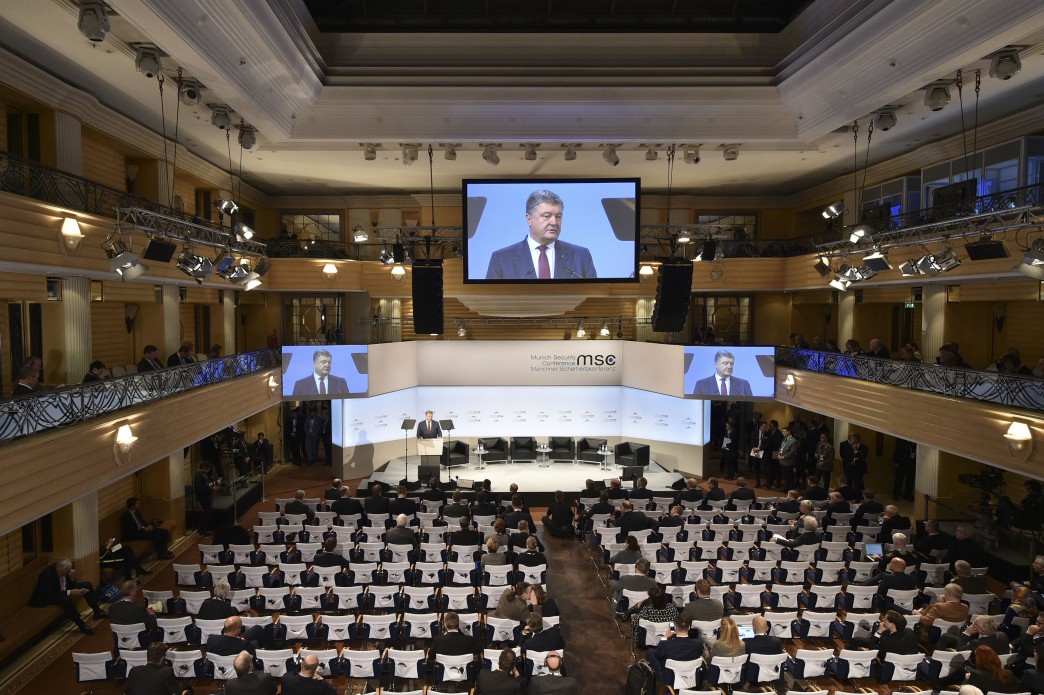

President Poroshenko, Munich, February 16th 2018
©President of Ukraine Website

At this year’s Munich Security Conference in mid-February, President Poroshenko seems to have met with all the people he would have wanted to meet, from the NATO Secretary General to US Congressmen. Ukraine’s traditional supporters have not changed their position of principle and will meet with the President of Ukraine. Poroshenko, however, ended up giving his “comment from Ukraine” to an half empty auditorium. That could be explained by many factors including a less than ideal timing for his address. Occasional indifference to another speech would not bear mentioning were it not accompanied by rumours suggesting that the US and the EU are “dropping” Poroshenko. Dissatisfaction with the expulsion from Ukraine of egocentric opposition leader Mikhail Saakashvili would not in itself have been enough to cause this turn of events. Yet, it could well have been the proverbial straw that broke the camel’s back. Dissatisfaction with Poroshenko has, however, been building up for some time both at home and abroad. Interestingly enough, the main opponent to Poroshenko, former Prime Minister Yulia Tymoshenko was also in Munich.

Among the meetings that Poroshenko had in Munich, the most remarkable one is probably not the one that received the most attention in Western media. Poroshenko had what was described as a constructive meeting with the new Prime Minister of Poland during which one particularly sensitive issue was discussed. There has been a lot of coverage of the dispute between Israel and Poland over the new Polish law that establishes what can or cannot be said about “Poles being responsible or complicit in the Nazi crimes committed by the Third German Reich”. Very little has appeared, however, about a controversy closer to home. The new Polish law also makes it illegal to deny war crimes committed by Ukrainian nationalists. It refers to “acts committed by Ukrainian nationalists between 1925 and 1950 which involved the use of violence, terror or other human rights violations against individuals or population groups” as well as to the fact that “participating in the extermination of the Jewish population and genocide of citizens of the Second Polish Republic in Volhynia and Eastern Malopolska [Lesser Poland] also constitute a crime committed by Ukrainian nationalists and members of Ukrainian units collaborating with the Third Reich”. Relations between Poland and Ukraine are obviously more than that controversy, but the strong diametrically opposed feelings continue to exist in both countries, complicating the political dialogue.

Another issue that was discussed in Munich was the UN peacekeeping arrangement for Eastern Ukraine. President Poroshenko continues to promote actively such an arrangement. The Ukrainian Foreign Minister had a detailed discussion of the matter with his Russian counterpart, according to the Russian side. There are, however, growing signs that some supporters of Ukraine are concerned that a Cyprus-type of peacekeeping accord, if successfully implemented, would essentially freeze the conflict for the foreseeable future, and would remove any incentive for its resolution.


--o--


SYRIAN SHADOWS


With the fight against the Islamic State no longer being the central issue, the underlying complexity of the situation in and around Syria has become more evident. A few observations may help clarify some aspects of the conflict. First, long-term Russian objectives in Syria have not changed. Russia wishes to preserve the existing state structure for fear that the implosion of Syria would plunge the region into total chaos. This means, accessorily, keeping Assad in power. There is no special attachment to the Assad family. This has been made clear on several occasions. Second, there is not always full convergence between the positions of Russia and those of the Assad government. Whether this is a bad cop/good cop show is possible. What matters more is that Russia can be the interlocutor for the international community. This has been demonstrated in the context of the Eastern Ghouta humanitarian crisis. The Syrian government did not conceal the intention to apply in the Eastern Ghouta the same ruthless level of military force as was deployed in the case of East Aleppo. In the view of the Damascus authorities, the continuing existence of a rebel enclave in close proximity to the capital and one from where the rebels could bomb the outlying residential areas of Damascus could no longer be tolerated. (See above map. Douma is a city in Eastern Ghouta.) It will make the implementation of any ceasefire extremely difficult. Nevertheless, Russia was not fully aligned with its Syrian ally on this issue. That is why it was able to vote in favour the Security Council resolution calling for a ceasefire, still with the caveat that the cease-fire does not apply to terrorists. Sensing the slight difference of opinion, that is why thereafter Western powers called on President Putin to exercise maximum influence on its Syrian ally. This is why, after a Macron-Merkel-Putin conversation, there was the announcement by Russia, not by Syria, of a five-hour a day humanitarian corridor to allow for the departure of civilians and the provision of humanitarian assistance. Ultimately though, the resolution may have to come from the rumoured indirect negotiations between some rebel groups and the Syrian government.

Russia and Syria do, however, share the desire to see uninvited foreign troops on Syrian territory. That applies first to US troops. Although Donald Trump has recently stated that US troops should deal with ISIS and leave, there is long-term US interest in a military presence that allows to rein in Iran and to prop up a US-friendly Kurdish entity, as a counterweight to all the other less US-friendly and less-Israel friendly entities. Keeping in mind the Afghanistan precedent, it is difficult to imagine an early departure of US troops.

When it comes to the Turkish presence in Northeastern Syria, the interests of Russia, Syria and even possibly Turkey may eventually coincide. Even though Syria and Russia do not share Turkey’s animosity towards the Kurds, the Turkish objective of doing away with the Kurdish threat could possibly be reconciled with the Syrian opposition to a Kurdish entity that could permanently jeopardize its territorial integrity. This is why Russia is supporting current attempts to re-establish a political dialogue between Damascus and Ankara. The Turkish side has already confirmed that there were direct contacts between the Turkish and Syrian intelligence agencies. This could become very significant, but, once more, the Kurds may have their future decided by others.


--o--


THE RUSSIAN ECONOMY, A POLITICAL TAKE


It is generally estimated that economic growth for 2017 in Russia will be around 1.5%, the first time in three years when growth is registered. In simple terms, the Russian economy shows resilience, but not dynamism.

The national unemployment rate is estimated at 5.2%. This would be very good, but the problem is that unemployment is virtually inexistent in large urban centres, yet considerably higher in areas such as the Causasus. Ingushetia unemployment, for instance, is estimated at 27%.

High inflation prevailed for most of the post-Soviet period. In a “new” consumer society, this has been a constant source of public concern. Inflation for January 2018 reached a record low of 2.2% well below the 4% target set by the Central Bank.

Despite the low inflation, disposable income is stagnating. The official poverty rate nevertheless decreased slightly in the first half of 2017.

The overall financial situation of the country is relatively sound. It has the sixth lowest level of national debt and the sixth highest level of financial reserves. On February 23rdth, Standard and Poor raised the credit rating of Russia from BBB- to BB+, taking the country out of the “junk” area and into investment territory.

Government expenditures are under control, with the federal budget inching towards equilibrium in 2017 and expected to be in a surplus condition in 2018. Dependence on oil revenues is slowly decreasing.

Structural issues obviously need to be addressed, even in the agriculture sector that, for instance, turned Russia into the largest wheat exporter in the world. In order to meet Innovation objectives, the economy will have to address demographic challenges, including skilled labour shortages. The continuing prevalence of state-owned enterprises, the limited availability of local capital are also factors that are seen as limiting growth.

All things considered, the Russian economy is showing some positive signs. Overall, it is moving in the right direction, albeit at a slow pace.

The relatively slow economic growth has not been an issue in the current presidential election campaign. It is becoming increasingly clear, however, that there is a growing expectation in the population that significant economic growth will return in coming years. This will be the main challenge of the (likely) last Putin presidency.


--o--


PERSON OF THE MONTH: CZECH REPUBLIC PRESIDENT MILOS ZEMAN


Milos Zeman, aged 73, the Czech Republic’s populist president, has been narrowly re-elected in late January 2018 in a close battle against a liberal opponent.

This is significant because Zeman's campaign was conducted on a clearly anti-immigrant and even anti-Western platform, potentially steering the country in an anti-western direction.

Zeman needed a second round runoff victory against Jiří Drahos, a former head of the Czech academy of sciences, a chemist by profession. The final vote count was: 51.5% to 48.5% in Zeman's favor.

Zeman is openly pro-Putin and promotes better ties with China. Significantly he called for referendums on the Czech Republic’s membership in the EU and NATO. He is a vocal critic of Islam and believes that unchecked immigration from Muslim countries threatens cultural cohesion of Europe and undermines its security.

The above-mentioned election will unlikely change the country's politics and alliances overnight as the position of Czech president is more ceremonial and actual power here is wielded by the Prime Minister and Parliament.


--o--


BRIEFLY NOTED


RUSSIA


The Levada center, an independent, non-governmental, polling and sociological research center in Moscow published some estimates for the upcoming presidential elections. The eight opposition candidates in combination could receive about 20% of popular vote. If Alexei Navalny, the popular opposition leader, who is banned from taking part in the election, was running, the opposition could amass nearly 40%. In the eyes of the Russian establishment that could be defined as a defeat for Putin. Stanislav Belkovsky, chief adviser to presidential candidate Ksenia Sobchak and one of Russia's leading political analysts, stated that if Putin failed to gather more than 60% of the popular vote, he would resign in the same way French president Charles De Gaulle resigned after collecting only 52% of the votes in the constitutional referendum in 1969. Most Russian observers, however, believe that Putin is slated to collect around 70% of the vote.

The Levada Center has now suspended its polling for the election, since under the new law on non-governmental organisations, it is considered as a “foreign agent” for having received some funding from abroad.


LATVIA


The Governor of Latvia's Central Bank Ilmars Rimsevics was arrested on charges of receiving and demanding bribes worth almost $200,000. Considering that Mr. Rimsevics has been head the bank since 2001, this scandal threatens to tarnish the reputation of the Latvian banking sector.

ROMANIA


The Romanian Minister of Defense and his Moldovan counterpart announced the creation of joint units as the nucleus of a potential unified army within a unified state of Romania and Moldova. The next parliamentary elections in Moldova will show whether the majority supports the reunification of the two countries. The current polls show that the Moldovan socialists led by President Igor Dodon have better chances. If they win, reunification will be put on the back burner. If they lose, great Romania may become a reality.

KAZAKHSTAN


President Nursultan Nazarbayev signed the historic law switching the Kazakh alphabet from Cyrillic to Latin letters The latter was in use in Kazakhstan before 1940 when Stalin ordered Kazakhstan's forced russification.

UZBEKISTAN


The open door policy for international business will become the main political course of the state for years to come, according to the Government in Tashkent. After many years since the Soviet industrial and scientific infrastructure was destroyed, Uzbekistan is turning to Western investors to fill the vacuum and to begin reconstruction of Uzbekistan's industrial, scientific and agricultural sectors. Starting this year the government liberalized the visa regime in order to attract foreign investors and tourists. For the latter, Uzbekistan has unique historical sites, such as the ancient cities of Bukhara and Samarkand.


NORD STREAM 2


After a long protracted political debates and strong US opposition, the natural gas pipeline from Northern Russia to Germany will go ahead as German construction permits were obtained. It will be a dual pipeline that will be laid at the rate of 3 km per day from special floating factories. Pipes will be welded and tested on ships and laid through the Baltic sea.

The main sticking point of that project was the EU concern that Ukraine could lose the transit of Russian natural gas to Europe and hard currency that it brings. In political terms the EU wanted to show support for Ukraine by opposing the Russian gas transit which bypasses Ukraine. The most active opposition to Nord Stream-2 came from Poland and Baltic countries. They do not fancy the idea that the most powerful European economy (Germany) could fall into even more substantial energy dependence on Russia's energy carriers.

Russia assured the EU that their Ukrainian gas transit will stay in place.

NORTH KOREA 


The noose is tighening. Not waiting for the Winter Olympics games to end President Trump announced a new set of crushing sanctions against North Korean shipping and scores of firms dealing with North Korea. According to Steve Mnuchin, US Treasury Secretary, this measure will significantly cripple North Korean ability to conduct evasive maritime activities, preventing North Korea from bringing coal and other energy supplies into their ports. The ships that were sanctioned are registered in North Korea, China, Taiwan, Marshall Islands, Tanzania, Panama and Comoros.
The sanctions also blocked certain companies’ assets and forbade US citizens to deal with the hermit kingdom. The $64,000 dollar question here is whether this step influence in any way the certain detente that has been developing of late between the two Koreas.


--o--

THE AUTHORS

Ilya Gerol, former foreign editor of the Citizen in Ottawa, syndicated columnist in Canadian, US and European media specializing in international affairs. His particular area of expertise includes Russia, Eurasian Economic Union, Eastern and Central Europe.  Ilya Gerol has written several books, one of them, The Manipulators, had become a textbook on relations of media and society.

During his career in the Canadian Foreign Service, Gilles Breton had three assignments at the Canadian Embassy in Moscow. His first posting there began during the Soviet period, in 1983. His last was from 2008 to 2012 as Minister-Counsellor and Deputy Head of Mission. He also served as Deputy Director responsible for Canada’s relations with Russia from 2000 to 2008. As an international civil servant, he was Deputy Director of the OSCE Office for Democratic Institutions and Human Rights in Warsaw from 1994 to 1997.


Tuesday, January 30, 2018

Issue 15

THE BRETON/GEROL NEWSLETTER


MONTREAL-DAVOS


Global cooperation and integration through international alliances and tariff-reducing agreements only recently looked like the only promising way for international trade development. President Trump came to the White House with the main motto of his presidency being replacing globalism by old-fashioned competition and the system of bilateral agreements. From his point of view, based solely on his subjective business experience rather than on detailed economic expertise, bilateral agreements provide the US economy (still the most powerful in the world) with additional advantages: striking deals that favor the US. In the same vein, Trump and his apparatchiks concluded that the framework of bilateral agreements where the US can more easily dominate is preferable to a complicated structure of multinational agreements like NAFTA, and similar regional trade facilitation treaties. In Davos, Trump expanded his “America First” formula with a more conciliatory “First but not alone”. Observers concluded that Trump's speech had substantially moved him away from all his pre-election radical statements.  The question is for how long.

NAFTA gets to Trump the most, as an example of depriving the US economy of its rightful advantages. In his view, NAFTA unduly favors Mexico and Canada. January talks in Montreal had been described by Trump economic advisers as the last attempt to modify NAFTA and make it more fair for the US. Most likely NAFTA will survive in a modified form, but it is also a possibility that if the modifications are not made as the American side envisions them, the US will nullify the whole agreement.

In Davos President Trump delivered a speech which he himself characterized as "historic". In this speech he attacked not only NAFTA but the entire framework of multilateral approaches to world trade. He gave the example of Great Britain's improved trade relations with the US in the immediate aftermath of Brexit. The team opposing Trump's view of world economy and defenders of globalization included such world leaders as Merkel , Macron and Trudeau.

--o--

UKRAINE AND DONBASS: BETWEEN THE ELUSIVE AND THE INCONCEIVABLE


President Poroshenko and Secretary of State Tillerson, Davos, January 26th
©President of Ukraine Website


The conflict in Ukraine receives relatively little media coverage. Yet it is probably the most significant source of political confrontation between Russia and the US for the foreseeable future.

The Ukrainian Parliament has just adopted a Donbass Reintegration Law that declares Russia the aggressor state and the Donbass region as occupied territories. The Law also gives to the president of Ukraine president  the authority to manage the military activity in the area of the conflict as well as it empowers a special operational unit of the Ministry of Defence to exercise control over the activity of the power ministries in the area. In this last respect, it is not clear whether there will be any change one way or the other to de facto blockade on the Ukrainian side of trade with the occupied regions.

With this new Law, the conflict in the Donbass will no longer be considered an anti-terrorist operation, but a military action in self-defence. President Poroshenko has called the new Law the “technology” that would allow bringing Donbass back into Ukraine. Whereas the Law clarifies a number of points concerning the liability of the occupying forces and the validity of administrative acts performed in the occupied territories one would be hard-pressed to find any provision that would contribute to reintegrate the Donbass into Ukraine.

Despite the assurances of President Poroshenko that the Law gives priority to a political solution it is difficult to see how this is the case. There is, for instance, no mention of the Minsk agreements, the basis on which diplomatic efforts have tried to build for the last few years. Russia has more or less called it the end of Minsk agreements. The EU has been more circumspect, but re-affirmed its attachment to the Minsk agreements.

Poroshenko’s insistence on having this new legislation could be explained by the fact that it caters to the partisans of a hard line against Russia, confirms his reading of the nature of the conflict in Eastern Ukraine and strengthens his authority to manage the conflict.

If the Law does indeed provide a “technology” it is the one that would be needed in case of a military solution to the conflict. Such a solution is, regardless of Western promises of new weapons for Kyiv, elusive. Russia is unlikely to abandon the Donbass. It would most likely match weapons improvement on the other side.

The Law complicates any further eventual negotiation with Russia. It seems that, for a majority of Ukrainians, any negotiated settlement with Russia is virtually inconceivable in that it would entail unacceptable concessions. Having Russia legally labeled as the aggressor only makes any real negotiation even more difficult even to initiate.

By calling the area of conflict “occupied territories” the Law also casts the current authorities in the area as irrelevant. For Kyiv, as for Washington for that matter, these authorities essentially do not matter, as it is their view that Moscow is calling the shots.

By making more difficult a negotiated reintegration, the legislation firms up the rebel regions’ sense that their future lays either in full independence from Ukraine or in integration with Russia. It is not clear though that Russia is ready for the latter.

After the last round of consultations with his US counterpart on January 26th, Vladislav Surkov, Putin’s adviser for relations with Ukraine, made the comment that the latest US proposal on peacekeeping seemed, at first sight, “doable”. While desirable from a humanitarian point of view, a functioning peacekeeping arrangement might freeze the conflict in a way that so delays reintegration of the rebel regions as to make it almost impossible. Such an arrangement might also serve as a pretext for the EU to lift some of its sanctions, decreasing the pressure for a full negotiated settlement.

--o--


RELUCTANT LEFT TURN


Chancellor Merkel, PM May, President Macron
©Facebook
German Chancellor Angela Merkel once again gave proof to the old dictum that the real goal of staying in power is to stay in power. There are very few things that a political leader will not want do for that. After all viable options of building a governing coalition with the Free Democrats or the Greens had failed, Merkel decided to restore the good old coalition with the Social Democrats. This time her concessions to the left will be more profound on social issues and immigration, but allying with the Alternative For Germany (the right wing party that successfully jumped into the Bundestag) would be political suicide for the Chancellor.

Germany, unlike Austria, is a leading European nation and it cannot allow itself to experiment bringing extreme right wingers into the government. Both Social Democrats and Merkel's Christian Democrats were opposed to the coalition, but harsh political realities forced their hand. This move to a certain degree relegated Merkel, for the time being at least, to the second fiddle seat in European politics and catapulted French President Emmanuel Macron into the position of top European leader, with a new party, a new approach and fresh ideas.

--o--

KIM JUNG UN'S OLYMPIC VICTORY


One has to admit that North Korea and its youthful tyrant already earned himself an Olympic Gold medal of sorts even before the games begin. He not only managed to walk away from what seemed to be an imminent military confrontation with the US, but suddenly re-engaged in negotiations with the South and agreed to send his athletes and for some reasons a music band of 140 performers to the Winter Olympic Games in PyeongChang, South Korea. All that was done without any visible compromises on its nuclear or ICBM development programs.

It is rather evident that so far Mr. Kim had outplayed Mr. Trump and outmaneuvered China and Russia. So the gold medal goes to Kim.

It is nevertheless premature to conclude that North Korea will avoid war in the long run, without some form of concessions on its part. It is not impossible to imagine that these Winter Games could be the last for Kim and his regime.

--o--


SANCTIONS AS A MAINSTAY OF US-RUSSIA RELATIONS


Under the Countering America's Adversaries Through Sanctions Act of 2017 (CAATSA) Section 241, Congress required Treasury, in consultation with the Department of State and the Director of National Intelligence, to provide a report regarding senior political figures and oligarchs in the Russian Federation.


The report was issued 10 minutes before midnight on January 29th. It lists 210 Russian officials and business people that could be subjected to sanctions for their business and political activities (going back decades). The business activities are deemed to have enabled them to amass fortunes through criminal or illegal practises. The vast majority of that capital has been transferred or invested, some in the US (in all available investment options) or stashed away in offshore accounts worldwide.

Not everyone on that long list will be hit with sanctions, but those who will risk seeing their assets frozen and subjected to forensic accounting. Many people formerly known as oligarchs are beginning to feel the heat and are faced with very unpleasant options: to transfer in a hurry what can be salvaged back to Russia, a move tantamount to admitting guilt, or take chances in a legal battle with the American justice system as was already stated by Oleg Deripaska, one such Russian tycoon.

President Putin, maybe expecting something even worse, reacted in a moderate tone, suggesting there would be for the time being no counter-measure.

Even if only by way of a threat, revving up sanctions once again against Putin and his base at this time is an obvious attempt to go after Putin before the upcoming elections in March by weakening an already vulnerable Russian economy. It looks like the relations between US and Russia will yet slide further down before they get any better.


--o--


PERSON OF THE MONTH: SEBASTIAN KURZ, CHANCELLOR OF AUSTRIA


Sebastian Kurz, Facebook profile photo


Elected in late 2017, 31-year old Kurz became the youngest government leader in Europe. This is not the first record he set. In 2013 he became the youngest foreign minister in the world. He looked almost like a teenager when in 2014 he met with aging John Kerry and gray haired Iranian Foreign Minister Javad Zarif.

Kurz fits well in a new trend that gives old parties a new makeover and introduces fresh faces to the top political echelons. Some political analysts in Europe have brushed aside dire predictions from the left that Kurz is an extreme right winger and define him as a more conservative version of Justin Trudeau and Emmanuel Macron.

--o--

BRIEFLY NOTED


SYRIA

The Turkish military continued their operation around the city of Afrin against Syrian Kurds. The Turkish army is assisted by Sunni militias. This operation, code named by the Turks 'Olive Branch' started to cause serious tensions between Turkey and the US (despite their status as NATO allies) as well with Iran and Russia, each pursuing its own interests and goals that do not coincide and in some cases are on a collision course.

KAZAKHSTAN


For the first month of 2018, Kazakhstan will chair the UN Security Council. During his January 2018 visit to Washington (during which he had a working lunch with President Trump) President Nursultan Nazarbayev said that in less than 10 years his country will join the club of 30 most developed countries in the world. Today Kazakhstan is implementing a wide array of reforms within every sphere of its economic, financial and social development.

MOLDOVA

The Government of Moldova announced that it will leave the Commonwealth of Independent States (CIS) only after the country is confirmed as a candidate member of the EU. The statement was made in response to some voices in parliament demanding the immediate withdrawal from the CIS.

MONGOLIA

Mongolia on Wednesday approved a plan to build the first oil refinery in its southeastern Dornogovi Province. The construction of the refinery is scheduled to begin in the second quarter this year, the Mongolian government press office said in a press statement Wednesday. The project was financed by a loan from India. The refinery will have a processing capacity of 1.5 million metric tons of oil per year and will annually produce 560,000 tons of gasoline and 670,000 tons of diesel fuel, as well as 107,000 tons of liquefied gas. The refinery would boost Mongolia's gross domestic product by 10 percent.Mongolia currently exports crude oil to China while importing petroleum products from Russia.

CHINA


Bejing announced that it will participate in Arctic development. China will use the Northern Sea Route Arctic seaways as a shortest transit route for transporting freight to Europe and North America. As part of this announcement Chinese offered the assurance that its participation will be in full respect of the local environment and the integrity of the Arctic's ecology.


THE AUTHORS

Ilya Gerol, former foreign editor of the Citizen in Ottawa, syndicated columnist in Canadian, US and European media specializing in international affairs. His particular area of expertise includes Russia, Eurasian Economic Union, Eastern and Central Europe.  Ilya Gerol has written several books, one of them, The Manipulators, had become a textbook on relations of media and society.


During his career in the Canadian Foreign Service, Gilles Breton had three assignments at the Canadian Embassy  in Moscow. His first posting there began during the Soviet period, in 1983. His last was from 2008 to 2012 as Minister-Counsellor and Deputy Head of Mission. He also served as Deputy Director responsible for Canada’s relations with Russia from 2000 to 2008. As an international civil servant, he was Deputy Director of the OSCE Office for Democratic Institutions and Human Rights in Warsaw from 1994 to 1997.


Thursday, December 28, 2017

Issue 14


THE BRETON/GEROL NEWSLETTER


HAPPY NEW YEAR TO OUR LOYAL READERS!


APRÈS MOI, LE DÉLUGE?

President Putin filing his candidacy documents at the Central Election Commission, December 27th
©Website of the President of Russia

There will probably be a lot of agitation around alternate candidates and even non-candidates, but there is, of course, little doubt about Vladimir Putin winning the Presidential election that will be held on March 18, 2018. The question that puzzles observers is: what next? As for Putin himself, it seems rather clear that this will be his last term as President. The most likely option for him afterwards is to assume the role of pater patriae, something of a cross between what Deng Xiaoping did in China and what Lee Kuan Yew did in Singapore. Two elements are at stake: a residual high-level involvement in the political life of the country, outside of politics (Putin, by the way is running as an independent not as the representative of a party), immunity from prosecution (you never know what could happen).

The question as to whether Putin might choose not to complete his six-year term does arise. The option indeed exists. Whereas it would not be like Vladimir Putin to abandon the ship, his “weakness is not an option” mantra may compel him not to want to become a lame-duck in a country where strong personal leadership is crucial.

Beyond Putin himself, the key question is to what kind of political system does Putin want the country transition to, after his departure. The simplest most efficient option would be to install a president that would essentially be a clone, politically speaking. The right person could then be president for up to 12 years. The main requirements for the new President would be loyalty to the Putin tradition and experience in government. In that context former President and Current PM  Dmitry Medvedev, albeit not inspiringly, tops the list.

President Putin, PM Medvedev, Deccember 21st
©Website of the President of Russia

The problems with that option are that electoral success is not guaranteed and that this would further aggrieve the young generation, essentially the people born after the end of the Soviet Union. Experienced pollsters have observed that although Vladimir Putin’s popular support is broad, it is not deep. The manipulation that allowed Putin to return  to the presidency in 2012 was not fatally unpopular, but it led to the lowest ever score for the party of power at the December 2011 parliamentary elections. The high overall rating of Putin does not mean there is strong support for the entirety of his political program, especially among younger people. The authoritarian bent as well as the lackluster economic performance create a long-term vulnerability for Putin’s managed democracy system.

For Putin, there is little if any attraction even to try to replicate the democratic systems of Western Europe and North America. To him Russia would need to develop progressively its own type of democracy that would meet the twin requirement of maintaining stability while opening up the political process, (essentially shifting the emphasis from authoritarian to liberal). He himself used the word “flexible” to describe the political system he sees for Russia. One possibility might be to make Russia more parliamentary than presidential, something President Nazerbayev seems to want to try in Kazakhstan. In a country that traditionally likes strong leaders, that has a long one-party tradition and where political parties do not seem up to the task, the challenge is daunting, the outcome uncertain. Yet, Putin the historian knows that evolution is unavoidable and that history will judge him on how he will address this last challenge.

--o--

WAR AFTER THE OLYMPICS?


The Winter Olympics in South Korea, to be held from February 9th to 28th, may be the last reprieve for the North Korean regime before the US decides to go ahead with a limited, but devastating attack on Kim Jong Un’s nuclear sites and possibly decapitating strikes against the regime’s upper echelon. According to military experts, the operation under consideration would definitely include various precision air strikes, including the heaviest, non-nuclear munitions like bunker busting bombs and the use of US Special forces with the expertise required for neutralizing and securing potential nuclear sites inside North Korea. Discussions around this issue have intensified in the last several weeks. There were back and forth visits and discussions among experts from the US, China and Russia. A recent visit to Pyongyang by a Russian Defense Ministry delegation was possibly a last ditch attempt to relay to Kim the seriousness of his situation. In addition US Secretary of State Tillerson just admitted that the United States gave assurances to China that should the above-mentioned military operation take place, the American troops would not remain in North Korea, but transfer day to day management of further developments to the Chinese. The Chinese have not gone as far as confirming what Tillerson said, but interestingly enough they also did not deny it.

If North Korea does not back down or come up with some pacifying and acceptable statement before the end of the Olympics, or if renewed diplomatic efforts do not show signs of progress, the war maybe a reality.

--o--

WEAPONS OF MASS DELUSION


Both the US and Canada announced in mid-December that the sale of some lethal weapons to Ukraine would henceforth be authorised. Those, including President Poroshenko, who have argued for more active support for Ukraine on the part of Western countries rejoiced. There is, however, limited ground for celebration.


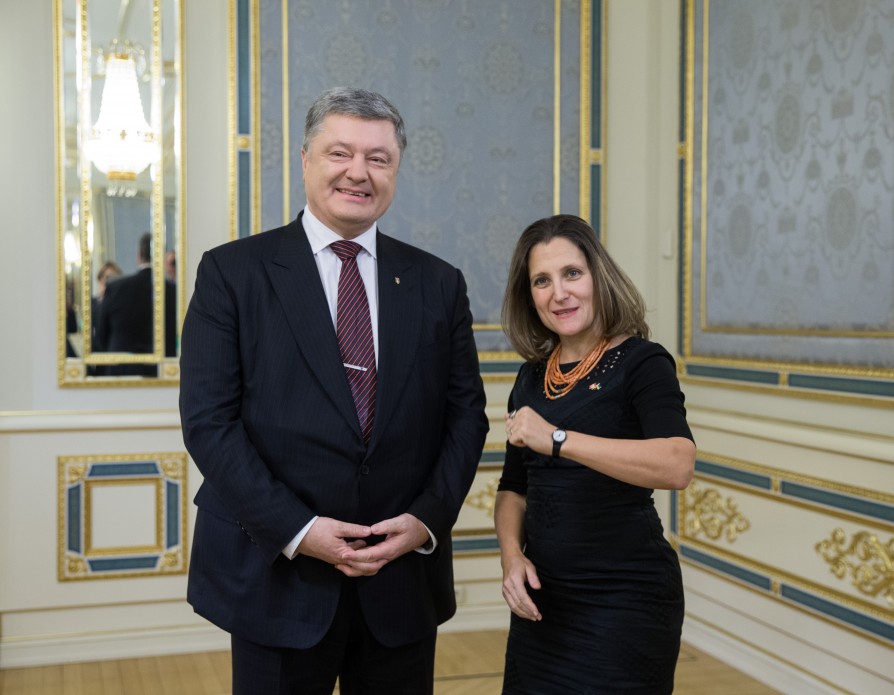
President Poroshenko, Foreign Minister Freeland, Kyiv, December 21st
©Website of the President of Ukraine
First, allowing the sale of weapons is not the same as providing weapons. It may become legal to export certain weapons, but in the absence of outside funding, Ukrainian buyers will have to pay for their purchases. It is not clear that funds are available for that purpose in Ukraine, or that the US or Canada would provide funding assistance directly related to such purchases.

Second it is not clear either that the weapons that have been cleared for export to Ukraine are needed or would make any difference in the ongoing conflict in Eastern Ukraine. The US statements refer to defensive weapons, the Canadian one to automatic weapons. There was speculation about the sale of some anti-tank weapons, but US officials seemed reluctant to provide any details.

When it comes to assessing Ukrainian weapon needs, it might be useful to remember that Ukraine is itself a large exporter of weapons, consistently ranking among the 10 top exporters. The weapons in question are mostly leftovers from the large arsenal of weapons that were stored in Ukraine during the Soviet period. The state of conservation of the weapons in question occasionally comes into focus when major explosions in destroy part of the arsenal, as was the case twice in 2017.

As for Canada, when it comes to authorising the export of weapons, the long-standing policy is that weapons cannot be exported to zones of conflict. It is worth reading the fine print in the official announcement:

“This change will enable Canadian companies and individuals to apply for a permit to export certain prohibited firearms, weapons and devices to Ukraine. Each permit application will be assessed on a case-by-case basis to ensure its consistency with Canada’s international obligations and foreign policy and defence priorities. (…) Inclusion in the Automatic Firearms Country Control List does not guarantee that exports of prohibited firearms, weapons and devices to a country will be approved.”

The gesture of authorising the sale of lethal weapons to Ukraine was highly symbolic. As could be expected, it upset Russia. Its actual impact remains, however, unusually vague for now.


--o--

SAAKASHVILI VS POROSHENKO, AND THE WINNER IS TYMOSHENKO


Mikheil Saakashvili
Facebook Profile
Mikheil Saakashvili continues his anti-corruption popular campaign that more and more looks like an anti-Poroshenko action. As legal attempts to either arrest or extradite Saakashvili have not succeeded, attempts were made to discredit Saakashvili by releasing a conciliatory personal letter he had just sent to Poroshenko. After the release of the first letter, Saakashvili wrote a second open letter in which he called for Poroshenko to resign, hinting, rather arrogantly, that resignation might result in “mitigation of punishment as well as pardon,”. Poroshenko created the problem by stripping Saakashvili of his Ukrainian citizenship, but cannot get rid of him through legal or political means. Saakashvili’s stature protects him so far from non-legal attempts, but his popular following is not strong enough to topple Poroshenko. He can however continue to annoy Poroshenko for the foreseeable future, especially now that Poroshenko has refused his peace proposal. The real impact is the constraint it imposes on Poroshenko’s attempt to work usefully at his campaign for a second presidential mandate, which he seems intent on seeking. This serves the interest of Yulia Tymoshenko, former Prime Minister and Poroshenko’s main challenger, who seems to be making a come-back in public opinion polls.


Yulia Tymoshenko
Facebook Profile


--o--

NEW GUIDELINES, OLD RIVALS


President Trump just announced a new National Security Strategy (NSS). It is based on four pillars:

Protect the homeland, the American people, and the American way of life

Promote American prosperity

Preserve peace through strength

Advance American influence

Two countries have been named as major "revisionist powers" attempting at rivaling the US: Russia and China and, as the text of the NSS memorandum goes, "use technology, propaganda, and coercion to shape a world antithetical to our interests and values".

Curiously and of note, China is mentioned 12 times while Russia only 6.

It did not take long for the Chinese rebuff. The Ministry of Foreign Affairs in Beijing categorically rejected being branded as an expansionist and revisionist. The Kremlin spokesman Dmitry Peskov shrugged the matter off, saying he could see traces of an “imperial nature” in the NSS “as well as unwillingness to abandon the unipolar world idea and accept a multipolar world. Some observers in Moscow sardonically commented that few people managed to do so much with so little to bring Russia and China closer together. This document owes a lot to President Reagan's principled stand in his Cold War strategy.

Trump allegedly participated directly in the elaboration of this new strategy. Whereas it will serve as guidance for the Administration as a whole, this does not mean that he will not improvise, depending on political circumstances or his own mood swings.

--o--

REX TILLERSON: TRUMP'S FOREIGN POLICY GLADIATOR


Secretary of State Tillerson, PM Trudeau, Ottawa, December 19th
©State Department


Rumors about the imminent resignation of Rex Tillerson as US State Secretary do persist but are most likely slightly exaggerated. While it looks certain that Rex Tillerson will not remain part of Trump's team until the end, today he serves a purpose: Tillerson’s more diplomatic approach, often contradicted by his boss (in his night-time tweets, or statements) and this tandem of foreign policy "bad cop, good cop" approach seems to be working for the time being as far as the White House is concerned. Boris Johnson, the British Foreign Minister, who visited Moscow in December, expressed different, sometimes controversial views, but we can be certain that all of it was coordinated with PM May. In Tillerson's case no foreign colleague of his can ever be certain that the next day White House would not either correct, deny, or even totally contradict what Rex stated. 

Not so long ago, the State Secretary assured the media that his negotiators were ready to travel to North Korea for some diplomatic efforts to ease the tensions. Two days later on his official visit to Asia, President Trump denied that such plans were in the works and put his personal touch on it by advising his State Secretary not to "waste time" on fruitless talks. As some observers noted such unconventional approach may have some purpose: to disorient enemies and allies alike to pursue certain political objectives.

Tillerson may, however, be remembered for having presided over the atrophy of the State Department, leaving a large number of positions unstaffed. The damage done to the institution is likely to be felt for years. The traditional US interests as defined by the liberal leaning State Department do not fare well against the more isolationist “make America great again” approach.

--o--


PERSON OF THE MONTH: PATRICK POUYANNÉ, CHAIRMAN AND CEO, TOTAL 


Patrick Pouyanné took over as head of Total in October 2014, after Christophe de Margerie was killed in a tragic accident at Moscow's Vnukovo airport. Total's executive jet was rammed by a fuel truck driven by a drunk employee. The three crew members also died. The driver was sentenced to prison time.

Total is one of the 7 "supermajor" oil and gas companies, which means that it covers the entire cycle of oil and gas from exploration, production, power generation, transportation, refining, product marketing and global crude oil and product trading. The company has a work force more than 100,000 people in 130 countries. Its total assets amounted to USD 230 billion in 2016, while profit was over USD 6 billion.

Total carries a special significance for the Russian economy and investment environment. At the time when Western sanctions substantially undercut Russian joint projects with scores of Western partners, Total not only remained in Russia during this difficult period, but also actively took part in the gigantic Yamal LNG project.

Yamal LNG processes natural gas from the giant onshore South Tambey gas and condensate field, located on the Yamal peninsula. The project includes an integrated gas treatment and liquefaction facility with three trains each having a capacity of 5.5 million tons per year, storage tanks, port and airport infrastructures. The construction of the first train as well as of the logistic facilities was successfully completed with more than 30,000 personnel actively involved on site at peak. The second and third trains will be commissioned in 2018 and 2019 respectively.

The project is operated by Yamal LNG Company, owned by Russian independent gas producer Novatek (50.1%), Total (20%), CNPC (20%) and Silk Road Fund (9.9%).

On December 8th, 2017 Total announced that the first cargo of liquefied natural gas (LNG) from Yamal LNG is ready to leave Russia. This first shipment is a big step for Yamal LNG and the Russian energy export structure, one of the biggest liquefied natural gas projects in the world. Yamal LNG has reserves of 4.6 billion barrels of oil equivalent in Northern Russia.


Symbolically, the first Russian tanker built for this project was named after Christophe de Margerie.


©Total

--o--


CHINA'S ONE BELT ONE ROAD INITIATIVE (OBOR), EURASIAN ASPECT


Four years ago when Beijing came up with the exotic initiative to resurrect in a modern context the ancient Great Silk Road that goes back more than 2,000 years and in its heyday dominated trade in Asia, Middle East, South Europe and Africa, it was not taken seriously. Today it has gained strategic and political traction. OBOR is not a unified political or economic structure. It is rather based on specific agreements with one or a group of countries that could serve as major junctions along that way. The main routes of the OBOR will go through Eurasia: Russian and Kazakhstan's Trans-Siberian railroads, Georgian and Turkish ports with further routes to the Middle East, Southern Europe plus auxiliary paths into Africa. On the surface it looks like a grand, but conventional plan to deliver Chinese-made goods all over the world by the shortest and cheapest possible route. On a deeper level, it brings with it joint investments into transit countries’ economies, joint projects (logistical, industrial or scientific) and consequently becomes a global project.

Politically, the gradual and long-term implementation of that project requires reduction in military conflicts along the way such as, among others, Ukraine-Russia in Donbass, Azerbaijan-Armenia in Nagorno-Karabakh and Afghanistan’s permanent civil war.

The question is whether OBOR can help to reduce the intensity of local conflicts in favor of trade and coexistence or whether it will fail to do so and remain only a hypothetical construct.

--o--


BRIEFLY NOTED


NORTH KOREA


A BGN source in Ottawa's diplomatic community confirmed that the conference that Canada is trying to arrange in Vancouver involves the participation of the US, Russia, China, South Korea and Japan to discuss the growing tensions around the North Korean nuclear program and overall rising chances for a full scale war between North Korea and the US. Russia's relations with Canada are at an all-time low, but it seems so far Russia is ready to come if China agrees to join. So the only hold out is China as Beijing has yet to reply positively to the invitation.

RUSSIA


The Central Election Committee denied Alexei Navalny, a Russian opposition leader, the right to register as a candidate for the March 18, 2018 presidential election on account of his criminal conviction for economic crimes. In a widely disputed and politicised verdict, Navalny was handed a 5-year conditional sentence. Alexei Navalny is the most notable opposition candidate and has election offices in dozens of Russian cities. His campaign attracted many dissatisfied voters, mainly younger generation of Russians. His presidential campaign dealt mainly with the widespread corruption of Putin and his inner circle and, to a lesser extent, the annexation of Crimea and certain aspects of Putin's foreign policy.

UKRAINE-RUSSIA 


After months of intense negotiations between Kiev and the self-proclaimed Eastern Ukrainian republics part of an all-for-all exchange of POW's took place on December 26th.
In November Putin and Medvedev met the special envoy of the Ukrainian President, Mr. Medvedchuk and the deal was finalized. The Ukrainian side has returned 306 prisoners and separatists 76. According to the deal, this is only the first phase of the prisoner exchange and more swaps are planned for later dates. This is the first prisoner exchange in 14 months. The conflict, according to human rights organizations has claimed over 10.000 lives.

The conflict is far from a peaceful resolution, but this prisoner exchange is a step in the right direction.


UZBEKISTAN


President Shavkat Mirziyoyev spoke on the phone with Donald Trump on December 19. He assured the American President that Uzbekistan is fully committed to the war against Islamic terrorism especially in light of a deadly car attack in New York City by an Uzbek national who pledged his alliance to ISIS. Uzbekistan also has a long border with Afghanistan and the White House counts on Uzbekistan's help in assisting America's efforts in the area. Uzbekistan's foreign policy is known for its balanced approach and friendly relations with both Moscow and Washington.

MOLDOVA


Moldova's government recalled its ambassador from Moscow for "consultations" as a gesture of protest against Moscow's attempts at undermining this country's efforts to strengthen its ties with EU. Moldova's president Igor Dodon, who is known for his pro-Moscow position, has condemned his government's actions. As a sign of its inevitable movement westwards, Moldova changed the name of its official language from Moldovan to Romanian. 


SYRIA


During his December 11th visit to Syria, President Putin announced the withdrawal of Russian troops from Syria. At the same time, he also re-confirmed that Russia would keep two military bases in Syria, the old one for the navy in Tartus and the relatively new one for the air force in Hmeimin, so that "they could deal a crushing blow to the terrorist threat should it rise ever again". Of note, in his congratulatory remarks to the troops, he thanked them for having defended the motherland, presenting the threat of terrorism originating from Syria as a direct threat to Russia itself. 


THE AUTHORS

Ilya Gerol, former foreign editor of the Citizen in Ottawa, syndicated columnist in Canadian, US and European media specializing in international affairs. His particular area of expertise includes Russia, Eurasian Economic Union, Eastern and Central Europe.  Ilya Gerol has written several books, one of them, The Manipulators, had become a textbook on relations of media and society.


During his career in the Canadian Foreign Service, Gilles Breton had three assignments at the Canadian Embassy  in Moscow. His first posting there began during the Soviet period, in 1983. His last was from 2008 to 2012 as Minister-Counsellor and Deputy Head of Mission. He also served as Deputy Director responsible for Canada’s relations with Russia from 2000 to 2008. As an international civil servant, he was Deputy Director of the OSCE Office for Democratic Institutions and Human Rights in Warsaw from 1994 to 1997.