Tuesday, June 30, 2020

Issue 43

THE BRETON/GEROL NEWSLETTER


TRUMP FALLING FURTHER BEHIND IN RECENT POLLS


Over the past two months, Donald Trump’s approval ratings have nosedived, first because of his heavily-criticized inadequate response to the coronavirus pandemic and, more recently, his reaction to the antiracism protests following, among other similar events, the killing of George Floyd by a Minneapolis police officer.

Trump's attempt to paint himself as a law and order candidate so far has very little positive reflection in the polls. It would almost seem as though the law and order label is turning off some of the less committed Trump supporters.

The latest New-York Times poll and (for balance) FOX news poll show the president behind Joe Biden in all 6 decisive battleground states (Michigan, North Carolina, Florida, Wisconsin, Pennsylvania and Arizona). In some states Biden's lead is in double digits.

Historically, only the elder George Bush senior had similar numbers as an incumbent. He went down big time to a young man by the name of Bill Clinton.

If the same numbers hold, though four months is a long time in politics, Biden will get around 333 electoral college votes against Trump's 202.


From Joe Biden's Facebook page


What should be troubling for Donald Trump and his camp is that he is trailing Joe Biden who hardly ever ventures out of his home and who has a hard time formulating simple concepts or even reading off the teleprompter. So far Biden gave interviews only to a selected group of partisan reporters and was served with soft ball questions. Even in this comfort zone Biden manages to mangle almost every interview and even in a limited capacity shows obvious signs of cognitive malfunctions. He is not the Joe Biden we knew even 3-4 years ago. This subject is almost a taboo for such news outlets as MSNBC, CNN, New York Times, Washington Post and other from anti-Trump media camp.

This cannot last and eventually American people will see Biden more thoroughly and some tough questions will be asked of him. There will be debates and interviews. Biden will have to finally face a marginally younger, but more dynamic, tough talking, aggressive and brilliant campaigner.
There is another aspect concerning accuracy of polls which so far has not been highlighted. We all live in a stringent, politically correct culture, and cancel culture is widespread. All kinds of people are fired, dismissed and forced to utter confessions and apologies for not expressing "proper and progressive views". Gone are the times when one can easily say what one thinks. Now most people say what is required. It would not be far fetched to state that a number of people, possibly a larger number than one imagines, would not reveal their true political beliefs and alliances. Many in America are weary of radical elements in the Democratic party who could easily manipulate Grandpa Joe and run circles around him while he is taking an afternoon nap.

The pandemic is not receding, quite the contrary. The economy is in deep trouble. It will probably pick up a bit before November, but not in a significant way.

Two things can help Trump to win a second term. Number one is Joe Biden will become incapacitated for reasons of health.

The second one is more nuanced.

If the economy begins to show signs of recovery and if Trump is able to verbalize in a semi coherent way that the election of Joe Biden and his progressive entourage will mean open borders, further destruction of American history and heritage, immunity for left-wing domestic terrorists, emasculation of police, soft approach to China, appeasement of radical Islamic regimes (mainly Iran) and most likely the most anti-Israeli administration in decades...and if people will buy this message, he may have a chance.


From Donald Trump's Facebook page


There is of course the possibility that Trump could undo all of that if there is no parental control over his Twitter account.


--o--

HOPING TO WIN, HOPING TO FAIL


Canada was hoping to secure a seat as non-permanent member of the UN Security Council for 2021 and 2022. It failed, losing to Norway and Ireland in the first round of voting. The post-mortem examination offered a multitude of explanations, including that Canada started its campaign too late. Some even argued that China, being upset with the detention of Meng Wanzhou, a senior Huawei executive, would have used its influence to denigrate Canada. The fact is that China did not have to do anything. To countries that look at this from a greater distance, Canada having agreed to detain a Chinese for what is essentially a violation of US law would send the signal that when it matters Canada will follow the US lead. Being perceived as different from the US and having your own identity could have have beeb helpful. In what turned out to be a tight race, it would only have taken a few states that did not want any greater support for the US at the Security Council to cast their votes for highly-respected and generous Norway or for the EU through Ireland rather than for Canada that would be perceived as too much under the influence of its neighbour.

The Meng Wanzhou detention in Canada and the ensuing detention of two Canadians, Spavor and Kovrig, in China have led to considerable political and legal debate.


©Free Michael Spavor Blog


Under Canadian legislation, the Minister of Justice can at any point put an end to an extradition process. This ministerial discretion serves to avoid an extradition process becoming an automatic process that could lead to undesirable consequences such as for instance the extradition to a country where the detainee could be subject to torture or the death penalty.

A group of senior legal and political luminaries just reminded the Minister of Justice of his legal authority to end the extradition process, arguing that he should use that authority to secure the release of the two Canadians held in China, to put behind the incident and to afford the Canadian government the occasion to re-define its overall policy vis-à-vis China.    

Another group of senior individuals quickly responded and argued the exact opposite on the basis of rule of law and our treaty obligations to the US, denouncing the ideas of a prisoner exchange and of yielding to hostake-takers.

In hindsight, it would have been much preferable for the Minister of Justice to end the extradition at the very outset. Although extra-territoriality no longer seems a very popular argument, the Minister of Justice could have used it a face-saving device to argue that Meng Wanzhou was arrested for violating US sanctions, not international sanctions, and that pursuing extradition would be according US law an extra-territorial reach which we reject as a matter of principle. Right or not, we would have avoided being caught in the middle. The Canadian government, however, did not want to displease the US. Such an approach would have required a high level of moral authority and the willingness to weather the consequences of such a decision.


Michael Kovrig
©International Crisis Group


Now that the judicial process has gone through several stages, it is far more difficult for the Minister of Justice to use his legal authority to stop the extradition process as it would reinforce the impression of political interference. The Minister is essentially caught in having the Canadian courts go through the full lengthy process and reserving for himself the right to review the final extradition decision. The two Canadians detained in China would certainly know that.

The group that asked for the Minister of Justice to end the extradition process probably find themselves on a better legal basis. The argument that using a legal provision to stop a judicial process is against the rule of law is weak, to say the least.

The group that asked for the Minister of Justice not to end the extradition process probably find themselves on more solid political ground. As noted above, this is not a simple matter of acceding to treaty obligations, it is, politically, a matter of helping a long-time ally versus a powerful adversary. It is not Canada cannot expect a reward from any US management, but that it can avoid more unpleasantness.

Ultimately the crux of the matter is the age-old problem of how to deal with a hostage-taker, with the added dimension that the hostage-taker is a sovereign government and a major trade partner.
It is morally right to argue against negotiating with hostake-takers. It is most unfair to condemn two innocent individuals to years of harsh detention on account of national interest. The humanitarian argument in favour of paying a ransom would be bolstered if you could demonstrate not that you will never do it again, but that you will go after the hostake-taker in such a way as to avoid ever becoming so vulnerable, which is essentially what is argued in other words by those who want an end to the extradition process when they seek a re-definition of Canada’s strategic approach to China, after the "exchange of prisoners".

The objective of re-defining relations with China is, however, much broader: it ultimately is to protect against arbitrary actions by China as well as to ensure that China follows agreed rules. Hong Kong’s problems obviously come to mind. This is not something that will be achieved by a few minor adjustments. Collective long-term commitment and actions by the leaders of the international community will be necessary to reset the terms of relations with China. Is there even appetite for that?

Finally, in the case of the two Canadian detainees, diplomatic efforts are a comfort, not much else. The Minister of Justice and the Prime Minister might also secretly harbour the wish that there could be a political window of opportunity, such as a presidential transition in the US or the failure of the extradition process in Court. Either are possible.


--o--

KOSOVAR PRESIDENT INDICTED ON WAR-CRIMES CHARGES


The Kosovo Specialist Prosecutor’s Office (SPO) has indicted Kosovar President Hashim Thaci, former parliamentary chairman Kadri Veseli, and “others” for war crimes and crimes against humanity allegedly committed during or after the 1998-1999 Kosovo conflict.


Aside from a few Croatian war criminals, most indictments by the International Criminal Tribunal for the former Yugoslavia were levelled against Serbs. Critics of such practices were always insisting that such inequity was due to the Western support of Croatia and, later, of Kosovo independence.
Serbia and its ally Russia were always skeptical of the one-sided motives of the Western powers in seeking only Serbian perpetrators of crimes against humanity.

The current attempt to restore justice for Serbian (and Roma) victims of the conflict clearly justifies, in retrospect, the above-mentioned concerns of Belgrade and Moscow.

The SPO said in a statement on June 24th that the suspects “are criminally responsible for nearly 100 murders,” as well as the “enforced disappearance of persons, persecution, and torture.”

The alleged crimes involved “hundreds of known victims of Kosovo Albanian, Serb, Roma, and other ethnicities and include political opponents. "

Thaci and Veseli were commanders of the Kosovo Liberation Army (UCK), an ethnic Albanian guerrilla group that fought against Belgrade's security forces in the 1998-99 war. The former Serbian province declared independence in 2008, a move Serbia, Russia, and a handful of European Union member states refuse to recognize.

Veseli, who currently leads the Democratic Party of Kosovo (PDK) and continues to serve as a lawmaker, denied "any involvement in any crime" and said he is "proud to have taken part in the liberation war of the Kosovo people."

Kosovo was part of Serbia until an armed uprising by the ethnic Albanian majority population in 1998-99 triggered a Serbian crackdown. The conflict ended following a 78-day NATO bombing campaign to force Serbian troops out of Kosovo. The war left more than 10,000 dead and over 1,600 still missing.


--o--

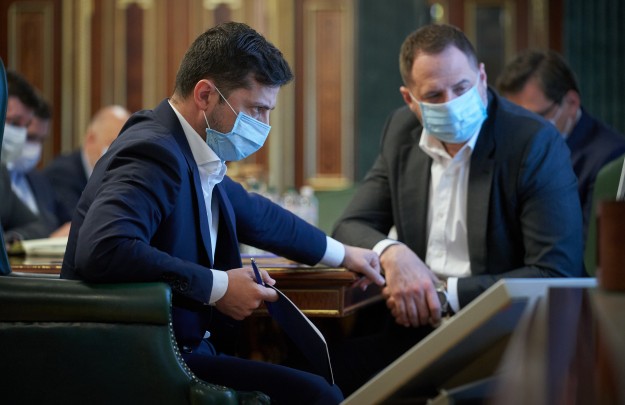
UNLOVED UKRAINE


In his recently published book former US National Security Adviser John Bolton reveals that Donald Trump virtually could not use the word Ukraine without qualifying it with some profanity.  This confirms the fact Ukraine is of no interest to Donald Trump as it cannot offer him anything that could contribute to his re-election, even though he tried.


President Zelenskyy on call with Canada's Globe and Mail, June 22nd
©President of Ukraine Website 


The lack of interest at the top of the US administration nevertheless does not prevent Ukraine from getting the necessary support from the international community. In early June the IMF confirmed it was offering Ukraine a USD 5 billion standby 18-month financing program.  This is good news for Ukraine’s short-term solvability. Ukraine currently has relatively good financial reserves and can now borrow more from institutional lenders that traditionally will follow the IMF lead. The IMF support took longer than expected to arrive and is now for only 18 months rather than 3 years. The problem is not that the Ukraine did not meet IMF requirements on privatisation of land and banking integrity. It did adopt the required relevant legislation on both counts. The explanation is that the pandemic conditions have created an uncertainty which calls for a shorter emergency measure rather than a longer-term arrangement.

The criticism that accompanied the IMF loan is more troublesome. Concern is expressed over Ukraine’s management of the COVID-19 pandemic and over its overall economic policies.
Ukraine’s management of the COVID-19 is difficult to gauge. The President is saying and doing the right things, but may have yielded too early to regional pressure to open up the economy. The relatively low level of testing is also a cause for considerable uncertainty.

 As for the economy, despite the fresh IMF money, it is clear that there is general lack of confidence and optimism that the Zelenskyy administration can deliver the required additional reforms that would underpin greater economic growth.

Rumours continue to circulate that President Zelenskyy would want to appoint former Georgian President Saakashvili as his Prime Minister. Saakashvili would be seen as one of the few people who can actually carry the required reforms in Ukraine. Not everybody agrees. Zelenskyy may have to get a new Parliament to get Saakashvili appointed. New parliamentary elections are a high price to pay and could be risky. The Saakashvili personality apart, the greater problem behind this is the perception that Ukraine’s reform and economic problems can be resolved by the intervention of some messiah. This does not instill a lot of confidence.


--o--

RUSSIA


President Vladimir Putin has said that he would consider standing for election again if Russian voters approve a controversial constitutional amendment in a vote scheduled for July 1st.
Putin’s comments, broadcast on state-run TV on June 21st, were the strongest indications to date of his intentions, and come just 10 days before the July 1st vote.
"I have not made any decisions yet," he said in comments excerpted by Russian news agencies. "I am not ruling out the possibility of running for office if the option appears in the constitution. We will see."


President Putin, Address to the nation, June 30th
©President of Russia Website


There was another interesting aspect as Putin suggested that finding a successor would potentially be a distraction if he chose not to run again. That is an indication that the Kremlin fears a succession struggle among rival factions in case Putin is to step down from his post, or that in the Kremlin’s eyes there is no political figure capable of consolidating power.

"If this does not happen [staying in power], then in about two years, and I know this from personal experience, the normal rhythm of work of many parts of government will be replaced by a search for possible successors," he was quoted by RIA-Novosti.

The Kremlin had hoped to hold the vote on constitutional amendments in April, but the sweeping restrictions put in place to curb the spread of the coronavirus forced its postponement until July 1st. All indications are that there will be strong support for the constitutional amendments.


--o--

PERSON OF THE MONTH: URSULA VON DER LEYEN


When the EU is confronted with a crisis, you can count on some commentators to predict that it is doomed. At the beginning of the COVID-19 pandemic, lack of solidarity among EU members and states turning to themselves were highlighted as a sign that the end was near. If the threat was not an exaggeration, Ursula von der Leyen could be seen as the latest saviour of the EU.

In her 7 months as president of the European Commission von der Leyen has done very well, probably better than most expected. In connection with the pandemic, she offered a heartfelt apology to Italy for the lack of response from other EU members at the beginning of the crisis. She was also a driving force behind the 500 billion Euros relief package to member countries. She may not have done so much about the Brexit issue, but enough to keep the political dialogue open with Boris Johnson.

Born in Belgium in a family with German and British American roots, she obtained her medical diploma in Germany where she also completed advanced medical studies. She studied for a time in London and also later on lived in the US with her husband.

Her political career began in Saxony when she was a minister of social affairs and labour. Later she became labour minister in the Angela Merkel government and later first woman defence minister in German history. According to NATO military experts she was a decent defence minister introducing tough measures to curb hazing in the armed forces and was credited with overall modernization of German Army at that time.

The political alignment was not there for her to replace Angela Merkel as Chancellor. She may well replace her as a European leader.


--o--

GERMANY


Amid a wide-spread vandalism and toppling of historical statues in the West, a life-sized statue of Russian revolutionary Vladimir Lenin was unveiled on June 20th in Gelsenkirchen, a former mining town in western Germany, by the radical left-wing Marxist-Leninist Party of Germany (MLPD).
The installation of Germany's first large public statue of Lenin outside the former communist East Germany was fiercely opposed by many Germans.

Gelsenkirchen's city council took the Marxists to court in an attempt to stop the action, calling Lenin a "representative of violence, suppression, terror, and immense human suffering."
But the council's case that the statue would "disturb the view" of a nearby historic bank was thrown out and the Marxists were given the green light to erect the monument.

The 1.3-ton, cast-iron statue was made in the former Czechoslovakia in 1957 and bought by the MLPD in an online auction for roughly $18,000.

The Marxist party is now planning to erect a statue of Karl Marx to stand next to the controversial Lenin, but gave no timeline for the project.


KAZAKHSTAN


Kazakh President Nursultan Nazarbayev, who continues to wield considerable influence in the Central Asian country after his sudden resignation last year, has tested positive for the coronavirus.
Recently, Health Minister Elzhan Birtanov, the chairman of the parliament's lower chamber, Nurlan Nyghmatulin, presidential spokesman Berik Uali, and several other officials have also tested positive for the coronavirus.
As of June 18, the total number of registered coronavirus cases in Kazakhstan was reported as close to 22,000, including 188 deaths. That is the highest number among the five Central Asian countries.


KYRGYZSTAN


Kyrgyz lawmakers have approved a bill ratifying a Kyrgyz-Russian protocol amending an agreement on the usage of Russia's military base in the Central Asian nation.

According to the bill approved in its third and final reading on June 12, Russia's annual fee for renting land for its combined military base in Kyrgyzstan will be increased. After the amount of rented territory is amended, the current annual rental fee of $4,502,495 will be increased by $291,600, according to the bill.

Russia's air base at Kant was opened in 2003 under the auspices of the Collective Security Treaty Organization (CSTO), which includes Russia, Kyrgyzstan, Armenia, Belarus, Kazakhstan, and Tajikistan.

A U.S. air base outside the capital, Bishkek, began hosting U.S. troops in 2001 as part of the military campaign in nearby Afghanistan, but Kyrgyzstan shut it in 2014 amid pressure from Moscow.
In 2017, the Kant air base and three other Russian military facilities in Kyrgyzstan were consolidated into a single combined base.


TURKMENISTAN


Turkmenistan is facing severe food shortages and has further tightened the rationing of basic foodstuffs at subsidized prices, introducing special registration books to track purchases at state stores. Each household will receive a school notebook with a certificate inside from a neighborhood committee stating the number of people in the family and its address.

Each purchase conducted by a household in state-owned stores will be registered in the book, according to the independent Turkmen.news website.

Those who do not have a book will not be allowed to purchase some of the subsidized staples available in government stores, including flour, rice, cooking oil, sugar, and potatoes.
Tightly controlled Turkmenistan has been facing food price hikes and a food shortage in recent years. The main reason behind this is ostensibly the decrease in revenue from gas exports.


UZBEKISTAN


The U.S. State Department has announced that religious freedom in Uzbekistan continues to improve, while Iran and China remain among the worst offending countries in the world.

"In many places of the world, individuals have become more familiar with religious oppression than religious freedom," Sam Brownback, the ambassador at large for international religious freedom, said on June 10th after the release of an annual report on religious freedom.

Uzbekistan was removed from the "worst of the worst" list of offenders of religious freedom last year and continues to take positive steps despite continued abuses.

“We documented no police raids of unregistered religious-group meetings during 2019, compared with 114 such raids in 2018, and 240 the year before that. These are great strides, real progress,” Secretary of State Mike Pompeo told a news conference in Washington.
However, Tashkent remains on a special watch list, meaning there are still "severe" violations of religious freedom in the Central Asian country.

Pompeo said that while there was improvement in some countries, there remained “great darkness over parts of the world where people of faith are persecuted or denied the right to worship.”


BELARUS


Belarusian President Aleksandr Lukashenka declared that his security forces thwarted an attempt to foment revolution in his country, a day after his government ordered the arrest of a popular, would-be presidential candidate, prompting thousands to take to the streets to protest what they see as increased harassment of opposition leaders.

Speaking at a government meeting on June 19th, Lukashenko said that forces “in the East and West” were trying to destabilize Belarus but that their “masks have been torn off” and the “puppets and puppet masters abroad” identified.

Belarus, with a population of some 9.5 million, has one of Europe’s highest infection rates for the coronavirus, which Lukashenka dismissed as a “mass psychosis” and ignored calls by the World Health Organization and others to institute any social-distancing measures.

The World Bank predicts the Belarusian economy will contract 4 percent this year as a result of the pandemic, while some informal, online polls put Lukashenka’s public support at just 3 percent.
In the election on August 9, Lukashenka will be seeking a sixth term in office. No election, either for president or parliament, during his rule has been deemed free and fair by Western governments and institutions.

The previous day, thousands of people took to Independence Boulevard in what was dubbed a picket of solidarity after Viktar Babaryka, who headed the Russian-owned Belgazprombank for 20 years, was detained on suspicion of financial crimes, as well as his son who heads his presidential election campaign.

Belarusian authorities on June 15 took control of the bank and arrested more than a dozen top executives on charges of tax evasion and money laundering.

Babaryka, 56, has said the actions taken against Belgazprombank were part of an intimidation campaign conducted on “political orders.”

On June 19th, the European Union called on Belarus to immediately release Babaryka and his son from detention and to guarantee full respect of the rule of law.


UKRAINE


European Union leaders on June 19 have supported a six-month extension of economic sanctions imposed against Russia over its role in the ongoing conflict in Ukraine.

French President Emmanuel Macron and German Chancellor Angela Merkel briefed other EU heads of state and government during a videoconference and declared that no progress had been made in implementing the Minsk agreement.

The sanctions were first adopted in July 2014 after Russia annexed Ukraine's Crimean Peninsula and began providing military support for pro-Russia separatists in eastern Ukraine in a conflict that has killed more than 13,000 people.

Since then, the sanctions have been extended every six months. A formal decision to prolong the sanctions beyond their current July 31 expiry date is to be taken by EU ambassadors in the coming weeks.

Russian President Vladimir Putin earlier this year proposed a freeze on economic sanctions on "humanitarian" grounds to allow countries to better combat the coronavirus pandemic however EU officials have rejected Putin's call, with both European Commission President Ursula von der Leyen and European Council President Charles Michel insisting the measures "do not impede Russia’s capacity" to combat the epidemic.

The sanctions mainly target Russia’s financial, energy, and defense industries.


--o--


THE AUTHORS

Ilya Gerol, former foreign editor of the Citizen in Ottawa, syndicated columnist in Canadian, US and European media specializing in international affairs. His area of expertise includes Russia, Eurasian Economic Union, Eastern and Central Europe.  Ilya Gerol has written several books, one of them, The Manipulators, had become a textbook on relations of media and society.

During his career in the Canadian Foreign Service, Gilles Breton had three assignments at the Canadian Embassy in Moscow. His first posting there began during the Soviet period, in 1983. His last was from 2008 to 2012 as Minister-Counsellor and Deputy Head of Mission. He also served as Deputy Director responsible for Canada’s relations with Russia from 2000 to 2008. As an international civil servant, he was Deputy Director of the OSCE Office for Democratic Institutions and Human Rights in Warsaw from 1994 to 1997.

Gilles Breton also currently serves as Chairman of the National Board of the Canada-Eurasia-Russia Business Association. The views expressed in this newsletter exclusively reflect the opinion of the authors.


Saturday, May 30, 2020

Issue 42


THE BRETON/GEROL NEWSLETTER


NEW ANGLES OF THE OLD TRIANGLE


A long time ago, Henry Kissinger, who was the only person ever to occupy simultaneously the positions of Secretary of State and National Security Adviser, formulated the US approach to Moscow and Beijing at every serious turn of history.

He compared the relations between the three major powers to a 'golden triangle'. All three sides of the triangle should never remain fixed, but rather have to reflect the geopolitical changes.


During the Cold War the main competition and animosity was taking place between the US and the USSR. China was then not as prominent within that geometrical construction or altogether in the world. It was also behind the US and USSR economically and militarily.

Still, at that time, Kissinger foresaw that with passing of time relations between Washington and Beijing could become more important and competitive than even with Russia.


Now, in 2020, it is clear that Kissinger was correct in his prediction. The idea of the 'golden triangle' theory was to have a geopolitical flexibility that would allow to keep in check any sudden ascendance of one of the parties. China has become not only a mighty competitor, but also a direct threat to America’s leading role in the world.

Alan Cohen of Forbes magazine stated in his report to the Atlantic council on May 10th that the real reason behind Trump's attacks on China with regard to the Covid-19 pandemic should be explained as a search for a pretext to get a bulk of American companies back from China.


Russia meanwhile is not willing to be a substitute player in that game. Russian media commentators usually loyal or neutral about China started to hint at the increasing behind-the-scenes power struggle within the Chinese Politburo and highest military circles.

Moscow expects some benefits from the China-US rift. Things could change if the rift turns out to be a full-scale economic war between Beijing and Washington. At the time of a world economic crisis Moscow may look to China as the only reliable market for its natural resources and military production. That could change the configuration of the 'golden triangle' once more.


And then there is the Hong Kong issue on which China disregards the views of most countries that care about Hong Kong setting the stage for a much broader confrontation.


--o--

PANDEMIC AND POLITICS


There is nothing surprising at Donald Trump’s innate incapacity to take on a leadership role in addressing the challenges of the COVID-19 pandemic. The fact that he is constantly taking credit (or receiving it from Mike Pence, the ultimate sycophant) for non-existent achievements while avoiding taking responsibility for anything that goes wrong nevertheless has made him even more despicable than before.


Those who did not like Trump before find it surprising that his popular rating has not taken a nosedive. Granted, there is a hard core of Trump supporters for whom the truth consists of what he says and what they believe rather than confirmed facts or hard science. Signs of some erosion of support for Trump are only now beginning to appear.

Trump’s supporters have grown into the habit of forgiving him almost anything since he identifies with their most important issues, such as for instance anti-abortion policies, unconditional support for Israel or anti-China attitudes. Trump’s attempt at catering to right-wing evangelicals by calling for the opening of all places of worship was consistent with this approach that includes a newly-found unlikely interest in religious matters. It did not go down well with many mainstream churches.

Trump’s shortcomings in handling the pandemic itself are also forgiven by his supporters. For one thing, the pandemic is an invisible enemy, not the President’s fault. Besides, whenever possible, the President sides with those favouring the re-opening of the economy, even going as far as to call for the liberation of some states and saying good things about some of the loudest and less savoury protesters.

What matters more in the long run to the November election is that Trump has lost his main argument to seek the support of middle-ground electors that he needs in a number of swing states, that is the good performance of the US economy (not that he deserved a lot of credit for that). The economy is not likely to be back in good shape by November.  Economic remediation measures turned out to very good for Trump’s traditional big-business supporters, not so much for middle-class America.

The uncertainty about the course of the pandemic (despite some basis for optimism) as well as the uncertainty over the speed of the economic recovery are testing Trump’s mettle. His solution, as always, is to blame anybody else and to find a scapegoat. China was an easy and convenient target. It can give good electoral mileage, but a head-on collision may not be in the long-term interest of either country. Besides, China can be more patient and does not have an electoral deadline.

As for the current civil unrest, it could firm up support for Trum within his base. It could also provide the opportunity for Biden to become truly "presidential".

--o--


STATISTICS, TO BELIEVE, OR NOT TO BELIEVE


The saying goes that the truth is the first casualty of war. No wonder then that the fight against COVID-19 has been called a war.

It began, of course, with China that was charged with not reporting early enough or not fully the number of cases or of deaths in Wuhan. The number of funeral urns picked up by family members after the lockdown seemed excessive, even for a city of 12 million.

Russia was then charged with not reporting fully its cases. Now that it is reporting a large number of cases, it is charged with not reporting deaths properly, especially in Moscow. This is the case even now after April figures were corrected upwards by using a different methodology for counting COVID-related deaths.

Questions arose about the large number of cases and deaths in Belgium. The answer, it would seem is that Belgium counts every possible case. The United Kingdom was charged with not reporting deaths of senior citizens outside of hospitals. That seems to have changed.

Some US states have even been under investigation for not fully reporting or even on changing dates on reports so as to create the right curve. The graph below gives an example of the White House using statistics to spin a story: total number of tests is given without reference to actual population.


A quick look at the international statistics would seem to suggest that there are even greater anomalies. Saudi Arabia has almost the same number of cases as Canada yet almost 15 times less deaths. Then, what about other Third World countries and, even worse, refugee camps where testing is a luxury item?

All things considered, one simply has to conclude that the statistics may give you a general idea of the situation in a given country, but are so affected by national circumstances that they have to be “filtered” through national lenses.

--o--

BAD NUMBERS, MIRACLE CURES?


Again, on the matter of the truth. The difficulty of comparing national statistics was mentioned above. Russia is seen as performing a relatively high level of testing, but there is such a long tradition of disbelieving Soviet/Russian official statistics that whatever figures the Russian state will produce, it will be accused of lying one way or another, even if in this case social media traffic does not suggest large-scale problems. The COVID-19 pandemic in Russia now seems to have reached its so-called “plateau” and to follow a pattern similar to the one observed in other European countries in terms of the overall evolution of the pandemic. The relatively low official number of deaths will nevertheless continue to draw attention regardless of plausible explanations.  


A more intriguing question revolves around the way in which Russia manages the medication issue. Authorities have officially created a list the medications that are recommended and authorised for the treatment of COVID-19, including hydroxychloroquine (at low doses and under limited conditions). There is admittedly no miracle cure on the list, but official statements have now confirmed the approval of favipiravir, a variant of an existing Japanese drug, as the first effective medication against COVID-19, after the conclusion of clinical studies conducted in Moscow and Russian regions. The perception may emerge that Russia is willing to move more quickly than others in approving medication and that it is managing differently the risks that come with that kind of approach. (The same perception is likely to affect any suggestion of the early availability of a vaccine made in Russia.) The scientific debate on favipiravir will continue and, should the medication be confirmed as any effective, may well turn into a commercial one. India is also working on its own variant of the same drug.

Russia’s more serious problem would most likely be the disparity between the treatment and equipment that is available in large urban centres and that which available in outlying regions. That was confirmed by what occurred in the republic of Dagestan (Caucasus region) where central authorities were forced to stage a major intervention to control the situation and facilitated the use of the above-mentioned “promising” medication. 

--o--

NORTH KOREA: RUMORS, MYSTERY, QUESTIONS-WHERE IS KIM?


During the nearly month long period, starting in mid-April when Kim did not appear in public, international media outlets amplified thinly sourced reports suggesting that he might be in “grave danger” or even dead following a rumored cardiovascular procedure gone wrong.


However Kim’s May 1 resurrection, alive and seemingly well at a ceremony marking the opening of a fertilizer factory, exposed the news reports as overblown. Obviously some unclear sources began questioning the authenticity of the footage, but no credible proof was offered.

Both President Trump and Mike Pompeo issued subdued statements re-assuring the public that Kim was alive and well. It was clear that after days of uncertainty the North and its protector China had informed Americans and South Koreans that Kim was alive and in control.

However, there is an important reminder that this nuclear-armed state could easily face a leadership crisis. It is clear just by looking at the overweight, chain-smoking and stressed young Kim that something is not well with the person at the very top of the power structure of the secretive state.

In the event of Kim's demise or incapacitation outside powers could clash in an attempt to secure weapons of mass destruction or prevent refugee outflows.

Kim’s brief disappearance has underscored the urgent need for the United States to adopt a regional security strategy for North Korea, one that coordinates the responses of the interested powers to the potential instability of the regime in Pyongyang.

The North Korean leader’s health has been a concern for some time. In the fall of 2014, Kim vanished from public view for around six weeks and returned with a cane. South Korea’s National Intelligence Service later indicated that he had undergone ankle surgery on a cyst, a condition that could recur because of his weight and lifestyle.

Since his brief, and still somewhat unproven appearance at the fertilizer factory, which by the way looked a lot like a typical Potemkin style village, Kim has vanished again. There were no further signs of his presence at controls of his strange country.

The health of the North Korean leader is one of the most closely guarded secrets in one of the world’s hardest intelligence targets, so any discussion of its future leaders is highly speculative. But among the possibilities is Kim Jong Un’s younger sister, Kim Yo Jong, who has risen in prominence in recent years and would offer the important advantage of maintaining the Kim family bloodline. Kim Jong Un’s uncle, Kim Pyong Il, recently returned to North Korea after several years of diplomatic service in Europe and is another possible successor. But the position could even go for the first time to someone outside the Kim family, an official from the military or political leadership, for instance.

There could be nasty surprises in store for the world in case young Kim dies and a brutal power struggle or even a civil conflict initiates. Or, as often the case, Kim Jong Un may yet live a long life, even with his many health problems. If he were to die, the loss of a brutal dictator and serial human rights violator would be a welcome development in many corners of the world, and the transfer of power to a new leader could be relatively smooth, as it has been for North Korea in the past.

--o--

ISRAEL AND IRAN SHOWDOWN


Since April 2013 when Israel launched its first known attack on Syria and its Iranian allies, hundreds of attacks against Iranian targets and Hezbollah in Syria have been carried by the Israel Air Force (IAF).

The outgoing Israeli defense minister Naftali Bennet recently claimed that Iran was slowly downgrading its presence in Syria. As COVID-19 ravages Iran and its economy Israel increases its attacks putting great deal of pressure the Iranian regime to abandon its ambitions in Syria.

Just in April and May 2020 Israeli jets, helicopters and missiles have struck dozens of Iranian and Hezbollah targets all across Syria and Iraq. According to Israeli sources Syria fired hundreds of its missiles at the Israeli jets (about 100 per year), but managed to score only one hit (Israeli F-16 was shot down in 2018 with the crew safely ejecting).


©cia.gov


It is true that the Syrian missiles are relatively obsolete and from older generations, but that still does not detract from the impressive capability of the IAF. Its achievements can be attributed to a new combat doctrine developed in recent years, to operational experience, to the introduction in different arenas of stealth aircraft (F-35), but also to the fact that Syria has yet to activate its advanced S-300 batteries.

This is an interesting fact. It is well known that S-300 batteries are operated by the Russian technicians and advisers. On one hand, Moscow seeks to stabilize Syria, is assisted by Iran in that effort, cooperates with Assad and with Hezbollah on the tactical level against ISIS and the rebels, and also wants to reduce Israel’s involvement in Syria. But on the other hand, Russia turns a blind eye to attacks by Israel, and in so doing actually tactically encourages the campaigns against Iran. Like Israel, Russia too wants to see Iranian troops, Shi’ite militias and Hezbollah leave Syria.

Another reason is more prosaic:  Russia is not excited by the prospect of activating the batteries and missing their targets: it would demonstrate the technological and operational superiority of Israel and the West. Not only the Russian pride would suffer, but also some potential customers of the systems may get cold feet.

The Israeli political and defense establishments now sees an opportunity to extricate Iran from Syria. Some analysts argued that Iran's partial withdrawal is of temporary nature. It is possible.
Iran is not to be underestimated. Its hostility towards Israel and the West may be stronger than its common sense. Iran is waiting mainly for the outcome of the U.S. elections in November. Last month Iran successfully launched its first military satellite in orbit and by using U.S. servers it failed to hack civilian Israeli water sites. It is expected that Israel with its more advance cyber warfare will soon retaliate. But above all Iran is still committed to its strategy, its vision and its three supreme goals: preserving the Islamic regime, achieving regional hegemony and attempting to obtain nuclear weapons.

--o--

ISRAEL STRIKES BACK


Israel appears to be behind a cyberattack a few weeks ago on computers at Iran's Shahid Rajaee port that caused massive backups on waterways and roads leading to the facility. It was most likely, according to unnamed foreign government officials in Israel, in retaliation for an earlier attempted cyberattack on rural water distribution systems in Israel.

The managing director of Iran's Ports and Maritime Organization, Mohammad Rastad, told Iran's ILNA news agency that the cyber attack did not penetrate the organization's computers and was only able to infiltrate and damage a number of private operating systems.

A foreign government security official said, however, the attack was "highly accurate" and the damage to the Iranian port was more serious.

--o--


UKRAINE


Vladimir Zelenskyy has just completed his first year as President of Ukraine. Not only did he survive literally and politically, but he managed to sustain and even increase slightly his popular rating at around 40%. This is a first for a president of independent Ukraine.

Zelenskyy good rating can also be explained to some extent by the fact that no new political figure has emerged that could challenge him.


©President of Ukraine Website

His accomplishments in resolving the conflict in the Donbass area may be seen as incremental. Yet, he managed to lower the temperature, make some localised cease-fire stick and generally decrease the number of casualties. He also managed to negotiate a long-awaited major exchange of prisoners.

The Normandy Format discussions, that are to facilitate the implementation of the Minsk Peace  Agreements, may not have seen a lot of progress. They have at least continued with the full support of France and Germany.

On the matter of the fight against corruption the achievements are not that many and not that tangible. Even his own Chief of Staff was indirectly embroiled in a new scandal.

Two most significant pieces of legislation needed to be passed to secure continuing Internationa Monetary Fund support for Ukraine: the Land Reform bill and the anti-Kolomoisky bill (from the name of a famous oligarch once seen as the major supporter of Zelenskyy) preventing the return to previous owners the assets of nationalised banks. There is success on both counts.

The most difficult part has been to keep the political majority together and to effect the renewal of Ukraine’s political class. Having had to change both PM and Chief of Staff during the course of the year was part of learning on the job. In this respect, the appointment of former Georgian President Mikheil Saakashvili as Head of the National Reform Council cannot be seen as a crowning achievement. Saakashvili did not have the required parliamentary support to be appointed Deputy Prime Minister. He is perceived as an archenemy of former President Poroshenko and as such can be expected to prolong the ongoing Zelenskyy-Poroshenko feud. His capacity to advance reforms from his new position remains under question.

To the rest of the world, Zelenskky may also claim to have survived the “perfect phone call” with President Trump.

As for Ukraine’s handling of the COVID-19 pandemic, it is still too early to pass judgment. The overall government response appears relatively efficient. The contamination rate is relatively low, but so is the level of testing. Besides, the figures used to measure rates of contamination and death are based on population levels going back prior to the migration movements of the past few years. The situation of senior citizens in outlying rural areas should be of considerable concern.

According to public opinion polls, Zelenskyy’s supporters continue to expect him to deliver first on the economic growth agenda, The resolution of the litigation with Gazprom and the ensuing payments to Ukraine were useful in the short term, but lucrative gas transit payments cannot be guaranteed for the long term. The post-pandemic worldwide economic downturn will not spare Ukraine.  All things being considered, Zelenskyy cannot be overly optimistic, but can take comfort in continuing public support for his proposed general course of action in addressing Ukraine’s challenges.

--o--

PERSON OF THE MONTH: DR TEDROS ADHANOM GHEBREYESUS


The current Director-General of the WHO is the person of the month, not so much for his achievements but for being the head of UN agency that has a key role to play in addressing the international dimension of the COVID-19 pandemic while the agency has become a scapegoat for Donald Trump.

Dr Tedros Adhanom Ghebreyesus was Ethiopia’s health minister and subsequently its foreign minister. His accession to the leadership of the WHO in 2017 was not without controversy. His personal style as well as his political manoeuvring to get the job could lead one to conclude that the WHO was getting more the former Foreign Minister than the former Health Minister or the scientist. He is the first WHO Director-General not to be a medical doctor.

In the eyes of the current US administration, Dr. Ghebreyesus has a few prior problems: he associated closely with President Bill Clinton and he advocates universal health care. There is no evidence that Trump himself is aware of this, but his senior health advisors would have to know of this background.

The WHO can make recommendations to member states, but essentially relies on cooperation with member states to achieve its objectives. The accusation that the WHO cosied up to China fails to take into account the essential nature of that relationship. In that context, the WHO DG that needed cooperation with China was even more justified in praising China than the US President.

At a different level, for a country like the US that tends to reject international organisations having supra-national authority, suggesting that the WHO should have stood up to China is at least paradoxical. The current US administration would never agree to give WHO the authority to intervene in US affairs the way it would want it to have intervened in Chinese ones.

The job of DG of the WHO is a much political as it is medical. Most of the participating states have acknowledged that and are not so eager to blame the WHO for the way it managed relations with China. This does not mean absolving the WHO of possible mistakes.

WHO is the agency that can best help Third World countries handling the pandemic. While the WHO is at risk of losing its US support China has come to the rescue with the promise of a generous financial commitment.

--o--

PUTIN’S POPULARITY


The most recent public opinion polls conducted by the reputed Levada Centre would seem to suggest that Putin’s popularity is at all-time low at somewhere around 59% support rating. Some observers were quick to see a link between the popularity drop and the unsatisfactory handling of the pandemic and of its economic consequences. Others even used this to question the efficiency of the Putin power system.

A note of caution is necessary. Some may wish to see too much too early. Should the coming months bring a relatively successful resolution of the pandemic-related issues, it could not be excluded that Putin’s popularity could fluctuate upwards again. In the history of Putin’s reign in Russia, the one thing that caused the greatest electoral damage was the decision by then Prime Minister Putin to trade places with then President Medvedev in late 2011. The long-term public opinion impact of the unexpected proposed constitutional changes that would allow Putin to seek two more presidential terms deserves further examination. “Putin fatigue” may come more from long-term decisions than a short-term crisis response.


ISRAEL


Chinese Ambassador to Israel Du Wei was found dead in his home on May 17th, sparking rumors and an avalanche of media coverage. There is no evidence that anything but natural causes was involved (it was a heart attack). However, the death of the ambassador of a high-profile state like China at this complex time, amid the coronavirus pandemic and in the wake of US Secretary of State Mike Pompeo’s visit, with stories about US pressure on Israel regarding China relations, feeds online conspiracy theories. First of all, the story spread widely throughout international media, from Hebrew media to reports at the BBC, CNN and other outlets.


AZERBAIJAN


Azerbaijan's central bank has put four of the energy-rich South Caucasus country's top banks under temporary administration, amid economic difficulties caused by a plunge in oil prices and the coronavirus pandemic.The central bank appointed temporary administrators for Atabank, AGBank, NBCBank, and Amrah Bank, which are among the country's 15 largest financial institutions.No explanations were officially given for the decision, but some media reports said it might be a first step toward the banks' possible closure or merger with other financial institution.


UZBEKISTAN


Uzbekistan says it has received from France assets worth $10 million illegally acquired by Gulnara Karimova, the imprisoned elder daughter of late President Islam Karimov.The assets were transferred to Uzbekistan's state coffers on May 14, the Justice Ministry said.

The statement did not provide further details on the assets, which represent a fraction of the more than $1 billion Tashkent has sought from foreign jurisdictions since announcing Karimova's imprisonment in 2017.

Karimova, once seen as a possible successor to her father, was placed under house arrest in Tashkent in 2014 while her father was still alive and running the country. Karimov died in 2016 and Shavkat Mirziyoev succeeded soon afterward. In December 2017, Karimova was sentenced to a 10-year prison term, but the sentence was later reclassified to house arrest and shortened to five years. She was placed in jail in March 2019 for allegedly violating the terms of her house arrest.


AFGHANISTAN


Three gunmen, disguised as doctors and security officers, stormed the clinic run by Doctors Without Borders (MSF) on May 12th. The clinic is part of the 100-bed, government-run Barchi National Hospital.

During a fierce, hours-long gunbattle with Afghan security forces, the men armed with automatic weapons and grenades indiscriminately gunned down babies, mothers, pregnant women, and medical workers. In total 11 mothers  of infants were killed in the attack. There were many injuries.

The attacked occurred in Dasht-e Barchi, an area in western Kabul that is predominately inhabited by Afghanistan's Shi'ite Hazara minority. It has long been a scene of gruesome attacks by the Taliban and Islamic State (IS) extremist groups, including on schools, mosques, and sports facilities.
No group has claimed responsibility for the attack, although the government has blamed the Taliban,- dismissing the group's denial.

Even in a country ravaged by war for more than 40 years, the attack on a maternity clinic targeting babies and women has sparked international outrage and shocked many Afghans who fear a war with no end.


RUSSIA-CZECH REPUBLIC


Russian Foreign Minister Sergei Lavrov says Czech officials should reinstall a controversial statue of Soviet Marshal Ivan Konev in Prague after city officials removed it last month.In an interview with the Russian news agency RBK published on May 15th, Lavrov called the Czech explanation for the move "childish" and "a blatant violation" of the 1993 Russian-Czech agreement on friendly relations.

Relations between Prague and Moscow have been in a downward spiral in recent months amid what the Czechs see as Russia’s growing assertiveness over its interpretation of history. At the center of the dispute is the removal of Konev's statue. Konev's armies completed Prague’s liberation on May 9th, 1945. The authorities of the district from where the statue was removed said the statue would be moved to a museum and a new monument honoring the city's liberation would take its place.

Russia has lashed out angrily over the move, and tensions were heightened further when Czech media reported that Moscow planned to poison three Prague politicians in retaliation for supporting moves that have irritated Russia.

--o--

THE AUTHORS

Ilya Gerol, former foreign editor of the Citizen in Ottawa, syndicated columnist in Canadian, US and European media specializing in international affairs. His area of expertise includes Russia, Eurasian Economic Union, Eastern and Central Europe.  Ilya Gerol has written several books, one of them, The Manipulators, had become a textbook on relations of media and society.

During his career in the Canadian Foreign Service, Gilles Breton had three assignments at the Canadian Embassy in Moscow. His first posting there began during the Soviet period, in 1983. His last was from 2008 to 2012 as Minister-Counsellor and Deputy Head of Mission. He also served as Deputy Director responsible for Canada’s relations with Russia from 2000 to 2008. As an international civil servant, he was Deputy Director of the OSCE Office for Democratic Institutions and Human Rights in Warsaw from 1994 to 1997.

Gilles Breton also currently serves as Chairman of the National Board of the Canada-Eurasia-Russia Business Association. The views expressed in this newsletter exclusively reflect the opinion of the authors.